


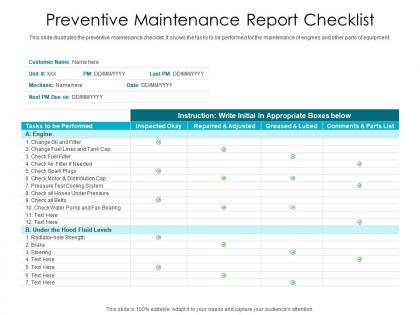
Preventive maintenance report checklist




Try Before you Buy Download Free Sample Product
 Impress Your
 Audience
 100%
100% Editable
 Save Hours
 of Time


Our Preventive Maintenance Report Checklist are topically designed to provide an attractive backdrop to any subject. Use them to look like a presentation pro.
People who downloaded this PowerPoint presentation also viewed the following :
Preventive maintenance report checklist with all 2 slides:
Use our Preventive Maintenance Report Checklist to effectively help you save your valuable time. They are readymade to fit into any presentation structure.

FAQs for Preventive
Start by making a list of all your equipment and when it needs maintenance - manufacturer guidelines are your friend here. Documentation is honestly where most people mess up, but you gotta track what's been done to spot patterns. Get your team trained on the actual procedures and make sure they have decent tools. A CMMS system will save your sanity by automating schedules and keeping everything in one place. Don't try to tackle everything at once though - focus on your most critical stuff first, then build out from there. Trust me, it's way less overwhelming that way.
You basically stick IoT sensors on your equipment to track vibration, temperature, all that stuff in real-time. Then machine learning finds patterns that tell you when something's about to break - like literally "this motor's gonna fail in 3 weeks." Way better than just guessing, honestly. The algorithms get smarter as they learn your specific setup too. I'd start small though, maybe just your most critical equipment first. Get some sensors on there and let the data drive your maintenance instead of those old school time-based schedules. It's pretty wild how accurate it gets.
So basically you catch problems early and avoid those nightmare repair bills - we're talking 3-6x cheaper than emergency fixes. Your equipment actually lasts longer too, which is huge because replacements are brutal right now. But honestly? The downtime thing is where you really win - preventive maintenance cuts that by around 70%. Plus your stuff runs way more efficiently when it's maintained, so lower energy bills. Oh, and you can actually plan your labor costs instead of paying crazy overtime when everything breaks at once. Just track what you're spending on breakdowns for a few months first - the numbers will blow your mind.
Dude, it's wild how different these industries handle maintenance. Manufacturing goes hard on their critical equipment - they'll do super aggressive PM schedules because downtime costs them massive money. Healthcare though? Completely different game. Patient safety trumps everything, so they're way more conservative with stricter regulations and backup checks on backup checks. Manufacturing might roll the dice sometimes to keep production going, but hospitals literally can't risk equipment failing when someone's life is on the line. Your risk tolerance basically shapes everything - some industries can gamble a bit, others absolutely cannot.
Ugh, the data thing is brutal - you're always missing specs or working with ancient maintenance logs that make zero sense. Honestly feels like doing a jigsaw puzzle blindfolded half the time. Then there's the whole dance of trying to schedule around production while keeping costs reasonable. Limited techs, critical equipment that absolutely cannot fail... it gets messy quick. Oh, and don't even get me started on trying to balance how often stuff actually needs attention versus what the manual says. Just focus on your most important equipment first and build from there instead of going crazy trying to plan everything at once.
Dude, preventive maintenance is a game changer for keeping equipment running longer. It's like car oil changes - you catch problems before they blow up into expensive disasters. I've seen the data on this, and good PM programs literally double or triple equipment lifespans. Pretty wild, right? When you stay on top of scheduled stuff, moving parts don't wear down as fast. Fewer surprise breakdowns too. My advice? Don't try to do everything at once. Pick your most critical equipment first and build a simple schedule around those. You'll thank yourself later when things actually work when you need them.
Dude, training is what makes or breaks everything. Your team needs to know how to inspect stuff properly and catch problems early. Without it? People either skip maintenance entirely because they're confused, or they screw it up and break things worse. Honestly happens all the time - drives me crazy. Focus on the biggest knowledge gaps first, that's where you'll get the most bang for your buck. And don't just teach the steps - explain why they're doing each thing. Makes a huge difference when people actually understand the reasoning behind it.
So basically you want to watch your downtime hours - they should drop as your PM gets better. Emergency repair frequency is huge too since that's what you're trying to avoid in the first place. I'd also track maintenance costs per asset and equipment lifespan. OEE scores are solid if you're into that stuff. The real trick is comparing before/after numbers once you get your PM schedule rolling. Honestly, a monthly dashboard makes this way easier - you can actually see what's working and what isn't instead of just guessing.
Document everything - date, who did the work, parts, time, problems found. Take pics of sketchy areas too. My old boss used to say "write it like you're never seeing this machine again" and honestly? Pretty solid advice. Use the same forms or whatever system your place has so everyone's on the same page. Make it detailed enough that whoever comes after you isn't completely lost. When you're stuck troubleshooting some random issue at 2am, you'll be really glad you wrote good notes earlier.
Start with the stuff that'll kill you or shut everything down if it breaks - that's your priority one. Look through your maintenance records for the equipment that's always giving you headaches or costing a fortune to fix. Managing spreadsheets across multiple sites is honestly a pain, but you gotta do it. Don't forget about parts availability - there's nothing worse than having a tech ready to work but waiting three weeks for a part. Make sure you've got skilled people at each location, or rotate your best crew around for the critical stuff. Some sites always seem to get the short end of the stick otherwise.
Look, preventive maintenance basically IS safety compliance - they're the same thing. Regular upkeep catches problems before they hurt someone, which is exactly what OSHA wants anyway. Broken equipment is just an accident waiting to happen, and nobody wants that headache. Plus your maintenance records double as compliance docs, so you're covering both bases at once. I learned this the hard way at my last job - we had way fewer safety issues once we got serious about routine checks. It keeps inspectors happy and workers safe. Win-win situation.
So basically you track data from your equipment to predict when stuff's gonna break. Look at things like vibration, temperature, how many hours it's been running - that kind of thing. Historical data shows you patterns, so you can do maintenance right before something fails instead of just guessing. Way better than fixing things after they've already broken down (expensive!) or doing it too early for no reason. I've heard teams cut their surprise downtime by like 30-40% doing this. Honestly it's pretty smart. Start with your most important machines first and just watch for trends that tell you when maintenance is actually needed.
Dude, preventive maintenance is actually amazing for the environment. Well-maintained equipment lasts way longer, so less junk ends up in landfills. Your energy bills drop since everything runs smoother. Those little problems you catch early? They don't turn into resource-wasting disasters later. Oh, and you avoid those gross fluid leaks that mess up soil and water – nobody needs an EPA headache. Track your energy usage before and after starting a maintenance routine. Seriously, the difference will shock you. It's one of those rare things that saves money AND helps the planet.
Honestly, preventive maintenance is a game-changer for keeping customers happy. You're fixing stuff before it breaks instead of dealing with angry calls later. Nobody wants to hear "we're down for repairs" at 2pm on a Tuesday - trust me on that one. When everything runs smoothly, customers get consistent service without those annoying outages. You can actually plan maintenance for slow periods rather than scrambling during rush hours. Way less stressful for everyone. Figure out which systems would cause the biggest headaches if they failed. Then build your maintenance schedule around protecting customers from those nightmare scenarios. It's pretty straightforward once you think about it that way.
Dude, AI predictive analytics and IoT sensors are total game changers - they'll catch problems before they cost you big money. Digital twins are huge right now too. You can basically simulate how your equipment's gonna perform without touching anything. The data dump is honestly pretty intense at first, but you get used to it. Mobile apps for maintenance teams are making field work so much smoother. Oh, and sustainability metrics matter just as much as saving cash these days - weird how that shift happened. My advice? Pick one thing and start there. Don't go crazy trying to change everything at once.
-
Awesome presentation, really professional and easy to edit.
-
Topic best represented with attractive design.
-
Enough space for editing and adding your own content.