


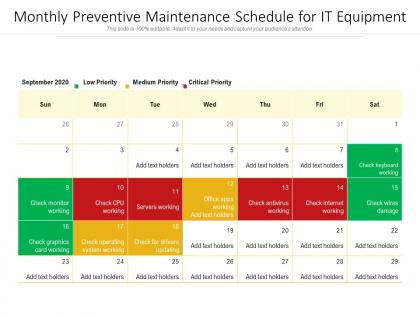
Monthly preventive maintenance schedule for it equipment




Try Before you Buy Download Free Sample Product
 Impress Your
 Audience
 100%
100% Editable
 Save Hours
 of Time


Our Monthly Preventive Maintenance Schedule For IT Equipment are explicit and effective. They combine clarity and concise expression.
People who downloaded this PowerPoint presentation also viewed the following :
Monthly preventive maintenance schedule for it equipment with all 2 slides:
Give your audience a fulfilling experience. They will find our Monthly Preventive Maintenance Schedule For IT Equipment elevating.

FAQs for Monthly preventive maintenance schedule
Look, preventive maintenance is basically about catching stuff before it explodes into expensive nightmares. Your equipment lasts way longer when you're not running it into the ground. Emergency breakdowns? Way fewer of those panic moments at 2am. Honestly, finance teams get pretty happy when maintenance costs become predictable instead of random budget killers. Performance improves too - machines actually work properly instead of barely hanging on. Safety's a big one since you spot dangerous stuff early. Start with whatever equipment would screw you over most if it died. Build from there.
Dude, preventive maintenance will save you so much money in the long run. You're talking about small regular costs - oil changes, inspections, replacing parts before they die. Way better than waiting for stuff to break. That's when you get hit with emergency repairs, rush shipping on parts, downtime... it's brutal honestly. I've seen companies spend 3-4x more just reacting to problems instead of preventing them. My old boss learned this the hard way when our main conveyor went down during peak season. Start tracking what you're spending on repairs now - you'll need those numbers to make your case for switching.
Honestly, manufacturing and healthcare see the biggest payoffs from preventive maintenance. Downtime in those industries is brutal - production lines stop, equipment fails when patients need it most. That's scary stuff. Airlines and trucking companies are also huge on this since broken planes and trucks just sit there burning money instead of making it. Energy companies can't afford power grid failures either. My buddy works at a plant and says they learned the hard way - now they check everything religiously. If your business depends on equipment that costs a fortune when it breaks, you'll want to start tracking what needs attention before it craps out on you.
Honestly, the data thing will drive you nuts - you're dealing with sketchy maintenance records and equipment that's basically held together with prayers at this point. Operations teams hate planned downtime until stuff explodes, then suddenly it's your fault. Resource juggling gets messy fast between scheduling people, stocking parts, and coordinating everything. Oh, and manufacturer specs? Half the time they're useless for real-world conditions. My advice is pick your most critical machines first, prove it works, then slowly expand from there. Don't try to boil the ocean right away.
Honestly, the automation part is huge - no more spreadsheets for scheduling work orders or tracking when you last serviced stuff. CMMS software handles all that boring admin work automatically. IoT sensors are where it gets really cool though, they'll actually tell you when equipment's about to fail instead of waiting for it to break. Some systems use AI to figure out maintenance schedules based on how much you're actually using equipment, not just random calendar dates. Oh, and everything gets documented without you having to think about it, which is clutch when budget season rolls around and you need to prove you're not just burning money.
So definitely start with equipment uptime and downtime reduction - those are your bread and butter. MTBF is clutch because it actually shows if your preventive maintenance is working or if you're just wasting time. Work order completion rates keep everyone honest, which honestly can be half the battle with maintenance teams. Safety incidents matter too since equipment failures usually mean more accidents. OEE and cost per unit give you that bigger ROI picture your boss will want to see. I'd pick maybe 3 metrics that actually apply to your setup first - you can always add more later once you've got a system down.
Honestly, I'd go with every 3-6 months for most stuff, but it depends on how critical your equipment is. Our main server died right before a huge deadline once - total nightmare. Monthly checks work better for anything you absolutely can't afford to lose. Less important gear? Quarterly is fine. The real trick is staying consistent though. Light checks done regularly beat those intense deep-dives you do once in a blue moon. Just audit what you've got first, then match your schedule to how much each piece actually matters to your day-to-day operations.
Dude, training is everything for preventive maintenance. Your crew needs to actually know what they're looking for during inspections, not just check boxes. I've watched so many programs crash because people didn't understand why they were doing each step. Catch problems early and you'll avoid those nightmare breakdowns later. Safety protocols matter too, obviously. Figure out where your biggest knowledge gaps are first - that's where I'd start anyway. Don't skimp on the technical stuff either.
Look, it's way smarter to catch stuff before it breaks. Regular inspections and cleaning help you spot worn parts early - then you're fixing small problems instead of dealing with major breakdowns. Like your car, right? Oil changes beat buying a new engine every time. I learned this the hard way at my last job actually. Schedule replacements based on wear patterns rather than waiting for things to fail completely. Start simple - just make a maintenance calendar for your biggest equipment. Trust me, the upfront time investment saves you so much headache later.
First thing - figure out which equipment breaks most often, that's your goldmine. Daily, weekly, monthly tasks need to be super specific. Don't write "check motor" because honestly? That tells nobody anything useful. I made that mistake once with a belt inspection and the night crew was completely lost. Safety stuff goes first, then performance checks, lubrication, wear parts. Each task needs clear pass/fail criteria and time estimates. Oh, and definitely talk to your techs before finalizing anything - they're the ones actually turning wrenches and know what's realistic versus what sounds good on paper.
Dude, preventive maintenance is everything for safety. You catch problems before they turn into accidents that could really mess someone up. I've seen too many close calls that were totally preventable - like, basic stuff nobody checked on time. Regular inspections stop mechanical failures, electrical problems, all that dangerous crap. Plus your safety systems actually work when you need them - emergency stops, alarms, guards. Honestly, some companies are terrible at this. Just make a maintenance schedule for your important equipment and actually follow it. Sounds boring but it'll save lives.
You gotta connect it to what they actually care about - safety and not having to work crazy overtime fixing broken stuff. Real examples work best. Like, show them how that $200 maintenance check saves a $10,000 equipment failure later. I'd definitely use before/after photos or videos of what happens when machines get neglected (trust me, it's not pretty). When preventive maintenance actually prevents downtime, make a big deal about it. Celebrate those wins publicly so people can see their work matters. The cost comparisons usually get people's attention too - nothing like hard numbers to prove your point.
Southwest saves crazy money doing engine checks based on flight hours instead of waiting for stuff to break. Vibration sensors in factories catch bearing problems weeks early - pretty clever actually. Hospitals do the same thing with life-support gear, testing it regularly. Google replaces server parts on schedules to dodge expensive crashes. The trick is learning your equipment's habits and swapping parts before they die on you. Oh, and start with whatever breaks down most expensively first. That's where you'll see the biggest difference in your maintenance budget.
Honestly, preventive maintenance is a game changer for keeping your equipment running. You catch the little problems before they turn into those nightmare 3 AM breakdowns that cost a fortune. Way less surprise downtime when you're fixing stuff on your own timeline instead of theirs. Your equipment lasts longer too, which is obvious but still worth mentioning. Performance stays more consistent overall. The trick is actually following manufacturer guidelines mixed with how hard you're really using the stuff - my buddy always says half the companies just make up their own schedule and wonder why things still break. Don't be that guy.
Honestly, regular maintenance is a game-changer for sustainability. Your equipment lasts way longer when you actually take care of it. Less waste, fewer emergency repairs (which always cost a fortune). Well-maintained stuff runs better too - lower energy bills are nice. Our HVAC completely crapped out last summer because we kept putting off maintenance. Total disaster. Oh, and you avoid nasty spills or leaks that create bigger problems. I'd start by looking at what you're already doing maintenance-wise. Bet there are obvious gaps where spending a little now saves you major pain later.
No Reviews