


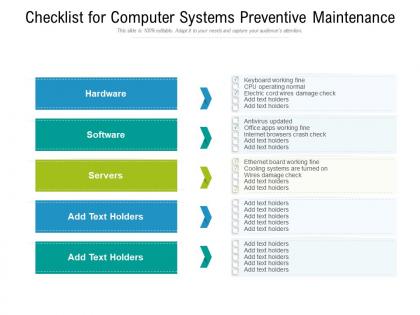
Checklist for computer systems preventive maintenance




Try Before you Buy Download Free Sample Product
 Impress Your
 Audience
 100%
100% Editable
 Save Hours
 of Time


Our Checklist For Computer Systems Preventive Maintenance are topically designed to provide an attractive backdrop to any subject. Use them to look like a presentation pro.
People who downloaded this PowerPoint presentation also viewed the following :
Checklist for computer systems preventive maintenance with all 2 slides:
Use our Checklist For Computer Systems Preventive Maintenance to effectively help you save your valuable time. They are readymade to fit into any presentation structure.

FAQs for Checklist for computer
Key components include equipment identification numbers, inspection schedules, lubrication points, safety checks, performance measurements, and documentation requirements. These elements streamline maintenance workflows by ensuring consistent procedures, reducing unexpected breakdowns, and extending asset lifecycles, with manufacturing facilities and healthcare institutions finding that comprehensive checklists ultimately deliver significant cost savings and operational reliability.
Preventive maintenance checklists should be reviewed quarterly and updated annually, with immediate revisions following equipment changes, regulatory updates, or recurring issues. Manufacturing facilities and healthcare organizations increasingly find that dynamic schedules, incorporating real-time performance data and seasonal operational demands, deliver enhanced equipment reliability and reduced downtime costs.
Industries with critical equipment dependencies benefit most from preventive maintenance checklists, including manufacturing, healthcare, aviation, energy, transportation, and food processing. These sectors rely on continuous operations where equipment failures result in significant costs, safety risks, and regulatory compliance issues, with many organizations finding that structured maintenance schedules reduce downtime by 30-50% while enhancing operational reliability.
A preventive maintenance checklist extends equipment lifespan by systematically identifying wear patterns, scheduling timely replacements, and ensuring consistent upkeep protocols across all operational assets. Through structured monitoring and proactive interventions, manufacturing facilities and healthcare institutions can reduce unexpected breakdowns by up to 70%, while minimizing repair costs and maximizing operational efficiency.
Technology significantly enhances preventive maintenance checklists through IoT sensors, predictive analytics, mobile applications, automated scheduling systems, and real-time data integration. These digital tools streamline inspection processes, enable condition-based monitoring, and provide instant access to maintenance histories, with many manufacturing facilities and healthcare institutions finding that automated alerts and data-driven insights ultimately reduce equipment downtime while optimizing resource allocation.
Common challenges include resistance to change, inadequate training, poor data quality, resource constraints, and inconsistent execution across teams. These implementation hurdles often stem from organizational inertia and insufficient planning, with many manufacturing and facility management organizations finding that phased rollouts, comprehensive staff training, and executive buy-in ultimately deliver smoother transitions and sustained operational efficiency.
Preventive maintenance checklists can be tailored by incorporating equipment-specific specifications, manufacturer recommendations, operational frequency requirements, and environmental factors unique to each machine. Manufacturing facilities, healthcare institutions, and transportation companies customize these checklists based on critical failure points, regulatory compliance needs, and usage patterns, ultimately enabling targeted maintenance schedules that minimize downtime while maximizing equipment lifespan.
Key metrics for evaluating preventive maintenance effectiveness include equipment uptime, mean time between failures (MTBF), maintenance costs per asset, planned versus unplanned maintenance ratios, and overall equipment effectiveness (OEE). These performance indicators enable organizations to optimize resource allocation, reduce unexpected breakdowns, and improve operational efficiency, with many manufacturing and healthcare facilities finding that comprehensive tracking ultimately delivers significant cost savings and enhanced productivity.
Employee training significantly impacts preventive maintenance checklist success by ensuring proper equipment inspection techniques, accurate data recording, and timely issue identification. Well-trained teams in manufacturing and healthcare facilities deliver more reliable maintenance outcomes, reduce equipment downtime, and enhance operational efficiency, with many organizations finding that comprehensive training programs ultimately minimize costly repairs while maximizing asset longevity.
Documentation serves as the foundation for effective preventive maintenance by tracking equipment history, recording inspection results, maintaining compliance records, and enabling data-driven decision making. Through comprehensive documentation systems, organizations can identify failure patterns, optimize maintenance schedules, and ensure regulatory compliance, while technicians access critical equipment specifications and previous service notes, ultimately reducing downtime and extending asset lifecycles.
Yes, several industry standards and regulations dictate preventive maintenance checklist creation, including ISO 55000 for asset management, OSHA safety requirements, FDA regulations for pharmaceuticals, and aviation standards like FAR Part 145. These frameworks ensure compliance, safety, and operational efficiency across sectors, with many organizations finding that standardized checklists significantly reduce downtime, enhance regulatory compliance, and ultimately deliver competitive advantage through systematic maintenance protocols.
Software solutions automate preventive maintenance checklists by scheduling tasks based on time intervals or equipment usage, generating work orders automatically, and tracking completion status in real-time. These systems enable maintenance teams to streamline workflows, reduce manual oversight, and ensure compliance, with manufacturing facilities and hospitals finding that automated scheduling minimizes equipment downtime while enhancing operational efficiency.
Involving employees in preventive maintenance checklist creation delivers enhanced accuracy, improved compliance, increased ownership, and practical insights from hands-on experience. This collaborative approach streamlines maintenance processes by incorporating frontline expertise, reducing equipment downtime through better adherence, and fostering accountability, with many organizations finding that employee-developed checklists achieve higher completion rates and more effective preventive protocols.
A preventive maintenance checklist integrates into safety programs by establishing routine equipment inspections, identifying hazard risks before failures occur, and ensuring compliance with safety regulations and standards. This strategic combination enables organizations across manufacturing, healthcare, and energy sectors to minimize workplace accidents, reduce unexpected downtime, and enhance operational safety, with many facilities finding that systematic maintenance scheduling ultimately delivers both cost savings and improved employee protection.
Successful preventive maintenance implementations include manufacturing plants reducing equipment downtime by 40%, hospitals maintaining critical medical devices through systematic inspections, airlines achieving 99.5% on-time performance, and data centers preventing costly server failures. These strategic programs streamline operations by scheduling regular inspections, tracking component lifecycles, and automating maintenance workflows, ultimately delivering significant cost savings and enhanced operational reliability.
No Reviews