

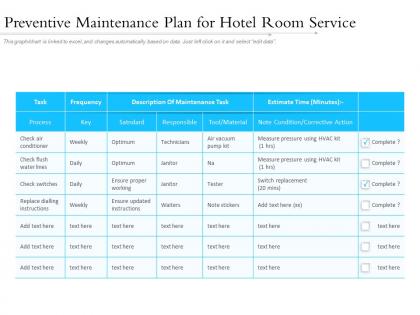
Preventive maintenance plan for hotel room service




Try Before you Buy Download Free Sample Product
 Impress Your
 Audience
 100%
100% Editable
 Save Hours
 of Time


Our Preventive Maintenance Plan For Hotel Room Service are explicit and effective. They combine clarity and concise expression.
People who downloaded this PowerPoint presentation also viewed the following :
Preventive maintenance plan for hotel room service with all 2 slides:
Give your audience a fulfilling experience. They will find our Preventive Maintenance Plan For Hotel Room Service elevating.
FAQs for Preventive maintenance plan for
Honestly, you'll notice the difference pretty fast once you start doing preventive maintenance. Equipment breakdowns basically disappear - no more scrambling around when something dies on a Friday afternoon (which always happens, right?). Your stuff lasts longer, costs drop, and your team can actually focus on their real work instead of putting out fires all day. I read somewhere that most companies save around 30% on maintenance costs when they make the switch. Safety gets better too since you're catching sketchy problems early. Just pick your most important equipment first and go from there.
Dude, technology basically turns maintenance from guessing into actually knowing what's going on. You get IoT sensors watching your equipment 24/7, then AI spots patterns before stuff breaks down. Your techs can pull up work orders and equipment history right on their phones - honestly saves so much time not hunting for paperwork. CMMS handles the scheduling automatically and tracks parts, compliance, all that admin stuff. The whole point is switching from "oh crap it broke" to "yeah, we saw this coming last week." I'd start with sensors on whatever equipment would hurt most if it died.
Oh man, the worst part is convincing your boss it's worth spending money upfront when nothing's broken yet. Leadership always wants to see immediate results, but preventive maintenance is all about long-term savings. Your crew will need training on new systems too, which honestly can be a pain when everyone's already swamped with daily emergencies. That whole "if it ain't broke, don't fix it" attitude is killer. Start small though - pick your most important equipment first. Once you show some quick wins, it gets way easier to expand the program and get more budget approval.
Dude, preventive maintenance is a total game-changer - extends equipment life by like 20-40% and cuts unplanned downtime by up to 70%. Basically you're catching small problems before they turn into expensive nightmares. We learned this the hard way when our main line went down for three days last year... all over a $50 belt we should've replaced months earlier. Super frustrating. The trick is making a schedule and actually following it (easier said than done, I know). Start with your most critical equipment first - don't try to do everything at once or you'll burn out.
Honestly, data analysis is like having a crystal ball for maintenance stuff. You can spot when equipment usually breaks down and figure out what actually needs fixing versus just doing routine stuff because "that's what we always do." Pretty cool shift, right? Look at your failure patterns, usage data, environmental factors - it all helps you predict when things will crap out instead of guessing. I'd start by digging through last year's maintenance records and breakdown data. You'll probably find some weird patterns that'll totally change how you schedule things.
So preventive maintenance is just doing stuff on a schedule - like changing your oil every 3k miles even if it's still good. You're basically playing it safe with regular checkups. Predictive is way smarter though. It actually watches your equipment with sensors and data to tell you when something's about to break. Only then do you fix it. Honestly, predictive saves you tons of money since you're not doing unnecessary work all the time. The downside? You need all those fancy monitoring tools and someone who knows how to read the data. But if you can swing it, it's definitely worth it.
Honestly, start with templates - same format every time with date, tech name, equipment ID, what you did, problems found. I made this mistake early on where everyone was doing their own thing and it was chaos! Document right after you finish the work, not later when you forget half the details. Take photos of issues, record before/after readings, note part serial numbers. Store it all digitally so anyone can pull up history fast. The biggest thing? Get everyone doing it the same way or you'll have a mess on your hands.
So basically, regulations set your bare minimum standards for preventive maintenance. OSHA handles safety stuff, FDA covers medical devices - you know the drill. Different industries get hit harder than others (aerospace is brutal honestly), but most have some compliance hoops to jump through. Your PM schedules gotta hit those regulatory minimums at least. Inspection timing, paperwork, tech certifications - it's all spelled out. When auditors show up, they're definitely gonna want to see your maintenance records are up to snuff.
You'll want to look into CMMS software - stuff like Maintenance Connection, Fiix, or UpKeep handles scheduling, work orders, and inventory tracking. Way better than juggling everything manually. Sure, spreadsheets can work when you're starting out, but trust me, they turn into a nightmare pretty quick. Project management tools work too if your needs are basic - Asana or Monday.com are solid options. The real trick is picking something your team won't hate using. I'd say start simple: figure out what you actually need to track first, then grab whatever tool checks those boxes without overcomplicating things.
So basically, when your people actually know what they're doing, they'll spot weird noises or whatever before stuff breaks down completely. Way better than scrambling for emergency repairs later. Trained employees don't just guess their way through maintenance tasks - they follow the actual steps and feel confident doing it. Focus on whoever needs the most help first, don't try to train everyone at once. Cover both the technical stuff and safety protocols because, honestly, nobody wants someone getting hurt over a routine check. You'll end up with equipment that actually works when you need it and way fewer headaches overall.
Track downtime and MTBF first - those tell you everything. Maintenance costs per asset matter too, obviously. Are you actually hitting your scheduled maintenance windows? That's where most operations fall apart tbh. Emergency repairs are a dead giveaway that your preventive stuff isn't working. OEE and cost per maintenance hour give you the financial side. Honestly though, pick maybe 3-4 metrics max and check them monthly. I've seen too many teams get buried in spreadsheets they never use.
Look, just start with basic checklists - daily, weekly, monthly stuff your team can actually do. Skip the fancy software for now (honestly, a spreadsheet works fine even though those expensive programs love to make you think otherwise). Pick one person to be your maintenance guru who keeps track of everything and catches problems early. Focus on the simple wins first - cleaning, lubing, quick visual checks. That's where you'll see the biggest impact without breaking the bank. Better to have a simple system you'll stick with than some complicated mess that gets abandoned after two weeks.
So manufacturing plants are obsessed with vibration analysis and thermal imaging - catches failures weeks early, which is genius. Airlines do those crazy strict inspections but also run predictive analytics on engine data. Healthcare? Daily checks on ventilators, MRI machines, all that critical stuff, plus they document everything religiously. Food processing is all about sanitation schedules mixed with regular mechanical maintenance. Honestly, I'd just spy on your biggest competitors and see what's working for them, then tweak it for your equipment.
Honestly, it's all about what kind of equipment you're dealing with and how hard you're running it. Critical stuff? I'd say monthly or quarterly checks - don't mess around there. Everything else can probably wait 6-12 months between visits. Look, I've worked places that went crazy with maintenance schedules and burned cash, then others that ignored everything until something expensive died. Neither's fun to deal with. Start with whatever the manufacturer says, but tweak it based on how you actually use the gear. Begin with shorter intervals, then stretch them out once you figure out what really needs attention.
Honestly, it all starts with management actually putting their money where their mouth is. They need to give teams real time for preventive stuff instead of just running everything into the ground. Don't punish people when scheduled maintenance delays production - I've seen that kill motivation so fast. Celebrate the wins when someone catches a problem early. Track those preventive successes, not just the dramatic firefighting moments everyone loves to talk about. You can have all the training in the world, but if leadership won't back it up with resources and support, you're screwed.
No Reviews