


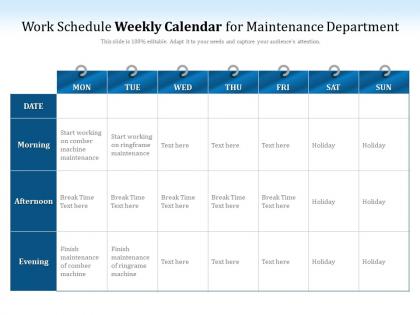
Work schedule weekly calendar for maintenance department




Try Before you Buy Download Free Sample Product
 Impress Your
 Audience
 100%
100% Editable
 Save Hours
 of Time


Our Work Schedule Weekly Calendar For Maintenance Department are explicit and effective. They combine clarity and concise expression.
People who downloaded this PowerPoint presentation also viewed the following :
Work schedule weekly calendar for maintenance department with all 2 slides:
Give your audience a fulfilling experience. They will find our Work Schedule Weekly Calendar For Maintenance Department elevating.

FAQs for Work schedule weekly calendar
Start with listing all your equipment and what maintenance each thing needs - daily checks, weekly stuff, monthly overhauls. Then figure out priority levels because honestly, some equipment failing would be catastrophic while other things... not so much. Asset inventory and task frequency are your foundation. Don't forget to assign clear ownership or tasks will definitely slip through cracks. Include time estimates and any special tools needed too. Oh, and build in buffer time for reviews - your perfect plan won't survive reality so you'll need room to adjust things as you go.
Honestly, I check mine monthly now - learned that the hard way. Equipment breaks down differently than you expect, and your crew usually knows what's actually busted before the schedule does. Used to do it quarterly but that felt like playing catch-up constantly. First Friday every month I sit down with the techs and we hash it out. Oh, and keep a little notebook or whatever for problems that keep coming up - way easier than trying to remember everything during the meeting. Your maintenance needs shift more than you think they will.
Honestly, you should check out CMMS software - it's been a lifesaver for scheduling maintenance stuff. Fiix and UpKeep are solid options that'll automate your recurring tasks and send alerts when things are due. IoT sensors are where it gets interesting though - they actually predict when equipment needs work instead of just following some random schedule. Your team can update everything through mobile apps too, which is huge. Oh, and if you've got an ERP system already, most of these integrate pretty well. I'd grab a free trial first to see if it's worth the switch.
Honestly, it's way cheaper to fix small stuff now than wait for everything to break. Like, you'll spend $50 on maintenance vs $5,000 on a full replacement later - the math is pretty obvious. Your equipment lasts longer too, so you actually get your money's worth from what you bought. Energy bills stay lower when things run smoothly. I get it though, spending money when nothing's "broken" feels weird. My dad taught me this lesson the hard way with his car - ignored oil changes until the engine seized up. Trust me, staying ahead of problems beats scrambling when stuff fails.
Look, documentation is like the foundation for your whole maintenance schedule. Can't really build anything solid without knowing what equipment you're actually working with. Catalog all your specs, manufacturer recommendations, plus any failure patterns you've noticed. I've watched teams just make stuff up as they go - ends badly every time with either wasted money or surprise breakdowns. The cool thing is you can track what's actually working vs what's not, then tweak your schedule based on real data instead of gut feelings. Maybe start with listing everything you have first, then work backwards from there?
Honestly, the biggest pain points are gonna be money and people. Your team will probably push back on all the new processes - nobody likes change, right? Budget's always tight too, so you'll have to pick and choose which equipment gets attention first. That's super frustrating. Plus you'll constantly fight between doing preventive stuff versus jumping on whatever's broken today. Fire fighting mode is addictive, I swear. My advice? Start small with your most critical gear and build from there. Once people see it working, they'll get on board.
Honestly, just think about what would totally screw you if it broke down - that's your critical stuff. Those machines get checked weekly, no exceptions. Monthly checks work fine for equipment that's important but won't kill your whole operation. Everything else? Quarterly is probably enough, though I've seen some places stretch it longer if they're tight on resources. The trick is actually being realistic about impact instead of just assuming everything's super critical. Map out what happens when each thing fails, then you'll know where to focus your time. Makes way more sense than treating a backup pump the same as your main production line.
So you wanna know if your maintenance schedule's actually doing anything? Start with equipment uptime and MTBF - those tell you if you're actually preventing stuff from breaking. Cost per unit matters too, plus your planned vs unplanned maintenance ratio. Work order completion rates are huge - like, are you even hitting your scheduled windows? I swear, half the shops I know just wing it and wonder why nothing works. Oh, and track how often you're scrambling for emergency fixes versus staying ahead of problems. These basics will show you pretty quick if you need to adjust things.
So predictive analytics is basically looking at sensor data and past failures to figure out when stuff's gonna break before it actually does. Way smarter than just waiting for things to crap out on you. You can plan maintenance around your schedule instead of having everything go sideways at 2am on a weekend - been there, trust me. It cuts down on surprise downtime and saves money since you're not doing unnecessary work or dealing with major breakdowns. Start with whatever equipment would totally screw you if it died, then get some monitoring tools that can actually feed useful data into the system.
Document everything and follow those manufacturer schedules religiously - seriously, this is what saves you during audits. Build solid checklists for each task and track when stuff gets done. The paperwork's honestly a pain at first but trust me, it beats dealing with compliance issues later. Your team needs proper training and certs for whatever equipment they're touching. I'd start by comparing your current schedule against the standards - you'll probably spot some easy fixes right away. Oh, and run regular internal audits. Way better to catch problems yourself than have regulators find them.
Yeah, seasonal stuff completely changes how you schedule maintenance. HVAC guys are swamped doing spring prep, manufacturing usually does big overhauls in winter when things slow down. Agriculture's obvious - everything follows growing seasons. Even retail times their equipment work around Black Friday and holiday madness. Construction's probably the craziest though - they're literally chasing good weather all year. The trick is spotting your busy periods and doing major maintenance when you're naturally slower. I'd start tracking your patterns now so you can build a calendar that actually makes sense for your business instead of fighting against it.
Dude, training your staff properly is huge - like, it literally decides if your maintenance schedule works or becomes useless paper. When people actually know what they're doing, they spot problems before they blow up and don't waste time figuring stuff out. I've watched too many good schedules crash because workers were just guessing their way through tasks. Plus you avoid the whole safety nightmare thing when someone does something totally wrong. Look, spend the money upfront on decent training. Your future self will thank you when people actually follow the schedule instead of... well, doing whatever they feel like.
Track your maintenance data after each job - downtime, repair costs, how often stuff breaks. Monthly team meetings work great for spotting weird patterns in the numbers. Like if that one machine keeps crapping out even though you're following the schedule perfectly. That's your cue to switch things up - maybe change the timing or try predictive maintenance instead of just reacting to problems. Don't try to overhaul everything at once though. Pick your most critical equipment first and build from there. Makes the whole process way less overwhelming.
Focus on your critical sites first - the ones that'd cause real chaos if they went down. Then think geography. Trust me, clustering nearby locations saves you so much driving time versus bouncing all over the place. Map out where everything is, then group maintenance trips by area. Don't forget about their busy hours - hitting a site during peak time is just asking for angry phone calls. Weather can mess with outdoor gear too, so factor that in. Basically start with a map of your must-have sites, then build realistic maintenance windows around when each place can actually handle being offline.
Dude, trust me on this - visual tools are a game changer. Gantt charts, calendars, dashboards... anything beats those awful spreadsheets nobody wants to read. Color-code stuff by priority and you can spot urgent deadlines instantly. I swear, half the maintenance plans I've seen just sit rotting in email attachments. Interactive dashboards let people filter by department or equipment type, so they only see what matters to them. Even something basic like a shared calendar works wonders. Seriously, communication improves overnight when people can actually see what's happening instead of deciphering some massive Excel file.
No Reviews