


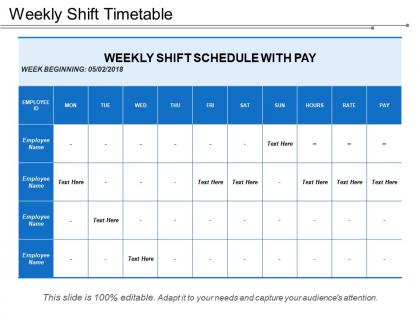
Weekly shift timetable




Try Before you Buy Download Free Sample Product
 Impress Your
 Audience
 100%
100% Editable
 Save Hours
 of Time


Hammer home the facts in an acceptable fashion with our Weekly Shift Timetable. You can be blunt but cordial.
People who downloaded this PowerPoint presentation also viewed the following :
Weekly shift timetable with all 5 slides:
Every presentation makes a difference in helping to build your business. Weekly Shift Timetable can help make your presentations work harder for you.



FAQs for
Primary factors include employee availability and preferences, skill requirements for each shift, labor regulations and compliance needs, workload distribution, and diversity considerations like cultural holidays and time-off requests. These elements work together to ensure adequate coverage while respecting individual needs, with many organizations finding that flexible scheduling approaches enhance employee satisfaction, reduce turnover, and ultimately deliver improved operational efficiency.
Technology enhances shift scheduling efficiency through automated roster generation, real-time availability tracking, predictive analytics for demand forecasting, and mobile accessibility for instant updates. These digital solutions streamline labor allocation by reducing manual errors, optimizing coverage patterns, and enabling faster schedule adjustments, with many retail and healthcare organizations finding significantly improved operational efficiency and employee satisfaction.
Common challenges in shift scheduling for 24/7 operations include ensuring adequate coverage across all shifts, managing employee fatigue and burnout, balancing labor costs with operational needs, accommodating staff preferences and availability, and maintaining compliance with labor regulations. These scheduling complexities particularly impact healthcare facilities, manufacturing plants, and customer service centers, with many organizations finding that strategic workforce planning and automated scheduling systems ultimately deliver improved staff satisfaction, reduced overtime costs, and enhanced operational efficiency.
Employee preference significantly impacts shift scheduling by affecting retention, productivity, and job satisfaction, with businesses accommodating preferences through flexible scheduling systems, shift-swapping platforms, and advance notice policies. Many organizations find that balancing employee preferences with operational needs through technology-enabled self-scheduling and transparent communication ultimately delivers higher engagement, reduced turnover, and improved workforce stability.
Labor law and compliance play a critical role in shift scheduling by establishing mandatory rest periods, overtime regulations, maximum working hours, and fair scheduling practices that organizations must follow. These legal frameworks help companies avoid costly penalties while ensuring employee welfare, with many businesses in healthcare, retail, and manufacturing finding that compliant scheduling systems ultimately enhance productivity and reduce turnover risks.
Shift scheduling improves employee morale and work-life balance by providing predictable schedules, flexible shift options, and fair rotation systems that accommodate personal needs. Strategic scheduling enables employees to plan personal activities, reduces burnout through adequate rest periods, and enhances job satisfaction, with many healthcare facilities and retail organizations finding that consistent scheduling practices ultimately deliver higher retention rates and improved workplace satisfaction.
Effective last-minute shift change management involves cross-training employees, maintaining on-call staff pools, implementing automated notification systems, and establishing clear coverage protocols. These strategies streamline operations by reducing response time, minimizing disruptions, and ensuring adequate staffing levels, with many healthcare facilities and retail organizations finding that proactive scheduling frameworks ultimately deliver improved employee satisfaction and operational continuity.
Automation in shift scheduling streamlines workforce management by reducing scheduling conflicts, minimizing administrative time, and automatically adjusting for availability changes, while manual methods often involve time-consuming spreadsheets and frequent errors. Healthcare facilities and retail chains increasingly find that automated systems deliver faster schedule creation, improved staff satisfaction through better work-life balance, and significant cost savings.
Key metrics include employee satisfaction scores, overtime costs, schedule adherence rates, labor cost per hour, and absenteeism levels. These measurements enable organizations to streamline workforce management, optimize resource allocation, and enhance operational efficiency, with many retail and healthcare institutions finding that comprehensive tracking ultimately delivers reduced costs and improved employee retention.
Shift scheduling influences productivity and operational efficiency by optimizing workforce allocation, reducing labor costs, and ensuring adequate coverage during peak demand periods. Through strategic scheduling systems, organizations streamline operations, minimize overtime expenses, and enhance employee satisfaction, while many manufacturing and healthcare facilities find that well-planned shifts ultimately deliver improved service quality and competitive advantage.
Best practices for communicating shift changes include providing advance notice whenever possible, using multiple communication channels like apps and email, maintaining clear documentation, and establishing consistent protocols for emergency changes. These approaches enhance operational efficiency by reducing confusion, minimizing no-shows, and improving employee satisfaction, with many retail and healthcare organizations finding that transparent communication ultimately delivers better workforce management and reduced turnover.
Varying time zones significantly complicate shift scheduling for global teams by requiring strategic coordination across different work hours, overlapping coverage periods, and regional compliance requirements. Organizations manage this through rotating schedules, flexible hybrid arrangements, and dedicated handoff protocols, with many multinational companies finding that strategic time zone leverage actually enhances 24/7 customer service capabilities and operational continuity.
Shift swapping can be managed through automated scheduling platforms, mandatory skill-level matching, advance notice requirements, supervisor approval workflows, and real-time coverage verification systems. These controls ensure operational continuity by maintaining adequate staffing levels, preserving essential competencies during transitions, and enabling quick adjustments, with many organizations finding that structured swap policies reduce scheduling conflicts while enhancing employee satisfaction.
Businesses can use data analytics to optimize shift scheduling by analyzing historical attendance patterns, forecasting customer demand fluctuations, identifying peak service periods, and predicting employee availability trends. Through predictive modeling and real-time data insights, organizations streamline labor allocation, reduce overtime costs, and enhance service coverage, with many retail and healthcare facilities finding that data-driven scheduling delivers improved operational efficiency.
Seasonal demand significantly impacts shift scheduling strategies by requiring flexible staffing models, variable shift patterns, and strategic workforce planning to match fluctuating customer needs. Retail businesses during holidays, hospitality during peak seasons, and tax preparation services adapt by implementing temporary scheduling increases, cross-training employees across departments, and leveraging part-time workers, ultimately delivering improved service levels while managing operational costs effectively.
-
Easily Understandable slides.
-
Easy to edit slides with easy to understand instructions.