


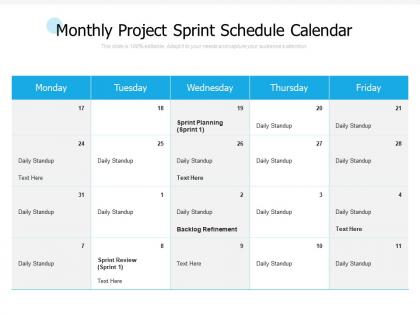
Monthly project sprint schedule calendar




Try Before you Buy Download Free Sample Product
 Impress Your
 Audience
 100%
100% Editable
 Save Hours
 of Time


Generate exponential growth with our Monthly Project Sprint Schedule Calendar. Bring about genuine and beneficial change.
People who downloaded this PowerPoint presentation also viewed the following :
Monthly project sprint schedule calendar with all 2 slides:
Our Monthly Project Sprint Schedule Calendar are excellent for completing deals. Bring it to a beneficial end.
FAQs for Monthly project
Honestly, you need five main things for sprints that don't suck: planning sessions upfront to scope work, daily standups (keep them short or people zone out), some kind of mid-sprint pulse check, reviews to show off what shipped, and retros to hash out what broke. Oh, and always pad your estimates - I learned this the hard way. Nothing ever takes the time you think it will. Keep meetings tight and focused. Nobody wants their day eaten by ceremonies. Start with this framework, then tweak timing based on how your team actually operates.
Go with 2 weeks - works for most teams I've worked with. Gives you enough runway to actually ship something without everyone zoning out halfway through. Team experience matters though, and how messy your work gets. Oh, and how often your stakeholders freak out wanting updates lol. Don't overthink this part! Pick something and run with it for 3-4 sprints minimum. Running out of time constantly? Bump it to 3 weeks. Wrapping up early and people getting bored? Try 1 week instead. Just stop changing it every sprint - that consistency thing actually matters way more than finding the "perfect" length.
Look, stakeholder feedback is what stops you from building features nobody wants. I learned this the hard way on my last project - we spent weeks on something they barely used. Get their input during sprint planning so you know what's actually critical. Reviews are good too for course-correcting. When timelines shift (and they will), tell them why. Most stakeholders are cool with delays if they understand the trade-offs. The trick is making feedback a regular thing, not something you panic about right before demos. Trust me on this one.
Ugh, this happens all the time. First thing - figure out if it's actually urgent or if someone just thinks it is. Half the "emergencies" I've seen can totally wait. If it really can't, don't just pile more work on your team (trust me, burnout is real). Instead, work with your PO to swap out something similar-sized from your current sprint. Write down what you're cutting and why - stakeholders need to see there's always a trade-off. You'll keep your capacity realistic while staying flexible. Push back hard on fake emergencies though.
Look at your team's past velocity - that's honestly your best bet for realistic planning. Get everyone involved in estimating because devs will catch technical issues you might miss. Break stories into smaller tasks so blockers don't blindside you later. I'd add like 15-20% buffer time because weird stuff always happens - trust me on this one. Don't forget about holidays or people taking time off either. Start with smaller commitments first. You can always ramp up once the team hits their groove, but overshooting early just stresses everyone out.
So during sprint planning, I figure out which tasks are gonna block others and put them in the right order. Like you can't build the frontend stuff until the API endpoints are ready, obviously. I just make a quick chart or even scribble down a list - honestly doesn't need to be pretty. The main thing is making sure everyone on the team knows what they're waiting for. Oh and if you see something that's gonna create a bottleneck, speak up right away! Sometimes you can break tasks down differently or get extra help to move things along faster.
Honestly, the biggest screwup I see is teams cramming way too much into sprints. Leave buffer time - code reviews take forever, testing finds weird bugs, and random stuff always pops up. Spreading high-risk items across different sprints saves your sanity too. Actually ask your team about capacity instead of guessing everyone can handle the same load. Oh, and never put critical stuff due on the sprint's last day (learned that the hard way). Plan for 80% capacity max. Your future self will thank you.
Look, retrospectives are basically where you figure out what went wrong and what actually worked each sprint. Your team talks through blockers and successes, then uses that stuff for next sprint's planning. Maybe you'll realize you're always way off on story point estimates - happens to everyone. Or certain task types consistently take forever. That's gold for tweaking how you plan capacity or break down stories. The trick is actually doing something with those action items instead of just... talking about them endlessly. I've seen too many teams turn retros into complaint sessions without follow-through. Use the insights to debug your process as you go.
Go with Jira or Azure DevOps if you want the full package - burndown charts, velocity tracking, all that good stuff. Trello's solid too for simpler setups. But honestly? I've watched teams spend way too much time tweaking dashboards instead of actually working. A basic Kanban board can work wonders if people use it right. What matters is everyone can see what's happening, what's stuck, and if you're gonna hit your sprint goals. Just pick something your team will update every day - doesn't matter how fancy it is if nobody touches it.
Honestly, you've gotta nail down time zones first or you'll go crazy. Kick off each sprint with everyone aligned on who's doing what and when it's due. Those daily standups? Make them async in Slack when the time zones are brutal - nobody wants a 6am call every day, trust me. Keep everything visible on Jira or whatever board you use so people can actually see what's blocked. Oh, and for reviews and retros, just accept that someone's joining early or staying late. Document literally everything because people forget stuff constantly when they're scattered across the globe. Better to overcommunicate than have things fall through cracks.
Daily standups are clutch - keep them short and actually catch problems before they explode. You'll want a solid definition of done because scope creep is the devil (seriously, "just one tiny change" has killed more sprints than I can count). Set your board up so progress is obvious to everyone walking by. Timebox everything ruthlessly or you'll spiral. Oh, and don't skip retrospectives - they're where you figure out what's broken. Also celebrate the small stuff along the way. Your team needs those wins, trust me.
Just bake it right into your sprint planning - set aside like 10-20% of capacity for exploration stuff. Treat it like any regular story, estimate it, throw it on the backlog. Here's the thing though: you've gotta protect that time ruthlessly because it always gets axed first when things get crazy. Some teams do innovation Fridays or save the last sprint day for experiments. Whatever works. The trick is making it official and visible, not crossing your fingers that people will magically find time. Oh, and definitely track what comes out of these sessions - you'll be shocked how much of that random exploration turns into your next major feature.
Honestly, stand-ups are lifesavers for catching issues early. Problems that would normally snowball into disasters? You'll spot them day one instead of sprint-end panic mode. The whole point is that quick visibility - who's stuck, what's blocking people, if someone's drowning in work. Yeah, they feel boring after a while, but that daily rhythm actually keeps everyone honest about the sprint goal. Stick to the basics: what you did yesterday, what's happening today, any roadblocks. Save the technical deep-dives for after - trust me on that one. Fifteen minutes max and you're golden.
Okay so the thing that helped me most was breaking everything down way smaller. Like instead of "build dashboard" I'd do "wireframe, API setup, data fetching, styling" - you catch so much hidden complexity that way. Get everyone doing planning poker together too, different people spot different problems. Oh and this might sound obvious but actually track your estimates vs reality for a few sprints. I was terrible at estimating CSS work specifically until I saw the pattern. Your story points will finally start making sense across sprints instead of being random numbers.
Honestly, start with velocity - how many story points you're knocking out each sprint. Burndown charts are solid too. Then check if you're actually delivering what you committed to (this one stings sometimes). Sprint goals matter way more than people think - like, did you achieve what you said you would? Watch for scope creep because it happens to literally everyone. Team happiness is just as crucial as the numbers though. I'd track retrospective feedback alongside the hard data. Oh, and commitment vs delivery ratio - that'll tell you if you're being realistic or just wishful thinking. Start simple, then add the softer metrics once you've got momentum.
No Reviews