

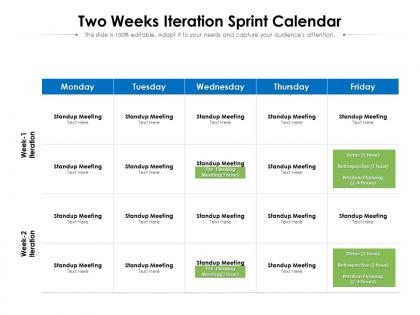
Two weeks iteration sprint calendar




Try Before you Buy Download Free Sample Product
 Impress Your
 Audience
 100%
100% Editable
 Save Hours
 of Time


Our Two Weeks Iteration Sprint Calendar are topically designed to provide an attractive backdrop to any subject. Use them to look like a presentation pro.
People who downloaded this PowerPoint presentation also viewed the following :
Two weeks iteration sprint calendar with all 2 slides:
Use our Two Weeks Iteration Sprint Calendar to effectively help you save your valuable time. They are readymade to fit into any presentation structure.
FAQs for Two weeks
So Agile boils down to four things: people matter more than rigid processes, actually working software beats endless docs, collaborating with customers trumps contracts, and adapting to change instead of sticking to some ancient plan. You'll work in short 2-week sprints, constantly check in with stakeholders, and pivot when stuff changes - which it always does. Teams get way more collaborative since you're actually talking to customers regularly. That whole "fail fast" mentality isn't just startup BS, it genuinely works here. Honestly? Try breaking your next project into sprints and see what happens.
So Waterfall is basically step-by-step - finish one phase completely, then move on. Pretty rigid if you ask me. Agile does the opposite and breaks everything into these short sprints where you're constantly tweaking stuff based on feedback. With Waterfall you map out ALL the requirements upfront (good luck with that lasting). But Agile actually expects things to change. You're shipping working pieces every couple weeks, so people can actually see what's happening and redirect if needed. If your project's gonna be unpredictable, Agile's definitely the way to go.
So there's three main roles you gotta know about. Product Owner handles what gets built and ranks everything by business value. Development Team does the actual building and figures out how to organize themselves. Then there's the Scrum Master - they run meetings and clear roadblocks (honestly probably the most underrated role). It's kinda like a three-legged stool situation where if one's missing, everything falls apart. The real magic happens when they all work together and actually trust each other. Keep roles clear but don't be weird about collaboration.
Track velocity trends and cycle time first - those show if you're actually shipping faster. Quality stuff matters more though: defect rates, customer happiness, whether you hit sprint goals. Numbers can be total BS if people game them, so I'd add team surveys and retros to see if everyone's burning out. Honestly, start small with like 3 metrics max. The human side's just as crucial as delivery speed. Sprint burndowns are useful too but don't obsess over every dip.
Honestly, resistance to change will be your biggest headache - plus people not knowing their new roles. Teams always mess up estimation at first, so don't stress about that. Oh, and watch out for "Agile theater" where you're just going through motions without the actual mindset shift. Get leadership on board first, then define who does what. Don't try implementing everything - maybe start with daily standups and retros? Those work well. The real key is embracing collaboration over just following processes. Let your team screw up quickly and learn from it.
Oh man, Agile totally fixes that silo problem! Daily standups become this regular thing where everyone actually talks about their work instead of staying in their own bubbles. Sprint planning gets the whole team deciding priorities together - no more guessing what other departments need. Way less paperwork too, which is honestly such a relief after drowning in documentation at my last job. Cross-functional teams stick together through the whole process instead of that annoying "toss it over the wall" mentality. Retrospectives help you figure out what's broken. You should definitely try daily check-ins if you're not already doing them!
Scrum's probably your best bet starting out - you get sprints, standups, retrospectives, all that structure. Kanban's cool too if you want to visualize workflow and limit how much you're juggling at once. Most teams honestly just grab bits from whatever works though. User stories, story mapping, test-driven development - these techniques work with pretty much any framework. Lean's another option but I'd stick with basic Scrum first. You can always tweak things later once you figure out what clicks with your team. Don't overthink it.
Yeah, remote Agile totally works! I'd move your standups and retros to video calls - though honestly, async Slack updates are clutch when people are scattered across time zones. Digital boards like Jira or Trello replace those sticky note walls pretty well. Communication gets tricky without the desk drop-bys, so you'll need solid norms upfront. Make sure everyone can actually see what's happening project-wise. Oh, and pick tools people don't hate using - I've seen teams fail just because they forced some clunky platform on everyone. It's really about being more deliberate with how you communicate.
Honestly, the speed is what gets me - you're shipping actual working stuff every couple weeks instead of waiting forever. When requirements change (and they will, trust me), you can actually adapt instead of being stuck with some plan from six months ago. Your team won't hate their lives because they see real progress happening. Stakeholders get regular demos which keeps them happy. Bug fixes are way cheaper when you catch them early too. If there's any uncertainty in what you're building, just do it. Seriously.
Honestly, you've got to get stakeholders involved from the very beginning - like, actually participating instead of just getting occasional updates. Regular demo sessions work way better than those boring status reports nobody ever reads. Make sure you have specific stakeholder reps who can actually make decisions and show up to sprint reviews consistently. Short, frequent feedback loops are everything here. Oh, and definitely start by figuring out who your most important stakeholders are and get them locked into specific touchpoints each sprint. Trust me, it'll save you so many headaches later.
Honestly, feedback loops are what make Agile actually work. Daily standups, sprint reviews, retrospectives - they're all designed to get you constant input instead of waiting months to discover you built the wrong thing. Think of it like... idk, checking your GPS regularly vs driving with a blindfold on? Short, frequent feedback helps you pivot when requirements change (and they always do). The trick is actually doing something with all that feedback you collect. Otherwise you're just having a lot of meetings for no reason. Catch problems early, build what users want.
Honestly, Agile works because you're not building in a vacuum anymore. Your customers are right there with you the whole time, so no more guessing games about what they want. Short sprints mean they see stuff every few weeks - way better than waiting months to find out you built the wrong thing. When they inevitably change their minds (and trust me, they will), you can actually adjust course without starting over. The feedback happens early and often, which saves everyone from those awful "this isn't what we wanted" moments at launch. Get them in your sprint reviews if you can.
Yeah, totally! Manufacturing teams do short production runs with quality checks. Marketing runs campaigns in sprints - constant feedback loops. Even seen construction crews doing daily "toolbox talks" (basically standups but with hard hats). HR does iterative hiring too, which honestly makes way more sense than their usual chaos. The trick isn't copying software practices exactly. Focus on the core stuff: collaborate more, adapt fast when things change, deliver smaller wins instead of waiting for one massive final thing. Pick a project and try 2-week cycles with regular team check-ins. You'll probably be surprised how well it works.
Honestly, just grab Jira or Trello for tracking your sprints - don't overthink it. Teams waste so much time debating tools instead of actually doing Agile. Slack's solid for day-to-day chat. Miro's clutch for virtual retros and planning (way better than trying to use sticky notes over Zoom, trust me). If you're coding, obviously you need Git. Start with the free versions of everything first. Your team will figure out what they actually need once they get into the rhythm. Azure DevOps is decent too if you're already in the Microsoft ecosystem.
Oh man, Agile is perfect for this! You're constantly doing retrospectives after each sprint where everyone just dumps what worked and what sucked. Daily standups catch problems before they turn into disasters. The feedback loops are honestly amazing - you get input from users and stakeholders constantly, so if something's not working, you pivot fast instead of wasting months. That's probably my favorite thing about it, you never get trapped doing something stupid for ages. Definitely try a quick retro after your next sprint and see what comes up.
-
Innovative and attractive designs.
-
It saves your time and decrease your efforts in half.
-
Informative presentations that are easily editable.
-
Great quality slides in rapid time.
-
Great quality slides in rapid time.