

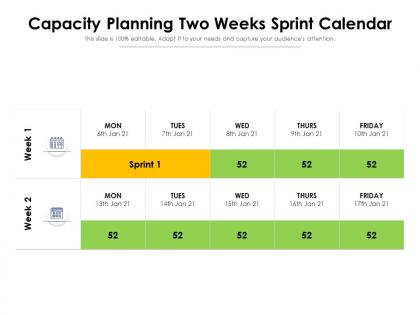
Capacity planning two weeks sprint calendar




Try Before you Buy Download Free Sample Product
 Impress Your
 Audience
 100%
100% Editable
 Save Hours
 of Time


Our Capacity Planning Two Weeks Sprint Calendar are topically designed to provide an attractive backdrop to any subject. Use them to look like a presentation pro.
People who downloaded this PowerPoint presentation also viewed the following :
Capacity planning two weeks sprint calendar with all 2 slides:
Use our Capacity Planning Two Weeks Sprint Calendar to effectively help you save your valuable time. They are readymade to fit into any presentation structure.
FAQs for Capacity planning two
Key components of effective capacity planning include demand forecasting, resource assessment, gap analysis, scenario modeling, and performance monitoring. These elements work together by analyzing current utilization patterns, predicting future requirements, and identifying optimization opportunities, with many organizations finding that this systematic approach delivers improved resource allocation, reduced operational costs, and enhanced service delivery capabilities.
Businesses can forecast demand accurately through historical data analysis, market trend evaluation, customer behavior insights, seasonal pattern recognition, and predictive analytics integration. These methodologies enable organizations to anticipate fluctuations across sectors like retail, manufacturing, and healthcare, ultimately delivering optimized resource allocation, reduced operational costs, and enhanced customer experiences while maintaining competitive advantage.
Data analytics and forecasting tools enable capacity planning by analyzing historical usage patterns, predicting future demand fluctuations, and identifying resource bottlenecks before they impact operations. These technologies streamline decision-making through predictive modeling, real-time monitoring, and scenario analysis, with many organizations finding that data-driven capacity planning reduces costs while enhancing operational efficiency.
Organizations balance capacity with fluctuating market demands through flexible staffing models, scalable infrastructure, demand forecasting analytics, strategic partnerships, and modular resource allocation. These approaches enable companies to adjust operations dynamically, with many retail and manufacturing businesses finding that hybrid capacity strategies reduce costs while maintaining service levels, ultimately delivering competitive advantage in volatile markets.
Common capacity planning challenges include inaccurate demand forecasting, insufficient historical data, resource allocation conflicts, budget constraints, and technology scalability limitations. These obstacles often create bottlenecks across industries, with many organizations finding that inadequate planning leads to either resource waste or service disruptions, ultimately impacting customer satisfaction and operational efficiency.
Cloud computing transforms capacity planning strategies by enabling dynamic resource scaling, eliminating upfront infrastructure investments, and providing real-time usage analytics for informed decision-making. Through auto-scaling capabilities and pay-per-use models, organizations can respond instantly to demand fluctuations while optimizing costs, with many enterprises finding that cloud flexibility delivers significantly improved operational efficiency and competitive advantage.
Key metrics for effective capacity planning include CPU utilization, memory usage, network bandwidth, storage capacity, response times, and throughput rates. These performance indicators enable organizations to identify bottlenecks, predict resource needs, and optimize system performance, with many enterprises finding that proactive monitoring ultimately delivers improved service reliability and reduced operational costs.
Scenario planning enhances capacity planning by modeling multiple demand forecasts, identifying potential bottlenecks, and stress-testing resource allocation strategies across various business conditions. This approach enables organizations to develop flexible capacity strategies, optimize investment timing, and maintain service levels during unexpected fluctuations, with many companies finding significantly improved operational resilience.
Capacity planning integrates with supply chain management through demand forecasting alignment, production scheduling coordination, and resource optimization across suppliers and distribution networks. This strategic combination enables manufacturers and retailers to minimize bottlenecks, reduce inventory costs, and enhance delivery performance, with many organizations finding that synchronized capacity and supply chain planning delivers significantly improved operational efficiency and customer satisfaction.
Manufacturing capacity optimization methodologies include demand forecasting, constraint analysis, lean manufacturing principles, statistical process control, and predictive maintenance scheduling. These approaches streamline operations by eliminating bottlenecks, reducing waste, and maximizing equipment utilization, with many manufacturers finding that strategic combinations deliver significantly improved throughput and cost efficiency.
Businesses can adjust capacity plans through flexible resource allocation, scenario-based contingency planning, real-time demand monitoring, cross-trained workforce deployment, and strategic vendor partnerships. These approaches enable organizations to quickly scale operations up or down during disruptions, with many companies finding that diversified supply chains, agile staffing models, and technology-driven forecasting deliver enhanced resilience and competitive advantage.
Capacity planning and workforce management are intrinsically linked, as capacity planning determines required operational capacity while workforce management allocates human resources to meet those demands. Through strategic workforce scheduling, skills mapping, and demand forecasting, organizations streamline operations by optimizing staffing levels, reducing labor costs, and enhancing service delivery, ultimately delivering improved operational efficiency and competitive advantage.
Different industries approach capacity planning through sector-specific methodologies, with manufacturing focusing on production line optimization and demand forecasting, healthcare emphasizing patient flow and resource allocation, and technology companies prioritizing server capacity and user scalability. These tailored approaches enable organizations to streamline operations, minimize bottlenecks, and enhance service delivery, ultimately delivering competitive advantage through strategic resource management.
Technology advancements revolutionize modern capacity planning through artificial intelligence, machine learning algorithms, cloud computing, predictive analytics, and real-time monitoring systems. These technologies enhance forecasting accuracy by analyzing historical patterns, automating resource allocation, and enabling dynamic scaling, with organizations across manufacturing, healthcare, and financial services ultimately achieving optimized performance and reduced operational costs.
Organizations ensure capacity planning aligns with business strategy by integrating forecasting models with strategic objectives, conducting regular cross-departmental reviews, and establishing key performance indicators that reflect growth targets. This strategic combination enables companies to anticipate resource needs, optimize operational efficiency, and scale infrastructure proactively, with many enterprises finding that aligned capacity planning delivers competitive advantage and sustainable growth.
-
Best Representation of topics, really appreciable.
-
Visually stunning presentation, love the content.
-
Use of different colors is good. It's simple and attractive.
-
Qualitative and comprehensive slides.