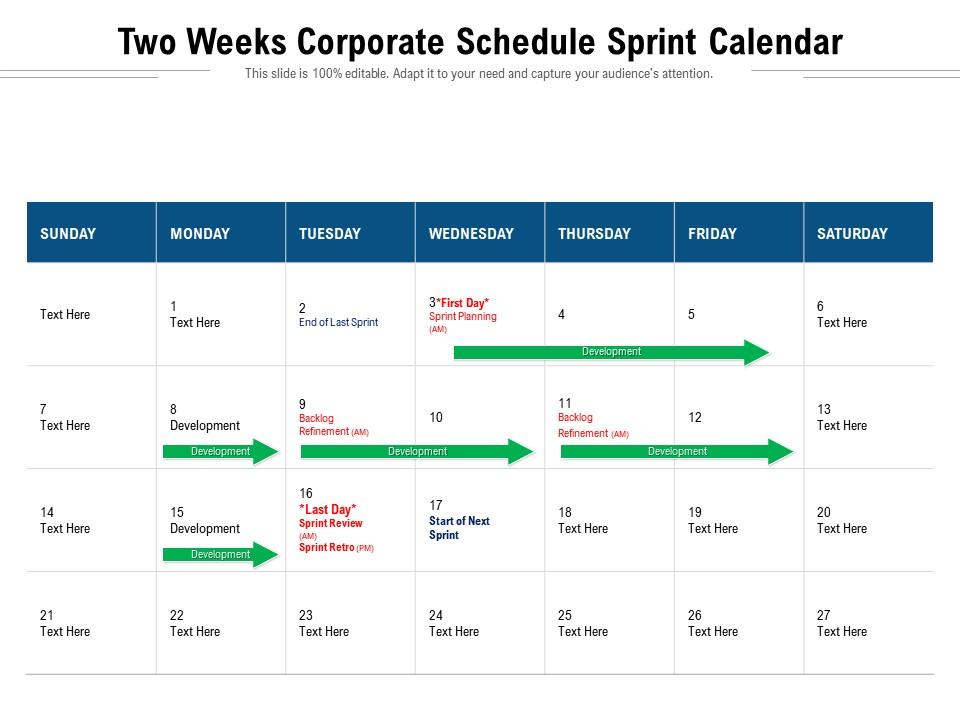
Two weeks corporate schedule sprint calendar

Rating:
80%
Two weeks corporate schedule sprint calendar
Slide 1 of 2
Favourites Favourites

Try Before you Buy Download Free Sample Product

Audience Impress Your
Audience
Editable 100%
Editable
Time Save Hours
of Time
The Biggest Sale is ending soon in
0
0
:
0
0
:
0
0
Rating:
80%
Introducing our Two Weeks Corporate Schedule Sprint Calendar set of slides. The topics discussed in these slides are Development, Backlog Refinement, Sprint Review, Sprint Planning, Sprint Retro. This is an immediately available PowerPoint presentation that can be conveniently customized. Download it and convince your audience.

People who downloaded this PowerPoint presentation also viewed the following :

FAQs for Two weeks corporate

Honestly, start with sprint length - 1-2 weeks is the sweet spot for most teams. Block out time for planning, standups, and retros right away. Map your big deadlines early and throw in buffer time because everything ALWAYS takes longer than you think it will. Don't forget holidays, PTO, and those random company meetings that somehow multiply like rabbits. The real key though? Actually share the damn thing with everyone and keep it updated. I've seen too many beautiful calendars that just collect digital dust because nobody bothers checking them.

So basically a corporate sprint calendar gets everyone on the same timeline instead of having different teams doing their own thing. Like, engineering might be doing 2-week cycles while marketing plans monthly - it's chaos. When you sync everyone up (usually quarterly or monthly), cross-team collaboration actually works because you're all planning and reviewing together. Leadership loves it too since they don't have to track five different schedules. Honestly, it cuts down so much of that "wait what are our priorities again" mess. I'd start by mapping out what cycles your teams are currently on - you'll probably be surprised how all over the place it is.

Honestly, just start with whatever project management tool you're already using - Jira and Azure DevOps both have decent built-in calendar stuff. Google Calendar syncs pretty well with most of these platforms too. Oh, and definitely set up Slack notifications because people will 100% forget about sprint planning otherwise (learned that one the hard way). If you need something more custom, Zapier's good for connecting random tools together. But seriously, don't overcomplicate it at first. Get the basic calendar integration working, then add the fancy automation later when you actually know what you need.

So basically it's like a shared calendar where every team puts their big deadlines and project timelines. Marketing's campaign launch, engineering feature releases, sales pushes - everything's visible to everyone. No more of those "oh crap, you needed this last week?" disasters. Honestly saves so much headache. You can actually plan cross-team stuff without stepping on each other's toes. Plus you'll spot problems coming instead of scrambling at the last minute. Just get your department heads to throw their major sprints in there first, then give access to anyone who needs to coordinate. Sounds obvious but most places still don't do this for some reason.

Honestly, timeline visualization is a game changer. When everything's laid out visually, you can spot overloaded teams and conflicting deadlines right away. No more mental gymnastics trying to remember who's doing what when. It beats digging through spreadsheets every time. Plus stakeholders actually get it when you show them a timeline instead of explaining dates verbally. I'd just start simple - use whatever tool your team already has and update it during weekly standups. My old manager used to say it's like x-ray vision for project mess, which sounds dramatic but it's honestly pretty accurate.

Okay so feedback loops are basically what keep your sprint calendar from being total garbage. After each sprint, collect input from your teams - what worked, what bombed, where timelines were completely nuts. Then actually use that info to fix future sprints. I swear, skipping this step just means you'll keep making the same dumb mistakes forever (trust me on this one). Don't wait for people to volunteer feedback though - most won't. Set up regular retrospectives and track the data properly. Pick one major pain point this quarter and start iterating from there. Way better than trying to fix everything at once.

So you want those retrospective insights to actually matter, right? Take 15-20 minutes at the start of your next planning session to review what went wrong. Did your team get pulled in too many directions last sprint? Plan for less capacity this time. Code reviews became a nightmare? Time to tweak that process before you commit to new stories. Honestly, most teams just document feedback and forget about it - don't be one of those. The whole point is letting what you learned actually change how you approach the next sprint.

Honestly, the biggest pain will be people hating change and departments that can't get on the same page. Different sprint lengths, misaligned deadlines, everyone defining "done" differently - it's a mess. Start small though. Pick 2-3 teams who actually want to try this stuff and work out the bugs first. Document everything clearly (I know, boring but necessary), then slowly expand. Oh, and get the executives on board immediately or you're screwed. Seriously, without leadership backing you, it's like trying to move a mountain. Focus on some early wins to keep momentum going.

So it really depends on your industry, honestly. Tech companies usually do 1-2 week sprints with daily check-ins because everything moves crazy fast and requirements shift constantly. But manufacturing? Totally different beast - they're looking at monthly or even quarterly cycles that match up with production schedules and supply chain stuff. You can't just change a factory line overnight like you can push new code, you know? My old roommate worked in manufacturing and always complained about how Silicon Valley "agile experts" didn't get their world at all. Bottom line: match your sprint timing to how your business actually operates instead of cramming some cookie-cutter framework in there.

Track your team's velocity first - how many story points you're actually finishing each sprint. Burndown charts are clutch for this, way better than just looking at numbers in a spreadsheet. Cycle time matters too, like how long stuff takes from start to done. I'd also watch completion rates and capacity utilization. Quality metrics are huge though - defect rates and tech debt. Nobody wants to ship garbage just to hit deadlines, right? Oh and definitely log blockers when they come up. Honestly, pick maybe 3-4 metrics that actually align with what your team cares about. Don't go overboard tracking everything.

Honestly, every 2-4 weeks works best for updating your sprint calendar. We made the mistake of letting ours go stale for months once - total disaster. Projects shift, people leave, priorities change constantly. I'd say do quick checks during standups, then deeper updates every couple weeks. Friday afternoons are perfect for this stuff since nobody's brain is working anyway. Block out like 30 minutes every other Friday to review what's coming up. You'll catch conflicts way earlier and keep everyone on the same page. Some teams go weekly but that feels like overkill to me.

Buffer time is everything - seriously can't stress this enough. Look at what your team actually delivered last sprint, not your wishful thinking numbers. We used to cram way too much in and it was a disaster every time. Get your team involved in estimates since they know the work best. Oh, and always block out time for those random urgent requests that inevitably pop up. Do a quick mid-sprint check around day 3 or 4 to catch scope creep before it gets out of hand. Trust me, being realistic upfront beats constantly putting out fires later.

Yeah, global sprint planning can totally bite you if you're not thinking ahead. Survey your team early about holidays and work styles - I learned this the hard way when half my Indian teammates disappeared for Diwali and I had no clue it was coming. Some cultures are super blunt about deadlines, others want to talk everything through first. Build buffer time into your sprints because honestly, you'll need it. Also don't forget religious observances - they're not always on the company calendar but they matter to your people.

Oh man, biggest thing? Don't cram everything into each sprint - learned that one the hard way. Your team will hate you. Also factor in holidays and PTO when planning (half my devs were at a conference during our "critical" release, oops). Actually ask the people doing the work what's realistic instead of just deciding for them. Buffer time between sprints is clutch - they need space to breathe and figure out what went wrong. Start short to get your groove down first.

Honestly, sprint calendars are total game-changers for keeping your team sane. Map out those 2-4 week cycles ahead of time so stakeholders can't just dump "emergency" tasks on you mid-sprint (you know they will anyway, but at least you tried). Block out your retros, planning sessions, and demos first - that stuff always gets pushed if you don't. The cool part is connecting it to whatever project tool you're using. Your team will actually see blockers coming instead of getting blindsided. I'd start with just the next quarter mapped out. Way less chaos that way.

Ratings and Reviews

80% of 100
Write a review
Most Relevant Reviews
  1. 80%

    by Eddie Sandoval

    The content is very helpful from business point of view.
  2. 80%

    by Claude Price

    Easy to edit slides with easy to understand instructions.
  3. 80%

    by Dominic Arnold

    Much better than the original! Thanks for the quick turnaround.

3 Item(s)

per page: