


Meeting business with time schedule




Try Before you Buy Download Free Sample Product
 Impress Your
 Audience
 100%
100% Editable
 Save Hours
 of Time


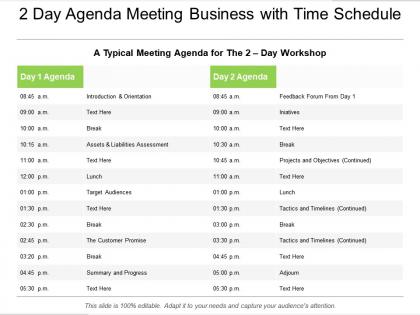
Harness your thoughts with our Meeting Business With Time Schedule. You will get a good grip on them.
People who downloaded this PowerPoint presentation also viewed the following :
Meeting business with time schedule with all 5 slides:
Act out your fantasy with our Meeting Business With Time Schedule. They enable dream fulfillment.


FAQs for Meeting business
Key principles of effective time management include prioritization using frameworks like the Eisenhower Matrix, time blocking for focused work sessions, setting clear boundaries with interruptions, and regularly reviewing goals for alignment. These strategies enable professionals to streamline workflow, reduce decision fatigue, and enhance productivity, with many organizations finding that structured time management approaches ultimately deliver improved work-life balance and competitive advantage.
Visualization tools enhance time management by transforming abstract time data into clear patterns, identifying productivity peaks and bottlenecks, and revealing resource allocation inefficiencies across projects and tasks. Through dashboards and analytics, professionals can track progress in real-time, optimize scheduling decisions, and communicate workload priorities more effectively, ultimately delivering better project outcomes and strategic time utilization.
Technology streamlines team project time management through project management platforms, automated scheduling tools, real-time collaboration software, progress tracking systems, and communication apps. These solutions enhance productivity by eliminating manual coordination, providing instant visibility into project status, and enabling seamless remote collaboration, with many organizations finding that integrated digital workflows reduce project completion times by 30-40%.
Effective task prioritization utilizes tools like the Eisenhower Matrix, categorizing tasks by urgency and importance, ABC ranking systems, and time-blocking methods. These approaches streamline workflow by distinguishing critical from routine activities, enabling professionals to allocate resources strategically, while many organizations find that structured prioritization delivers enhanced productivity and competitive advantage.
Effective time management techniques for creative professionals include time blocking for deep work, the Pomodoro Technique, batch processing similar tasks, energy-based scheduling, and project segmentation. These approaches enhance focus and productivity by protecting creative flow states, minimizing context switching, and aligning demanding work with peak energy periods, ultimately delivering higher quality output and reduced deadline stress.
The Pomodoro Technique enhances focus and productivity by breaking work into structured 25-minute intervals followed by short breaks, reducing mental fatigue and maintaining sustained attention. This method enables professionals to tackle complex projects systematically, minimize distractions, and track progress more effectively, with many organizations finding that employees complete tasks faster while experiencing less burnout and improved work quality.
Effective distraction-minimization strategies include establishing dedicated workspaces, implementing time-blocking techniques, using focus apps, setting communication boundaries, and creating structured daily routines. These approaches enhance productivity by reducing interruptions, improving concentration spans, and streamlining workflow processes, with many organizations finding that employees achieve significantly better task completion rates and operational efficiency.
Time blocking assists busy individuals by creating dedicated, uninterrupted periods for specific tasks, eliminating decision fatigue, and preventing reactive scheduling that derails productivity. This strategic approach enables professionals across industries like consulting, healthcare, and financial services to maintain focus, reduce context switching, and accomplish high-priority work more efficiently, ultimately delivering better time allocation and enhanced professional outcomes.
Common time management pitfalls include overcommitting to tasks, failing to prioritize effectively, constant multitasking, inadequate delegation, and poor boundary setting with interruptions. These challenges can be avoided by implementing strategic planning frameworks, using priority matrices for task evaluation, and establishing clear communication protocols, with many organizations finding that structured time-blocking and regular workflow assessments ultimately deliver enhanced productivity and reduced operational stress.
Presentation templates effectively convey time management strategies by providing structured frameworks, visual hierarchies, and consistent formatting that organize complex information into digestible segments. Through strategic layouts and design elements, presenters can demonstrate prioritization techniques, workflow processes, and scheduling methodologies clearly, while audiences retain key concepts more effectively, ultimately enhancing workplace productivity and strategic time allocation across teams.
Goal setting significantly influences time management by establishing clear priorities, creating structured schedules, and enabling strategic resource allocation based on objective importance and deadlines. Through defined goals, professionals streamline daily activities, minimize time spent on non-essential tasks, and enhance focus on high-impact initiatives, with many organizations finding that goal-oriented employees deliver improved productivity and measurable outcomes.
Leaders foster effective time management culture by establishing clear priorities, implementing structured planning processes, modeling disciplined scheduling behaviors, and providing time management training and tools. Through regular goal-setting sessions and workload assessments, teams develop shared accountability for productivity, with many organizations finding that consistent leadership emphasis on focused work periods and strategic task delegation ultimately delivers enhanced operational efficiency and improved team performance.
Procrastination significantly undermines time management by creating rushed deadlines, increased stress levels, and compromised work quality, ultimately reducing overall productivity and strategic focus. Organizations combat this through structured scheduling systems, breaking complex projects into manageable milestones, and implementing accountability frameworks, with many companies finding that clear priorities and deadline transparency enhance employee efficiency while delivering better outcomes.
Understanding your chronotype helps optimize scheduling by aligning demanding tasks with natural energy peaks, scheduling meetings during high-focus periods, and protecting low-energy times for routine work. This biological awareness enables professionals to enhance productivity significantly, with many executives finding that chronotype-based scheduling reduces decision fatigue, improves meeting effectiveness, and ultimately delivers better work quality while minimizing burnout.
Industries approach time management through sector-specific strategies, with manufacturing utilizing lean principles and just-in-time scheduling, healthcare implementing triage systems and shift rotations, financial services adopting automated trading algorithms, and tech companies using agile methodologies and sprint cycles. These diverse approaches demonstrate that effective time management requires tailoring methods to operational demands, with cross-industry adoption of proven techniques like automation, prioritization frameworks, and resource optimization ultimately delivering enhanced productivity and competitive advantage.
No Reviews