


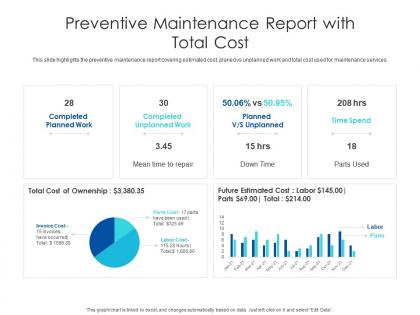
Preventive maintenance report with total cost




Try Before you Buy Download Free Sample Product
 Impress Your
 Audience
 100%
100% Editable
 Save Hours
 of Time


Our Preventive Maintenance Report With Total Cost are topically designed to provide an attractive backdrop to any subject. Use them to look like a presentation pro.
People who downloaded this PowerPoint presentation also viewed the following :
Preventive maintenance report with total cost with all 2 slides:
Use our Preventive Maintenance Report With Total Cost to effectively help you save your valuable time. They are readymade to fit into any presentation structure.
FAQs for Preventive maintenance report
Track these four things: labor costs, parts/materials, equipment downtime, and overhead like tools and training. Honestly, the downtime costs are what'll kill you - when production stops or you're suddenly paying overtime because something crapped out. I'd start simple though. Just track labor and parts for a month first, then add the other stuff. Oh, and use your current reactive maintenance spending as your baseline to compare against. Most companies totally miss the cost of NOT doing preventive work, which is actually massive. The hidden costs are brutal if you're not watching for them.
Honestly, just pick whatever system you already have - your accounting software or get a CMMS if you're feeling fancy. Break down costs by equipment type and whether it's preventive or emergency repairs (labor, parts, contractors, all that). The real nightmare is getting everyone to actually input data consistently - good luck with that one! Monthly reviews help catch trends and figure out which machines are money pits. Track downtime too since that's where the real costs hide. After a few months you'll have solid numbers to wave around when asking for budget increases.
Track maintenance cost per asset and equipment uptime first - that's your foundation. Work order completion rates matter too, plus how often you're doing emergency repairs. If you're still putting out fires constantly, something's broken with your preventive approach. Mean time between failures is solid for spotting problem equipment early. Oh, and don't sleep on inventory turnover and labor efficiency since those hit your budget hard. Monthly tracking works best. You'll spot pretty quickly which gear is worth the investment and which strategies are just money pits.
So from what I've seen, preventive maintenance usually bumps equipment lifespan up by like 20-40%. Reliability can hit 95%+ versus just fixing stuff when it breaks. It's kinda like car maintenance - you wouldn't skip oil changes, right? Same concept here. The tricky part is finding the balance though. Too much maintenance and you're throwing money away. Too little and everything falls apart on you. Honestly, I'd start by tracking your current failure rates and what you're spending on repairs now. That way you'll actually know if it's working later. Makes sense?
Dude, the cost savings are insane. Predictive analytics tell you when stuff actually needs fixing instead of following some random schedule. Those IoT sensors track everything constantly - like, the amount of data is honestly crazy. Emergency repairs are budget killers, but you'll catch problems way earlier. Automated scheduling takes care of all that coordination mess too. Most companies see returns in under a year. My advice? Pick one important piece of equipment first, see how it goes, then expand. Way less overwhelming that way.
Honestly, just track what you're spending on breakdowns versus regular maintenance - that's your starting point. Focus on your most critical equipment first since that's where failures really hurt. I'd run a quarterly check to see what's actually breaking versus what you're preventing. Reliability-centered maintenance is clutch here - it helps you put money where it matters most instead of just maintaining everything equally. Those emergency repairs are brutal and cost like 3-4x more, so you want just enough preventive work to dodge most of them without going overboard.
Honestly, the worst budget killers are doing maintenance way too often and terrible scheduling. Your techs end up replacing stuff that's got years left just because some manual tells them to - it's ridiculous! Then there's inventory nightmares where you're either hoarding expensive parts or scrambling to pay rush fees. Plus if your crew spends half their day driving between jobs instead of actually fixing things, that's pure waste. Oh, and scheduling disasters where people just sit around waiting for parts to show up. Start tracking when things actually break instead of following manufacturer timelines blindly. You'll catch the money drains pretty quick.
Labor's gonna eat up most of your PM budget - like 60-70% usually. Wages, benefits, overtime, contractor fees if you outsource stuff. Travel time between sites gets expensive too (learned that one the hard way). Track your actual hours vs what you planned because things always take longer than expected. Senior techs cost way more than newbies, so break that down separately. Honestly, most people underestimate how much time PMs actually take. Start logging real hours per task now so you can budget better next time. Makes a huge difference once you have solid data.
Look at your maintenance records from the past 2-3 years - they're honestly like a roadmap for what's coming. You'll catch patterns you missed before, like equipment that always breaks down during certain seasons or parts that constantly need swapping out. I swear, once you dig into the data you'll have those "aha" moments about weird trends. Schedule preventive work before stuff actually breaks (way cheaper that way). Plus you can finally show management real numbers instead of just saying "trust me, we need this budget." Focus on finding your biggest cost drivers first - that's where the money is.
Start with calculating your maintenance costs as a percentage of asset replacement value - that's what most industries benchmark against. Industry associations like SMRP publish these numbers, and honestly, maintenance software vendors are goldmines for this data since they work with so many companies. Manufacturing typically runs 3-5%, though ranges go 2-10% depending on your sector. Just make sure you're comparing similar stuff - asset types, age, operating conditions matter way more than people think. Grab your current numbers first, then hit up industry groups or maintenance consultants. They'll have the relevant benchmark data you need.
So basically, the more you stay on top of maintenance, the less your stuff randomly breaks down on you. You catch problems early when you're doing regular check-ups instead of scrambling when everything goes to hell. Think of it like... I don't know, changing your oil regularly vs. waiting for your engine to seize up (been there, not fun). Yeah, preventive maintenance costs money upfront, but unplanned downtime is brutal - we're talking hundreds per hour sometimes. I'd start by figuring out what your current downtime is actually costing you. That'll show you where it's worth investing in prevention.
Look, catching problems early saves you a ton of money compared to dealing with breakdowns. Regular inspections let you spot worn parts or leaks before they totally fail on you. It's like changing your car's oil instead of waiting for the engine to blow up - way cheaper that way. Emergency repairs are the worst because they always happen at inconvenient times, plus you're paying rush fees and overtime rates. Planned maintenance? You can actually budget for that stuff. Honestly, I'd start by looking at what's been breaking lately to figure out a realistic schedule.
Start with your most critical stuff - the equipment that'll cost you big if it fails. Bundle jobs by location or skill type so you're not wasting time driving around. Most places are awful at this honestly. Check your historical data for patterns too. Some machines probably need way more attention while others you're babying unnecessarily. Geographic clustering saves tons of travel time. Oh, and try condition-based monitoring instead of just following the calendar - way smarter to fix things when they actually need it rather than guessing.
Look, training your maintenance crew is huge for cutting costs. Good techs spot problems before they blow up into expensive emergencies. Plus they work faster and don't mess things up as much - which honestly saves you way more than you'd think. Most companies are weirdly cheap about this stuff though. Your team needs to know what red flags to watch for during inspections. Otherwise you're just waiting for breakdowns. The training usually pays for itself in like 6-12 months through less downtime and fewer parts replacements. I'd start with whatever's breaking down most often and train around that first.
Dude, the savings are insane - we're talking 3-5x less money than just waiting for stuff to break. Equipment lasts way longer, no more surprise $10K bills hitting you out of nowhere (seriously the worst). Downtime becomes almost non-existent too. Yeah the upfront costs sting a little, but your total spending drops like crazy over time. You can actually plan your budget instead of praying nothing explodes this month. Honestly, just pick your most critical machines first and build a basic schedule around those - don't overthink it.
-
Innovative and Colorful designs.
-
Innovative and attractive designs.