

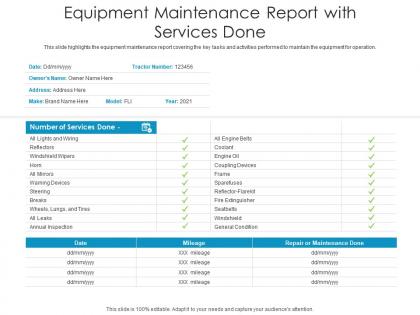
Equipment maintenance report with services done




Try Before you Buy Download Free Sample Product
 Impress Your
 Audience
 100%
100% Editable
 Save Hours
 of Time


Our Equipment Maintenance Report With Services Done are topically designed to provide an attractive backdrop to any subject. Use them to look like a presentation pro.
People who downloaded this PowerPoint presentation also viewed the following :
Equipment maintenance report with services done with all 2 slides:
Use our Equipment Maintenance Report With Services Done to effectively help you save your valuable time. They are readymade to fit into any presentation structure.
FAQs for Equipment maintenance report
Track your uptime/downtime percentages first - that's the big one. MTBF and maintenance costs split between preventive vs reactive work matter too. Work order completion times are crucial, and honestly, safety incidents will come up in every meeting so have those numbers ready. Don't forget parts inventory levels and how your suppliers are performing, because late deliveries will wreck your whole schedule. Oh, and keep it visual - charts work way better than spreadsheets for showing equipment health trends. Start simple with these basics, then build from there once you get the hang of it.
Your maintenance reports are basically crystal balls if you know how to read them. Check for stuff like rising vibration numbers or performance dropping off - that's your early warning system right there. I'd set up alerts when things hit certain levels, then use all that old data to figure out better maintenance timing. Weekly reviews work pretty well for catching problems early. Honestly beats the hell out of scrambling when equipment dies during peak production. You'll go from reactive firefighting to actually preventing the fires in the first place.
For maintenance reports, I'd honestly start with CMMS platforms - Maintenance Connection, UpKeep, and Fiix are solid choices. They handle work orders plus automated reporting, which saves tons of time. Monday.com or Smartsheet work too if you want something simpler. Budget tight? A good Excel template with basic automation can actually do a lot. I mean, I've seen companies run on spreadsheets for years lol. The real trick is finding something your team won't hate using. Try free trials of maybe 2-3 options first - you'll know pretty quick which one feels right for your workflow.
Honestly? Monthly works for most stuff, but you gotta think about what'll actually break your operation if it goes down. Your critical equipment probably needs weekly checks - I learned that the hard way once. Less important things can wait till quarterly. Don't make the mistake some places do and try weekly reports for everything. Your maintenance crew will hate you and probably quit. I'd say start monthly across the board, then dial it up or down based on what keeps breaking. Oh, and whatever frequency you pick, actually stick to it - inconsistent reporting is worse than no reporting.
Always document everything chronologically with specific dates, tech names, and part numbers. Don't just write "fixed AC unit" - note what component failed and why. Root cause analysis saves your ass later when the same problem comes back (trust me on this one). Track preventive maintenance with your repairs so you can spot patterns developing. Include warranty info and vendor contacts too. The format needs to stay consistent so anyone can quickly read the equipment's history. I've watched techs skip the details part and regret it months later.
Dude, visual elements totally transform equipment reports. Charts help you spot performance trends way faster than staring at endless spreadsheet rows. Graphs make it easy to see when machines are declining or compare multiple assets side by side. Your team will love you for it - they can understand equipment health in seconds instead of squinting at numbers forever. Heat maps are probably my favorite for maintenance stuff, but trend lines work great too. Trust me, once you start using visuals, you'll wonder how you ever managed without them. Makes decision-making so much cleaner.
So instead of just writing down what already broke, you're now tracking stuff that might break soon. Your reports start including sensor readings, vibration patterns, temp changes - basically anything that screams "hey, I'm about to fail." Honestly took me forever to get the hang of reading those trend charts, but once you do? You can actually plan maintenance instead of getting those lovely 3am emergency calls. Short version: you're shifting from reactive "oh crap" reports to "we saw this coming" reports. Start small - just add some leading indicators to whatever you're already tracking.
So you basically need to map everything you do back to whatever standards your industry follows. Document it all systematically - yeah, it's boring as hell but saves your butt during audits. I'd start by pulling up your specific regs and building templates around those exact requirements. Your reports should hit all the data points they want: inspection schedules, corrective actions, the whole deal. Standardized checklists work great here - just make sure they reference the actual standard numbers. The goal is showing you're not just fixing stuff randomly, you're following their playbook. Creates that paper trail auditors love to see.
Oh man, the data thing is such a pain - you've got technicians who just forget to log stuff, info scattered everywhere, and those annoying half-empty maintenance forms. Been there! Pick one system as your main hub first, that's key. Then get everyone trained on the same digital forms with automatic reminders (seriously, people need the nudges). Regular audits help catch the gaps before they become disasters. Honestly, the hardest part is just getting everyone to actually stick with it consistently, but once they do it becomes second nature.
Honestly, just tailor your reports to what actually breaks down on each type of equipment. Manufacturing stuff? Track downtime and when parts are wearing out. Healthcare equipment is a pain - you've got to document every calibration and compliance thing because regulators are everywhere. Construction and mining gear needs safety checks since those machines get destroyed daily. Aviation has crazy strict rules, obviously. The trick is figuring out what your bosses actually care about seeing, not just dumping data on them. What kind of equipment are you dealing with? That'll help narrow down what matters most.
Dude, training your maintenance crew is seriously worth it. They'll spot problems faster and actually write stuff down properly instead of just "machine broke lol." Better reports mean techs can fix things quicker. Honestly, I used to get these useless reports like "sounds weird" - now after some training we get actual details that help. Your team won't miss those little warning signs that turn into expensive disasters either. Yeah it costs upfront, but trust me you'll save way more money avoiding those big breakdowns. Plus fewer angry calls at 2am when everything falls apart.
Dude, maintenance reports are seriously underrated for buying decisions. They show you what actually breaks down vs what keeps running. Check your failure rates and repair costs - that data will save you from buying the same junk twice. We literally had a department keep ordering these terrible printers because "they were cheap" but never looked at how much we spent fixing them every month. Track repair frequency per unit in a basic spreadsheet, then actually use it before purchasing. Total ownership cost matters way more than sticker price, trust me on this one.
Hit the big stuff first - total maintenance hours, downtime, repairs done, and anything that's on fire right now. Managers literally have 30 seconds to scan this thing, so make it count. Cost breakdowns and compliance status are must-haves. Flag any equipment that's acting weird or breaking down repeatedly - nobody wants surprises during production. Oh, and definitely call out safety issues up front. I learned this the hard way, but you basically want to answer "how screwed are we?" before anyone panics. Keep it dashboard-style so they can grab what they need fast.
Just throw a comments section on your maintenance reports where people can jot down whatever they notice during shifts. Monthly check-ins work great too - operators always spot the weird stuff first anyway. A shared digital form is probably your best bet, or just use whatever work order system you've got already. Don't make it a pain though, nobody wants more paperwork. Actually, I'd probably start with just one approach and see what happens. The whole point is keeping it simple so people actually use it.
Okay so here's what works - skip the technical stuff and hit them with dollar signs instead. When equipment breaks, don't talk about bearing tolerances (honestly, their eyes will glaze over). Tell them it'll cost $50k in lost production. That gets their attention real quick. Use lots of visuals - before/after photos, simple charts, those red/yellow/green dashboards everyone loves. Put an executive summary right up front, then bury the technical details later for the nerds who actually want to read that stuff. Always end with clear next steps and what it's gonna cost them. Works every time.
-
Excellent template with unique design.
-
Understandable and informative presentation.
-
Designs have enough space to add content.
-
Excellent work done on template design and graphics.