

Bottoms up approach and top down approach ppt example 2015




Try Before you Buy Download Free Sample Product
 Impress Your
 Audience
 100%
100% Editable
 Save Hours
 of Time


A finger is enough for our Bottoms Up Approach And Top Down Approach Ppt Example 2015. Chop and change as you fancy.
People who downloaded this PowerPoint presentation also viewed the following :
Bottoms up approach and top down approach ppt example 2015 with all 5 slides:
Give your format a firm foundation with our Bottoms Up Approach And Top Down Approach Ppt Example 2015. They establish an enduring framework.


FAQs for Bottoms up approach and top down approach
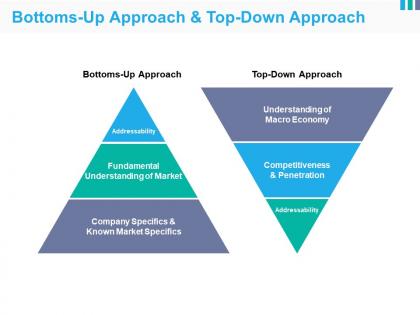
Bottom-up approaches prioritize team input, detailed task estimation, and grassroots planning, while top-down methods emphasize executive vision, strategic alignment, and hierarchical decision-making. These contrasting methodologies deliver different advantages, with bottom-up fostering accuracy and team buy-in, and top-down ensuring strategic consistency and faster implementation, ultimately enabling organizations to choose based on project complexity and organizational culture.
A bottom-up approach enhances collaboration by empowering frontline employees to contribute ideas, encouraging cross-departmental knowledge sharing, and creating inclusive decision-making processes that leverage diverse perspectives. This method fosters innovation through decentralized problem-solving, with many organizations finding that employee-driven initiatives deliver faster solutions, improved operational efficiency, and stronger team engagement than traditional hierarchical structures.
Top-down approaches prove more effective during crisis management, large-scale organizational transformations, regulatory compliance initiatives, and tight deadline projects requiring swift coordination. These scenarios demand centralized decision-making and unified direction, with many financial institutions and healthcare organizations finding that top-down strategies streamline implementation, minimize confusion, and accelerate critical changes while ensuring consistent standards across departments.
Relying solely on top-down decision-making can create significant challenges including limited employee engagement, reduced innovation from frontline insights, slower implementation due to disconnect from operational realities, and decreased organizational agility in rapidly changing markets. While this approach enables clear strategic direction, many organizations find that combining it with bottom-up input delivers better employee buy-in, faster adaptation, and more comprehensive solutions that address real-world operational challenges.
Organizational culture and structure significantly influence approach selection, with hierarchical cultures favoring top-down methods for quick decisions and control, while collaborative cultures embrace bottom-up approaches for innovation and employee engagement. Companies with rigid structures, like traditional banks or manufacturing firms, often use top-down for efficiency, whereas tech startups and creative agencies leverage bottom-up approaches, ultimately finding that cultural alignment with methodology choice enhances implementation success and organizational buy-in.
Communication serves as the foundation for bottom-up success by enabling transparent feedback channels, facilitating cross-departmental collaboration, and ensuring leadership actively listens to frontline insights. Through regular team meetings, digital collaboration platforms, and structured reporting systems, organizations streamline idea flow from employees to management, ultimately delivering faster innovation and enhanced operational efficiency across all levels.
Industries with complex, specialized operations like healthcare, software development, manufacturing, and financial services often benefit more from bottom-up approaches. These sectors require deep frontline expertise and detailed operational knowledge, with many hospitals, tech companies, and banks finding that employee-driven insights deliver more accurate forecasting, realistic project timelines, and enhanced operational efficiency than executive-level estimates alone.
Leaders can balance top-down and bottom-up approaches by establishing clear strategic frameworks while actively soliciting input from frontline employees, creating cross-functional teams that bridge hierarchical levels, and implementing regular feedback loops. This strategic combination enhances decision-making quality, improves employee engagement, and accelerates implementation, with many organizations finding that hybrid approaches deliver superior results and sustained competitive advantage.
Tools facilitating bottom-up strategic planning include employee suggestion platforms, collaborative planning software, cross-functional workshops, departmental feedback systems, and innovation management platforms. These frameworks enable organizations to capture frontline insights, streamline input collection, and integrate operational expertise into strategic decisions, with many companies finding that employee-driven planning delivers more realistic timelines, enhanced buy-in, and ultimately stronger execution across all organizational levels.
Bottom-up methodologies create continuous, informal feedback loops where insights flow naturally from operational levels to leadership, enabling real-time adjustments and collaborative decision-making. Top-down approaches typically establish structured, formal feedback channels with scheduled reviews and reporting hierarchies, while bottom-up systems foster immediate responsiveness and grassroots innovation, ultimately delivering greater organizational agility and employee engagement.
Employee empowerment significantly enhances bottom-up strategy success by fostering innovation, increasing ownership, improving decision-making speed, and boosting engagement across organizational levels. When employees feel trusted to contribute ideas and make decisions, companies experience higher productivity, better problem-solving capabilities, and stronger competitive positioning, with many organizations finding that empowered teams deliver faster implementation and more sustainable results.
Companies transition from top-down to bottom-up methodologies by decentralizing decision-making authority, establishing cross-functional teams with autonomy, investing in employee development programs, and implementing collaborative communication platforms. This strategic shift requires leadership to embrace employee insights, restructure reporting hierarchies, and create feedback mechanisms, with many organizations finding that empowered teams deliver faster innovation and improved operational efficiency.
Success metrics for bottom-up initiatives include employee engagement scores, innovation pipeline development, process improvement frequency, cost reduction achievements, and cross-departmental collaboration rates. These measurements enable organizations to track grassroots momentum while demonstrating tangible business value, with many companies finding that bottom-up metrics ultimately deliver enhanced operational efficiency and competitive advantage.
Managing resistance requires transparent communication about the shift's benefits, involving skeptical stakeholders in planning processes, and providing comprehensive training on new collaborative methodologies. Organizations can minimize pushback by implementing gradual transitions, celebrating early wins from employee-driven initiatives, and demonstrating how bottom-up approaches enhance innovation and operational efficiency, ultimately delivering improved engagement and competitive advantage.
Technology serves as the foundational infrastructure for bottom-up innovations by providing accessible platforms, collaboration tools, data analytics capabilities, and rapid prototyping resources that enable grassroots experimentation. These technological enablers streamline idea development, enhance cross-functional communication, and accelerate testing cycles, with many organizations finding that cloud-based innovation platforms and AI-powered insights ultimately democratize innovation processes across all organizational levels.
-
Very well designed and informative templates.
-
Use of icon with content is very relateable, informative and appealing.