


BPO Call Center Organizational Structure Call Center Agent Performance




Try Before you Buy Download Free Sample Product
 Impress Your
 Audience
 100%
100% Editable
 Save Hours
 of Time


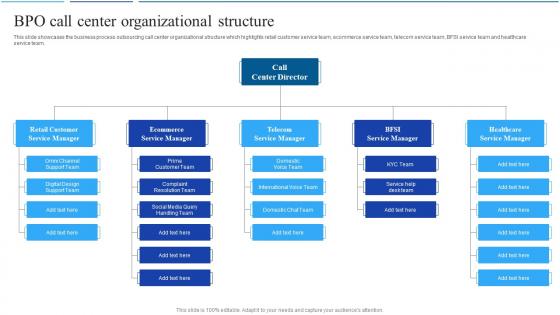
This slide showcases the business process outsourcing call center organizational structure which highlights retail customer service team, ecommerce service team, telecom service team, BFSI service team and healthcare service team.
People who downloaded this PowerPoint presentation also viewed the following :
BPO Call Center Organizational Structure Call Center Agent Performance with all 6 slides:
Use our BPO Call Center Organizational Structure Call Center Agent Performance to effectively help you save your valuable time. They are readymade to fit into any presentation structure.





FAQs for BPO Call Center Organizational Structure Call
You'll want three main layers set up. Operations handles the actual calls - that's your agents and team leads doing the front-line work. Management sits above them monitoring performance and dealing with escalations. Support functions like IT and HR keep things running behind the scenes. Oh, and don't forget workforce management for scheduling - learned that one the hard way at my last place. The tricky part is getting all these layers talking to each other properly. I'd start by looking at your current setup and figuring out where communication breaks down. Trust me, that's usually where most problems start.
Honestly, the whole hierarchy thing is such a balancing act. Too many layers and nothing gets done - I've seen issues take forever just bouncing between people. But strip away too much structure and your team leads are drowning trying to manage like 20 people. Most places do the typical agent → team lead → supervisor → manager setup. What really works is keeping teams around 8-12 agents max, and - this sounds obvious but you'd be surprised - actually telling people who handles what. Can't tell you how many times I've seen agents waste time because they don't know where to escalate stuff.
So there's basically a hierarchy thing going on. Frontline agents take the calls, then team leaders watch over small groups of them. Operations managers run whole departments. Quality analysts are pretty crucial - they listen to calls and help agents improve (honestly those guys make or break the whole operation). Workforce management people handle all the scheduling stuff, which is way more complicated than it sounds. Training coordinators get new people up to speed. If you really want to get it, maybe try shadowing different roles for a bit? That's how I finally understood how everything connects.
So basically, you want all your call center systems talking to each other instead of working in silos. CRM integration is huge - agents can pull up complete customer histories right away. AI routing helps match callers with the best agents too. Real-time dashboards give supervisors actual visibility into what's happening (finally, right?). The productivity boost is pretty nuts once everything's connected. Cloud solutions make scaling your team way easier without rebuilding infrastructure. I'd start by mapping what systems you've got now and figuring out where data's getting stuck.
Start with structured onboarding - have them shadow your best agents for 2-3 days first. Cover your systems, common scenarios, and de-escalation stuff in week one. The technical parts are honestly way easier to teach than soft skills! Then gradually move them to supervised calls. Regular feedback sessions that first month are huge. Oh, and definitely create cheat sheets for common issues they can reference quickly - saves so much time. Track their call quality from day one so you catch problems early. Role-playing scenarios helps too before they jump into real calls.
So you've got to map out your customer segments first, then build your team around that. VIP customers? Give them your best agents. Basic tier folks can start with newer reps or bots. Each segment needs different training and quality metrics too - which honestly becomes a pain to manage but whatever. Your whole staffing model pretty much revolves around this segmentation thing. Don't try cramming everyone into the same process. Set up separate escalation paths for each group. Way better than the one-size-fits-all mess most places do.
Your whole call center structure should basically revolve around whatever metrics matter most. Like if you're tracking first-call resolution, you'd set up different teams - one for simple stuff, another for the complicated headaches. I've worked places that went totally overboard with the numbers game though. Anyway, your main KPIs (call time, satisfaction scores, etc.) will shape everything - how many people you hire, what training looks like, who handles escalations. Pick your top 3-4 metrics first. Then organize around those goals instead of doing it backwards.
QA teams are basically the backbone of your call center - they keep everything consistent. They'll listen to calls, score your agents, and spot training issues before they blow up. Nobody wants pissed off customers escalating every problem, right? But here's the thing - good QA isn't just about catching mistakes. Your team should use it for actual coaching and process improvements. They analyze patterns, give feedback, help agents get better. The trick is making sure it doesn't feel punitive. Otherwise you'll just have stressed agents who hate being monitored.
Honestly, location changes everything about how you set up your BPO. Big cities? Go for larger centralized teams since there's tons of talent and good infrastructure. But rural spots are trickier - you'll probably need smaller teams where everyone's cross-trained because specialized skills are harder to find. Time zones matter way more than people think too. If you're serving global clients, you're looking at 24/7 shifts with overlapping managers, which is totally different from regular business hours. My advice? Check out what talent and infrastructure you can actually get first, then build your structure around that reality.
Honestly, start with daily huddles - they're a game changer for catching stuff before it blows up. Get your agents standardized scripts and clear escalation steps so nobody's winging it. Weekly all-hands meetings help build that communication habit too. You'll need decent tech like Slack or Teams for quick messaging between floors. Oh, and don't skip the feedback stuff - regular coaching keeps everyone actually talking to each other instead of just assuming things are fine. The daily check-ins are probably the biggest win though, way better than finding out about problems after the fact.
Dude, scalability is huge when you're setting up your BPO. Nothing sucks more than your whole system crashing right when business picks up - been there, it's brutal. You'll want cloud platforms that can handle volume spikes and workflows flexible enough for quick team expansion. Your management structure needs to support rapid onboarding too. Honestly, I'd map out where you think you'll be in 2-3 years first, then work backwards. That way your tech stack, office space, even training programs can grow with you instead of constantly playing catch-up.
Honestly, remote work totally changes the game for call centers. No more cramming agents into those depressing cubicle farms - now they're spread out everywhere, different time zones and all. The cool part? You can actually hire good people instead of just whoever lives nearby. But here's the thing - your tech setup needs to be bulletproof or you're screwed. Cloud infrastructure, new ways to track performance, the whole nine yards. Your agents also need to be way more self-motivated since nobody's breathing down their necks. You'll save on office costs though, which is nice.
Honestly, flexibility is your best friend here. Cross-train your agents so they're not trapped in one department - way more efficient. Keep digging into your call data too because patterns will jump out at you. Like suddenly everyone's calling about the same bug or feature (management never sees this stuff coming, I swear). Short bursts work better than long shifts sometimes. Chat support might save your sanity if people want instant answers. Oh, and don't assume what customers want - the data tells the real story. Small tweaks based on actual call volume beats major overhauls every time.
So basically you set up tiers to save money and actually help people faster. Tier 1 handles the easy stuff - password resets, basic questions, whatever. Complex problems go to Tier 2 people who aren't totally clueless. Makes sense, right? You're not wasting your expensive specialists on simple calls, and customers get help quicker since everyone sticks to what they're good at. Honestly, it's way better than having one person try to do everything. Call times drop, people are happier because they're not getting transferred five times. Just make sure you write down clear rules about when to escalate so nobody's guessing.
Chatbots are handling all the basic stuff now, so call centers don't need as many tier-1 agents anymore. The people who stay need way better problem-solving skills though. It's totally flipping the old structure - less about handling tons of calls, more about actually solving complex issues. New jobs are popping up too, like people who train the AI systems and design conversations (which sounds kinda cool actually). My advice? Start training your current team for these higher-level roles now. Better to get ahead of it than scramble later when everything shifts.
-
Thank you for offering such helpful pre-designed templates. They are really beneficial to me in my job.
-
They helped us design the pamphlets for our church’s food drive! The people loved the design, and I’m happy to say it was successful. Thank you, SlideTeam!