


Call Center Business Plan Powerpoint Presentation Slides




Try Before you Buy Download Free Sample Product
 Impress Your
 Audience
 100%
100% Editable
 Save Hours
 of Time


A call center plan is crucial for any organization that handles a significant amount of customer interactions. Check out our professionally designed Call center Business Plan, which provides detailed information on industry statistics and growth drivers. It also showcases the market trends and critical industry challenges, including lucrative opportunities. Moreover, our BPO call center deck focuses on the company overview, which includes vision, mission, goals, start up expenses, essential products offered, and success factors. Additionally, it describes the customer analysis for the call center industry, buyers persona, and market sizing. Further, our Customer service center PowerPoint Presentation covers the competitor analysis, SWOT analysis, PORTERS framework, and detailed marketing plan. Lastly, it exhibits a financial summary section, including a revenue model, economic impact, profit and loss statement, break even analysis, etc. Download this 100 percentage editable presentation and get access to our highly researched and skillfully designed product.
People who downloaded this PowerPoint presentation also viewed the following :
Content of this Powerpoint Presentation
Slide 1: This slide introduces Call Center Business Plan. Commence by stating Your Company Name.
Slide 2: This slide depicts the Agenda of the presentation.
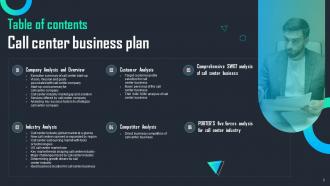
Slide 3: This slide incorporates the Table of contents.
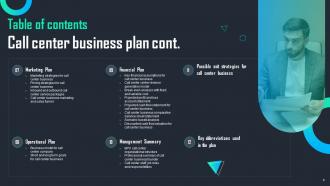
Slide 4: This is yet another slide continuing the Table of contents.
Slide 5: This slide highlights the Title for the Topics to be covered further.
Slide 6: This slide shows the Executive summary of call center start-up.
Slide 7: This slide portrays the Vision, mission, and goals associated with call center company.
Slide 8: This slide depicts the Start-up cost summary for call center company.
Slide 9: This slide covers the Call center industry market gap and solution.
Slide 10: This slide highlights the Services offered by call center company.
Slide 11: This slide focuses on Analyzing key success factors to strategize call center company.
Slide 12: This slide exhibits the Heading for the Contents to be coveerd further.
Slide 13: This slide showcases Call center industry global market at a glance.
Slide 14: This slide talks about the New call centres opened or expanded by region.
Slide 15: This slide reveals Call center outsourcing market with tools or technologies.
Slide 16: This slide illustrates the united states call center market size.
Slide 17: This slide exhibits the Key market trends shaping call center industry.
Slide 18: This slide continues the Key market trends shaping call center industry.
Slide 19: This slide presents the Major challenges faced by call center industry.
Slide 20: This slide continues the Major challenges faced by call center industry.
Slide 21: This slide deals with Determining growth drivers for call center industry.
Slide 22: This slide presents the Ideal business location for call center business.
Slide 23: This slide includes the Title for the Ideas to be covered in the upcoming template.
Slide 24: This slide depicts the Target customer profile selection for call center business.
Slide 25: This slide represents the Buyer personas of the call center business.
Slide 26: This slide talks about the TAM SAM SOM analysis of call center business.
Slide 27: This slide portrays the Heading for the Ideas to be discussed next.
Slide 28: This slide shows Direct business competitors of call center business.
Slide 29: This slide mentions the Title for the Contents to be discussed next.
Slide 30: This slide displays the Comprehensive SWOT analysis of call center business.
Slide 31: This slide contains the Heading for the Topics to be covered in the following template.
Slide 32: The slide highlights porter’s five forces model and its implications in the US call center industry.
Slide 33: This slide depicts the Title for the Topics to be discussed next.
Slide 34: This slide exhibits the Marketing strategies for call center business.
Slide 35: This slide shows the Pricing strategies for call center business.
Slide 36: This slide talks about the Inbound and outbound call center service packages.
Slide 37: This slide reveals the Call center business marketing and sales funnel.
Slide 38: This slide mentions about the Heading for the Contents to be covered further.
Slide 39: This slide presents the Business model for call center company.
Slide 40: This slide highlights the short-term and long-term milestones.
Slide 41: This slide portrays the Title for the Ideas to be discussed next.
Slide 42: This slide states the Key financial assumptions for call center business.
Slide 43: This slide shows the Call center revenue generation model.
Slide 44: This slide represents the Break-even analysis with fixed and variable cost.
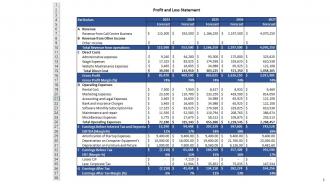
Slide 45: This slide outlines the Projected profit and loss account statement.
Slide 46: This slide continues the Projected profit and loss account statement.
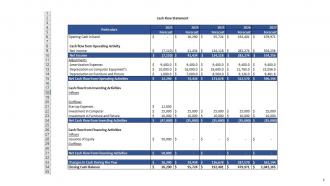
Slide 47: This slide exhibits the Projected cash flow statement for call center business.
Slide 48: This slide continues the Projected cash flow statement for call center business.
Slide 49: The slides covers the snapshot of the company's financial position at a specific time.
Slide 50: This slide continues the Call center business comparative balance sheet statement.
Slide 51: This slide illustrates the Scenario-based analysis with realistic, optimistic, and pessimistic cases.
Slide 52: This slide continues the Scenario analysis with realistic, optimistic, and pessimistic cases.
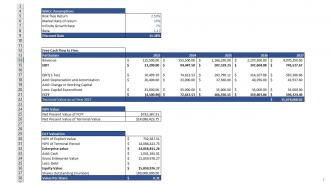
Slide 53: This slide showcases the Discounted cash flow valuation for call center.
Slide 54: This slide indicates the Heading for the Ideas to be covered in the upcoming template.
Slide 55: The slide highlights the organizational hierarchy in the company.
Slide 56: This slide presents the Professional summary of call center business founder.
Slide 57: This slide exhibits the Call center staff job roles and responsibilities.
Slide 58: This slide continues the Call center staff job roles and responsibilities.
Slide 59: This slide presents the Title for the Contents to be discussed further.
Slide 60: This slide represents exit strategies.
Slide 61: This slide displays the Heading for the Topics to be covered next.
Slide 62: This slide reveals the Key abbreviations used in the plan.
Slide 63: This is the Icons Slide containing all the Icons used in the plan.
Slide 64: This slide is used for depicting some Additional infomration.
Slide 65: This is the Magnifying glass for minute details.
Slide 66: This is the Venn diagram slide.
Slide 67: This is Our goal slide for stating your organizational mission, vision, and goals.
Slide 68: This is the Puzzle slide with related imagery.
Slide 69: This is the Idea generation slide for encouraging fresh ideas.
Slide 70: This slide contains the Post it notes for reminders and deadlines.
Slide 71: This is the Thank you slide for acknowledgement.
Call Center Business Plan Powerpoint Presentation Slides with all 76 slides:
Use our Call Center Business Plan Powerpoint Presentation Slides to effectively help you save your valuable time. They are readymade to fit into any presentation structure.






FAQs for Call Center Business Plan
Start with market research - that's what'll shape everything else and help you figure out how much cash you actually need upfront. Cover your target customers, what services you're offering, and how you'll staff it. Tech requirements are huge too. Financial projections matter most if you're pitching investors, obviously. Location stuff gets tricky - good real estate with proper telecom setup is honestly a pain to find, especially for 24/7 ops. Don't skip the boring compliance and quality control pieces either. Oh, and have a growth plan ready.
Honestly, market analysis is like your cheat sheet for knowing where to put all your time and money. Dig into what competitors are charging and what's driving customers crazy - that's your goldmine right there. Found out most companies can't handle after-hours calls? Perfect, there's your angle. This stuff shapes everything - your services, pricing, what tech you buy, who you hire. I'd start by figuring out the biggest gaps nobody's filling yet. Then just build around those holes. Way easier than guessing what people want.
Honestly, call centers are all about nailing your projections upfront. Revenue's pretty straightforward - figure out your call volume, what you're charging per hour/call, and how many clients you'll keep. Your biggest expense will be staff wages, then tech infrastructure and facility costs. Growth happens crazy fast in this space, so factor in scaling expenses early. Oh, and definitely do monthly cash flow projections for year one since you'll drop money on tech before any revenue comes in. I always tell people to build three scenarios - conservative, realistic, optimistic. Helps you see if your assumptions actually hold up.
Honestly, your staffing needs are gonna control pretty much everything. First thing - figure out when calls actually come in so you're not just guessing. Peak times need way more people, obviously. Quiet periods you can run with fewer agents. Don't forget you'll need more supervisors when you have more staff too. Oh and different call types need different skills - technical stuff vs basic questions, you know? It's like putting together a jigsaw puzzle sometimes, but way more stressful. Build your whole structure around those busy/slow patterns instead of just hiring whoever.
Honestly, start with a good CRM to track all your customer stuff - that's like the foundation. Then grab an automatic call distributor so calls actually go to the right people. IVR is clutch for those basic "what are your hours" type calls that eat up time. I'd probably go cloud-based since you won't have to worry about servers crashing or whatever. Workforce management software helps with scheduling (trust me, manual scheduling is hell). Performance analytics are solid for figuring out where things get stuck. CRM and call routing first though - everything else can wait until you see what's actually breaking.
So you need to dig into customer service metrics - they're basically what'll make or break your call center plan. Look up industry benchmarks for stuff like how long calls take, first-call resolution rates, customer satisfaction scores. These numbers tell you how many people to hire and what your training budget should look like. Honestly, most people just throw around fancy tech terms for their pitch decks, but the real money's in knowing which tools actually help. Find metrics from similar companies in your space first. Then build your staffing and revenue projections around what's actually realistic, not some pipe dream.
Honestly, training makes or breaks call centers. I've seen places with awful turnover because they just throw people on the phones after like two days. You need solid onboarding - product knowledge, systems training, plus the soft skills stuff like how to calm down angry customers. The real key though? Don't stop after week one. Monthly refreshers, cross-training, showing people how they can actually move up in the company. It's crazy how much better retention gets when agents see a future there. Start with a 90-day plan for newbies, then keep building on it.
Start by figuring out who your direct competitors are - other call centers in your area doing similar stuff. Their websites usually give away way too much info about pricing and services, honestly. Job boards are goldmines too since you can see what they're paying people and what skills they need. Check out their tech, response times, specializations. Make a basic spreadsheet comparing prices, services, what they're good at, where they're lacking. You'll spot gaps where you can either beat their prices or offer something they don't. It's pretty straightforward once you dig in.
Oh man, compliance is such a headache but you gotta get it right. TCPA stuff is probably your biggest worry - that's all the rules about when you can actually call people and getting proper consent first. Data protection is another beast, especially GDPR if you're dealing with overseas customers. State privacy laws change constantly too, which is super annoying. Industry stuff matters depending what you do - HIPAA for healthcare, PCI DSS for finance. Don't forget basic labor laws either, like break requirements. Honestly, I'd start by figuring out exactly which regulations hit your specific situation first.
Look at what's actually pissing off your potential clients that competitors suck at handling. Long wait times? Language issues? Zero industry knowledge? Build around fixing that specific mess. The call centers killing it right now are super niche - like "24/7 healthcare with actual certified nurses" or bilingual SaaS tech support. Way better than the generic "amazing customer service" BS everyone throws around. Here's the real test though: would someone pick you over the cheapest option because of what you're offering? If not, you're not specific enough yet.
Train your agents on both tech stuff and people skills - frustrated customers need empathy, not robots. Set up customer surveys and actually do something with the responses (most companies just ignore them, which is dumb). Get a solid CRM so agents can see customer history and personalize conversations. Multiple contact options help too. Oh, and measure your current satisfaction scores first so you know where you're starting from. Quick resolution times are huge - nobody wants to wait around forever when they're already annoyed.
Data analytics will transform your call center - seriously, the insights are game-changing. You can track things like average handle time, first-call resolution rates, and peak volumes to nail your staffing. Honestly, the predictive stuff is where it gets interesting though. Historical data helps you route calls smarter and anticipate what customers need before they even ask. You'll catch complaint trends early too, which saves major headaches later. My advice? Start simple with basic dashboards for your KPIs. That alone will show you exactly where you're losing efficiency and money.
Honestly, the turnover rate will crush your soul - I've seen call centers lose half their staff in a month. Tech setup costs are insane upfront, plus you're constantly walking this tightrope between keeping clients happy and actually making money. Compliance stuff is a nightmare too, especially with healthcare or finance data. Getting those first contracts without any track record? Good luck with that. Competition's everywhere. Start small though - pick one thing you're good at first. And dude, save up at least 6 months of expenses before you even think about launching.
So basically inbound means you're waiting for customers to call you - think customer service or tech support lines. You'll be spending money on SEO and ads to get people to find you first. Outbound is the opposite though, you're calling them. Way more aggressive honestly. Your team needs sales training and cold calling scripts since they're reaching out to prospects who didn't ask to be contacted. Marketing budget goes toward buying lead lists and data tools instead of brand stuff. Figure out which direction your calls are going first - that'll determine your whole strategy. Makes a huge difference in how you approach everything.
Track your call volume, response times, customer satisfaction, and revenue monthly - though honestly, I'd check weekly your first year since call centers can be pretty unpredictable. Compare everything to industry benchmarks, not just your original projections. Be brutal about what's actually working vs what isn't. A simple dashboard helps you catch problems early. I learned this the hard way, but don't look at metrics in isolation - they tell a story when you connect them. Quick weekly check-ins beat lengthy monthly deep-dives when you're starting out.
-
I am not the best at presentations but using SlideTeam’s PPT template made it easier for me. Thank you SlideTeam!
-
The design is very attractive, informative, and eye-catching, with bold colors that stand out against all the basic presentation templates.