


BPO Call Center Organizational Structure Outbound Call Center Business Plan BP SS




Try Before you Buy Download Free Sample Product
 Impress Your
 Audience
 100%
100% Editable
 Save Hours
 of Time


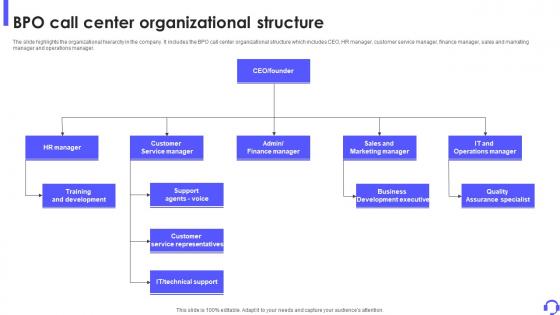
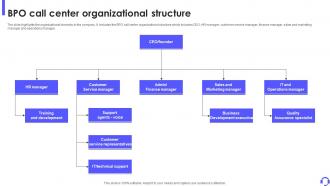
The slide highlights the organizational hierarchy in the company. It includes the BPO call center organizational structure which includes CEO, HR manager, customer service manager, finance manager, sales and marketing manager and operations manager.
People who downloaded this PowerPoint presentation also viewed the following :
BPO Call Center Organizational Structure Outbound Call Center Business Plan BP SS with all 9 slides:
Use our BPO Call Center Organizational Structure Outbound Call Center Business Plan BP SS to effectively help you save your valuable time. They are readymade to fit into any presentation structure.








FAQs for BPO Call Center Organizational Structure Outbound Call Center Business
So basically you've got your agents doing the calls, then team leads watching over small groups of them. Quality assurance people listen in to make sure nobody's screwing up too badly. There's workforce management - they handle all the scheduling headaches and try to predict how busy you'll be. Training teams get people up to speed, IT keeps the phones working, and floor managers run the day-to-day chaos. Above them are ops directors calling the shots. Some places go crazy with specialized teams for different clients though. Honestly, just figure out the chain of command fast so you know who to bug when stuff breaks.
Okay so call centers are basically set up like a pyramid. Agents handle the calls at ground level, then you've got team leads managing maybe 8-12 people each. Above them are supervisors watching over multiple teams, then managers running whole departments. Directors and VPs sit at the top making the big decisions - honestly feels pretty corporate once you get up there. Each level just manages the one below it, nothing too crazy. If you want to climb up, nail your numbers first. That's always step one. Then start helping out your teammates and showing you can actually lead people, not just take calls.
Your team leader is basically your lifeline in BPO. They're monitoring calls, jumping in when customers get crazy, and giving you feedback to improve. Mine manages like 12 of us, so you actually get decent one-on-one time. They handle all the performance tracking stuff too - metrics, scheduling, coaching sessions. Honestly, don't be shy about reaching out during calls if you're stuck. That's literally what they're there for. Way better to ask for help than let a call go sideways, trust me.
Good training honestly makes a huge difference in call centers. Your agents get way more confident and handle calls faster. Customer satisfaction goes up too. I mean, nobody wants to get bounced around between five different people who don't know what they're doing. Well-trained staff actually solve problems instead of creating new ones. Plus they don't quit as much, which saves you money on hiring. My advice? Figure out where your team's struggling most and focus your training there first. Don't try to fix everything at once.
Okay so the main ones you need are First Call Resolution, Average Handle Time, Customer Satisfaction, and Net Promoter Score. FCR is probably the most important - shows if your people are actually fixing stuff or just passing the buck. Handle time tells you about speed, CSAT and NPS are about whether customers are happy. Also track abandonment rate and how well you're using your agents. Oh and don't go crazy with too many metrics like some managers do - that's just overwhelming everyone. Set baselines first, then work with your team on realistic goals from there.
How you handle calls totally changes customer satisfaction - I've seen it firsthand. Active listening and showing empathy can bump your scores up 30-40% compared to just reading scripts. Nobody wants to feel like they're talking to a robot, right? When agents actually personalize their responses and acknowledge frustrations instead of rushing through calls, CSAT ratings shoot up. Oh, and don't dump all the training on your team at once. Pick one technique, master it, then move on. Way less overwhelming that way.
So the big ones are your CRM (Salesforce, Zendesk, whatever) and an ACD system that routes calls around. You'll need workforce management stuff for scheduling too. Call recording and quality monitoring are pretty standard, plus some kind of knowledge base so agents aren't scrambling for answers. Predictive dialers are clutch if you're doing outbound - seriously speeds things up. Most places have real-time dashboards so managers can watch wait times and call volumes. Oh, and if you're just starting out? Get your CRM and ACD sorted first. Everything else can wait honestly.
Honestly, it's all about treating people like actual humans instead of robots. Give feedback regularly - not just once a year when it's too late. Flexible schedules help tons when you can swing it. Celebrate the small wins publicly, and here's the kicker - actually listen when they complain about stuff. I can't tell you how many places just ignore agent feedback then act shocked when everyone quits. Training matters too, plus showing them there's room to grow. Quick feedback beats annual reviews every time. People want to know they're not stuck answering calls forever, you know?
You've gotta watch those call volumes like a hawk and shift people around constantly. Forecasting tools help predict busy periods, but they're wrong half the time so always pad your schedule. Cross-training is huge - when one campaign blows up, you can pull agents from quieter teams. Plan for at least 25-30% shrinkage because people actually need bathroom breaks and sick days (shocking, I know). Give your workforce team live dashboards so they're not flying blind. Oh, and ditch hourly blocks - 15-minute intervals work way better for catching those random spikes.
Dude, outsourcing totally changes your call center setup. You'll have way fewer management layers since the BPO does most of the day-to-day stuff. Your team becomes more about managing the vendor and quality checks instead of running agents directly. Staff-wise, you go from like 100+ agents down to maybe 5-10 people handling contracts and escalations - it's wild how much it shrinks. The scalability is clutch though; ramping up doesn't mean hiring sprees anymore. Oh, and definitely figure out what you want to keep internal first. That part's crucial but kinda obvious, I guess.
Honestly, you need three things sorted: regular check-ins, solid communication, and good feedback systems. Daily huddles work great - keeps everyone aligned and catches problems early. For Slack, separate your channels by purpose. Trust me, I've watched teams implode when urgent stuff gets buried under random updates! Feedback has to go both directions too. Give your agents space to tell you what's actually working (and what sucks). The real trick? Stick with whatever system you pick. People need to know exactly where to look when things get hectic.
You're so right about layout being huge. I've been at places where agents are basically sitting on top of each other - nightmare for concentration when you're hearing three other conversations. Bad chairs and terrible lighting? People call out sick way more. Spacing between desks makes a massive difference. Also putting printers somewhere that doesn't require a hike across the office (learned that one the hard way). Natural light helps too if you can swing it. Honestly, just ask your team what bugs them most about their workspace. You'll probably find some easy fixes that won't break the budget.
Honestly, most call centers just hire a bunch of temps when things get crazy - like during holidays or tax season. They'll extend hours and pull people from other departments too. The smart ones have these "seasonal pools" - basically experienced agents they can call back when needed. Staffing agencies are huge for quick scaling. Oh, and they push all the boring stuff like training to slower months, which actually makes sense. My advice? Build those temp agency relationships way before you're scrambling and desperate for bodies.
Ugh, honestly the turnover thing is brutal - you're constantly training new people just to watch them leave. Plus keeping everyone on the same page is impossible when you've got different shifts and skill levels everywhere. Language barriers make everything messier too. Your agents are burnt out from dealing with angry customers all day for pretty mediocre pay, so can you really blame them? Quality monitoring gets tricky when communication breaks down internally. My advice? Invest in solid training upfront. Regular audits help catch problems early. It's like whack-a-mole but you can get ahead of it.
Hey! So there's tons you can do tech-wise. AI chatbots handle the basic stuff instantly, which is clutch. Predictive analytics helps you figure out when you'll get slammed with calls so you can staff properly. Cloud systems scale way better than old-school setups - way more reliable too. Your agents need CRM integration badly - gives them the customer's whole history right there. IVR routing is solid for getting calls to the right people faster. Real-time call monitoring tools are pretty sweet for catching issues as they happen. Honestly though? Don't try to do everything at once. Pick your worst problems first, then grab 1-2 tools that actually fix those specific issues.
-
The templates are handy and I can personalize them as per my needs. Glad to be your subscriber!
-
SlideTeam provides PPTs on every single topic. Their templates suit my job very well. I am very grateful!