

Call Center Process Improvement Plan




Try Before you Buy Download Free Sample Product
 Impress Your
 Audience
 100%
100% Editable
 Save Hours
 of Time


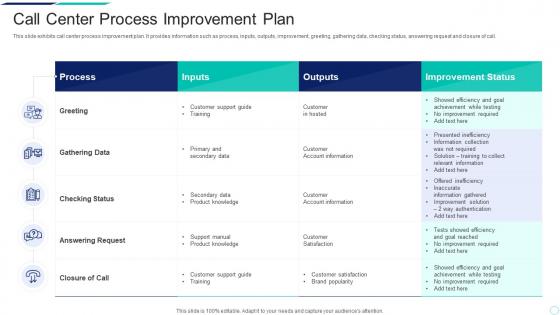
This slide exhibits call center process improvement plan. It provides information such as process, inputs, outputs, improvement, greeting, gathering data, checking status, answering request and closure of call.
People who downloaded this PowerPoint presentation also viewed the following :
Call Center Process Improvement Plan with all 6 slides:
Use our Call Center Process Improvement Plan to effectively help you save your valuable time. They are readymade to fit into any presentation structure.






FAQs for Call Center
Key call center KPIs include average handle time, first call resolution rate, customer satisfaction scores, agent utilization rates, and call abandonment percentages. These metrics streamline operations by identifying bottlenecks, optimizing staffing levels, and enhancing service quality, with many organizations finding that comprehensive KPI tracking ultimately delivers faster customer resolutions and significantly improved operational efficiency.
AI and machine learning enhance call center operations by automating routine inquiries, predicting customer needs, and optimizing agent workflows through intelligent routing and real-time assistance. These technologies streamline operations by reducing wait times, improving first-call resolution rates, and enabling predictive analytics, with many organizations finding that automated systems handle up to 80% of standard queries while freeing agents for complex interactions.
Workforce management optimizes call center performance by accurately forecasting call volumes, scheduling agents efficiently, monitoring real-time performance metrics, and ensuring proper staffing levels across all channels. Through advanced analytics and predictive modeling, call centers reduce wait times, improve agent utilization, and enhance customer satisfaction, while minimizing operational costs and ultimately delivering superior service experiences in an increasingly competitive landscape.
Call routing strategies enhance customer satisfaction by directing calls to the most qualified agents based on skills, language preferences, and customer history, while minimizing wait times through intelligent queue management. These systems enable faster issue resolution, personalized service experiences, and reduced call transfers, with many financial services and retail organizations finding that strategic routing delivers up to 40% improvement in first-call resolution rates.
Essential call center optimization technologies include cloud-based phone systems, automatic call distribution (ACD), interactive voice response (IVR), workforce management software, and real-time analytics platforms. These technologies streamline operations by reducing wait times, improving agent productivity, and enhancing customer experiences, with many organizations finding that strategic integration ultimately delivers significant cost savings and competitive advantage.
Employee training significantly enhances call center performance by improving first-call resolution rates, reducing average handle times, and increasing customer satisfaction scores. Well-trained agents deliver more consistent service experiences, handle complex inquiries more efficiently, and demonstrate better product knowledge, with many organizations finding that comprehensive training programs ultimately reduce employee turnover while boosting both productivity and customer loyalty.
Common call center optimization challenges include high agent turnover, long wait times, inconsistent service quality, outdated technology systems, and ineffective performance metrics. These obstacles can be overcome by implementing comprehensive agent training programs, deploying AI-powered routing systems, establishing clear quality standards, and leveraging real-time analytics, ultimately delivering improved customer satisfaction and operational efficiency.
Data analytics enhances call center decision-making by analyzing call patterns, agent performance metrics, customer satisfaction scores, and operational bottlenecks to identify improvement opportunities. Through predictive analytics and real-time dashboards, managers can optimize staffing levels, reduce wait times, and personalize customer interactions, ultimately delivering faster resolutions and improved service quality while minimizing operational costs.
Effective AHT reduction strategies include comprehensive agent training programs, intelligent call routing systems, streamlined workflows, knowledge management platforms, and real-time coaching tools. These approaches enhance efficiency by empowering agents with faster access to information, automated processes for routine inquiries, and predictive analytics that anticipate customer needs, ultimately delivering shorter resolution times while maintaining personalized service quality.
Omnichannel support streamlines call center operations by integrating customer interactions across phone, email, chat, and social media platforms, providing agents with unified customer histories and context. This strategic approach reduces call resolution times, minimizes customer transfers between channels, and enhances first-call resolution rates, with many organizations finding that seamless channel integration ultimately delivers improved customer satisfaction and operational efficiency.
Remote work transforms call center optimization by enabling global talent access, reducing overhead costs, and requiring enhanced digital monitoring systems. While organizations benefit from increased flexibility and cost savings, they must invest in cloud-based technologies, robust performance tracking, and virtual training programs, with many finding that hybrid models ultimately deliver improved agent satisfaction and operational efficiency.
Customer feedback enhances call center processes by identifying pain points, revealing service gaps, and highlighting agent training needs through systematic analysis of complaints, surveys, and interaction data. Organizations leverage this intelligence to streamline workflows, personalize customer interactions, and optimize resource allocation, with many financial services and retail companies finding that feedback-driven improvements reduce call volumes while significantly enhancing customer satisfaction scores.
Call center quality assurance best practices include regular call monitoring, standardized evaluation criteria, real-time feedback systems, comprehensive agent training programs, and customer satisfaction tracking. These approaches enhance service delivery by identifying improvement opportunities, ensuring consistent performance standards, and reducing response times, with many organizations finding that systematic QA processes ultimately deliver higher customer retention rates and operational efficiency.
Gamification motivates call center agents through leaderboards, achievement badges, point systems, performance competitions, and real-time progress tracking. These elements enhance engagement by recognizing top performers, celebrating milestones, and fostering healthy competition, with many organizations finding that gamified environments reduce turnover while significantly improving customer satisfaction scores and operational efficiency.
Call center technology integration with CRM systems delivers comprehensive customer visibility, streamlined workflows, automated data capture, reduced handling times, and enhanced agent productivity. This strategic combination enables agents to access complete customer histories instantly, personalize interactions effectively, and resolve issues faster, with many organizations finding that integrated systems significantly improve customer satisfaction while reducing operational costs.
-
Qualitative and comprehensive slides.
-
They helped us design the pamphlets for our church’s food drive! The people loved the design, and I’m happy to say it was successful. Thank you, SlideTeam!