


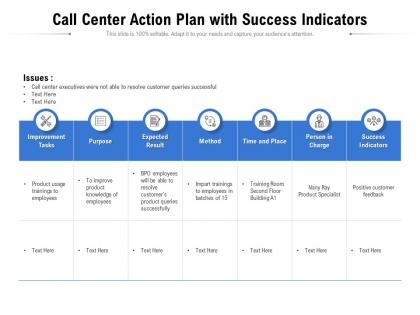
Call center action plan with success indicators




Try Before you Buy Download Free Sample Product
 Impress Your
 Audience
 100%
100% Editable
 Save Hours
 of Time


Our Call Center Action Plan With Success Indicators are topically designed to provide an attractive backdrop to any subject. Use them to look like a presentation pro.
People who downloaded this PowerPoint presentation also viewed the following :
Call center action plan with success indicators with all 2 slides:
Use our Call Center Action Plan With Success Indicators to effectively help you save your valuable time. They are readymade to fit into any presentation structure.
FAQs for Call center action plan
So I'd track four main things: First Call Resolution, Average Handle Time, Customer Satisfaction scores, and Service Level. FCR is honestly where you'll see the biggest impact - happy customers AND lower costs. For AHT, just don't let your team rush through calls to hit targets, that always comes back to bite you. CSAT scores give you the real customer viewpoint. Service Level tells you if people are actually getting through when they call. I'd start by seeing where you're at now with these metrics, then figure out realistic goals from there. Oh, and benchmark against your industry if you can find that data.
Look for metrics that show the whole picture - first call resolution, customer effort scores, stuff like that instead of just call duration. Honestly, the "faster = better" thing is pretty outdated now. Give your agents decent tools and training so they can actually fix problems quickly without rushing people off the phone. Quality scores matter just as much as speed metrics. Don't make your incentives fight each other either - that's always a mess. What you want is agents who feel confident enough to work fast but still do a thorough job.
Honestly, training makes or breaks everything. I've watched call centers tank because they skimp on this stuff - agents get overwhelmed and quit left and right. You'll see your first-call resolution rates jump when people actually know what they're doing. Customer satisfaction goes up too, obviously. Don't just do it once during onboarding though, that's pointless. Keep it rolling with ongoing sessions. Figure out where your team's struggling most right now and hit those problem areas hard. Well-trained agents stick around longer and handle calls way faster.
Honestly, start with something simple like chatbots for basic FAQs - that alone will surprise you. Your agents can focus on the tricky stuff while AI handles repetitive questions and routes calls to the right people. Real-time suggestions during calls are pretty sweet too. The analytics you get afterward are actually useful, not just random data dumps. Plus predictive staffing tools help you avoid those nightmare understaffed days (we've all been there). Customer satisfaction usually jumps once you get it running smoothly. Just don't try to automate everything at once - that's where people mess up.
Train your agents better and get them solid knowledge base tools - that's gonna give you way more first-call resolutions. Smart call routing helps too, so customers hit the right person immediately instead of getting bounced around (hate when that happens to me). Templates for common stuff are clutch, just don't let your team sound like robots reading scripts. Pull up customer data before calls start so agents aren't going in blind. Set clear escalation rules - when to transfer vs when to keep digging. Oh, and track quality scores with your handle time metrics. You don't want to just rush people off calls.
Customer feedback is basically free consulting from the people who actually use your service. Set up surveys after calls, follow-up emails, maybe even check social media comments. Patterns will emerge - stuff like long wait times or agents who don't know their stuff. Customers are surprisingly direct about what's broken if you actually listen. Map those complaints to your KPIs and training gaps. Here's the thing though - you've got to close the loop. When you fix something they complained about, tell them! It's such a simple step but most companies forget to do it.
So there's a bunch of ways to slice this stuff up. Time periods are obvious - weekly/monthly trends show seasonal patterns or if you're actually improving. Then break it down by agent groups, call types, customer segments. Honestly, the agent-level data is where it gets interesting - you'll see who needs help vs your superstars. Compare before/after training results, peak hours vs slow times, customer satisfaction against handle times. I'd start with whatever metric is tanking the worst and just keep segmenting it different ways until something clicks. Sometimes you gotta dig past those high-level dashboards to find the real story.
Honestly, start with a survey to see what's actually driving people away - you might be surprised. Money's obviously part of it, but I've seen places throw cash at the problem while ignoring the real issues. Career growth is massive - nobody wants to feel trapped in the same role forever, so create some kind of advancement track or at least skills training. The micromanaging thing will kill morale fast. Give them more flexibility with schedules if you can swing it. Oh, and definitely upgrade your systems if they're outdated. Nothing makes people quit faster than fighting with terrible software all day.
Honestly, multi-channel stuff will boost your customer satisfaction big time - people love reaching out however they want. Your response times might tank at first though (fair warning, the learning curve is real). Once your team gets the hang of it, you'll crush way more volume and cut down on those annoying repeat contacts. Here's the thing - don't just focus on old-school call metrics anymore. You've gotta track performance the same way across chat, email, social, all of it. It's messier to manage but totally worth it.
Honestly, good teamwork makes such a huge difference in call centers. Your agents can share knowledge way faster, and customers don't get bounced around between three different people (which is the worst). Resolution times drop when everyone's actually talking to each other. I'd start with something simple - maybe a team chat where agents can quickly ask questions or escalate stuff smoothly to back-office teams. Those daily huddles help too since agents learn from each other's wins and failures. You'll see your handle times improve pretty quick, and customer satisfaction scores usually follow. It's not rocket science, just basic communication really.
Make your team's progress super visible - dashboards work great for this. Pick one metric to start with (trust me, don't try to track everything at once). Regular check-ins help way more than just meeting when someone's failing. I'd set up peer recognition too since agents actually listen to each other sometimes more than management. The tricky part? You have to be consistent with both rewards AND consequences. Maybe create some friendly competition around your chosen metric. Build those habits first, then expand later. Oh, and make sure everyone can actually see how they're doing compared to goals.
Look, workforce management is basically matching your staffing to actual demand - right people, right skills, right times. You'll avoid the nightmare of understaffed shifts where customers wait forever (and get pissed), plus you won't blow your budget on overstaffing. Honestly, it's a lifesaver for agent morale too since nobody likes constant chaos. Track your call volume patterns first - that's your foundation. Historical data shows you peak periods, then you adjust in real-time when things get weird. Short sentences work. But the real magic happens when you stop scrambling and start predicting demand properly.
Look at your historical data first - see what your best people actually hit vs. your average performers, then aim somewhere realistic in between. Don't just pull numbers from nowhere (seriously, why do so many companies do this?). Keep it to 3-4 key metrics max or people get stressed trying to nail everything. Factor in stuff like how complex calls get and seasonal changes too. You want it challenging but not soul-crushing. Oh, and tiered goals work great - gives people mini wins on their way to the big target. That middle ground between "too easy" and "impossible" is where the magic happens.
Honestly, start with the basics - call resolution rates, customer satisfaction, handle times. That stuff's important but don't stop there. Employee turnover is huge too because miserable agents = miserable customers, you know? I'd set up monthly check-ins comparing your numbers to before you made changes. Focus on 3-6 month trends instead of daily ups and downs - that daily stuff will drive you crazy. Oh and make a visual dashboard if you can. Charts make it so much easier to spot when something's going sideways.
Honestly, I'd focus on just 2-3 things instead of going crazy with everything at once. Video chat is absolutely massive right now - people really want that face-to-face feel. AI chatbots handle the basic stuff instantly, which frees up your team for harder problems. Predictive analytics sounds fancy but it's basically just spotting what customers need before they ask. Oh, and gamification for your agents works surprisingly well - like leaderboards and badges. Makes the job less soul-crushing, you know? Real-time sentiment analysis is clutch too since it flags when someone's about to lose it. Just pick whatever fixes your worst headaches first.
-
Excellent design and quick turnaround.