


Brand Activation And Rollout Campaign Plan




Try Before you Buy Download Free Sample Product
 Impress Your
 Audience
 100%
100% Editable
 Save Hours
 of Time


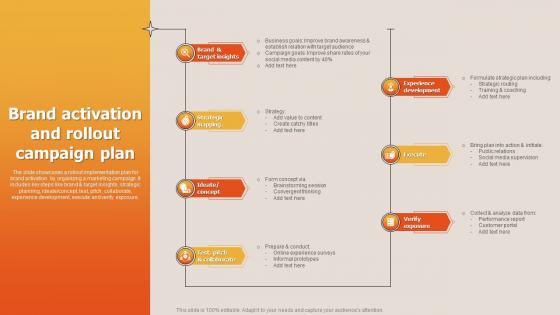
The slide showcases a rollout implementation plan for brand activation by organizing a marketing campaign. It includes key steps like brand and target insights, strategic planning, ideate concept, test, pitch, collaborate, experience development, execute and verify exposure.
People who downloaded this PowerPoint presentation also viewed the following :
Brand Activation And Rollout Campaign Plan with all 6 slides:
Use our Brand Activation And Rollout Campaign Plan to effectively help you save your valuable time. They are readymade to fit into any presentation structure.





FAQs for Brand Activation And
So first off, you gotta nail down exactly what you're trying to achieve and who you're targeting. Create something people will actually want to share - not just boring samples or whatever. Honestly, location and timing can make or break the whole thing. Budget flexibility is clutch because you'll probably need to adjust on the fly. Make sure you can measure results so you're not just throwing money into the void. Oh, and keep your brand messaging consistent across everything - that part's huge. I'd start by figuring out what success looks like, then build backwards from there.
So brand activation is basically getting people to actually *do* stuff with your brand instead of just seeing ads about it. Regular marketing is like throwing messages at people - billboards, social posts, whatever. Activation pulls them in through events, pop-ups, free samples, things where they participate. Way more engaging than just staring at another banner ad, right? It's about creating experiences that make people try your product or connect with it emotionally. Instead of being passive viewers, they become participants. Honestly works way better for getting people to actually change their behavior rather than just remembering your name.
Look, people don't remember boring ads - they remember stories that hit them in the feels. Nike doesn't sell shoes, they sell the whole "just do it" journey. Your brand needs that same emotional hook. Stories connect all your marketing stuff together, whether it's events or social media campaigns or whatever. Find what human truth your brand actually stands for (not some corporate BS), then build everything around that narrative. Honestly, most brands skip this step and wonder why their campaigns fall flat. Features and benefits are fine, but stories make people care.
Honestly, social media is where brand activations really take off. You get way more reach than just whoever shows up in person. Build hype beforehand, then live-stream for people who can't make it. The best part? When attendees start posting their own stuff with your hashtag, it doesn't feel like advertising anymore - just real people having fun. I'd definitely nail down your hashtag strategy first though. Oh, and have someone actually responding to posts during the event, not just broadcasting. You'll get solid data on what's working too, which is pretty clutch for next time.
Honestly, you gotta track both the fun stuff and the boring business stuff. Foot traffic, social engagement, how many people actually showed up - that's your immediate "did this work" check. But also measure if it moved the needle on sales or leads afterward. I always survey people about brand perception changes too, though response rates can be brutal. The trick is picking your 3-4 key metrics before you launch, not after when you're panicking about results. Don't get caught up tracking everything - just focus on what actually matters for your specific goals.
Oh totally! Digital activations are honestly pretty awesome now. Figure out where your people actually hang out online first - that's key. Then build something interactive there. AR filters work great. Virtual events too, though some can feel kinda meh if done wrong. Social challenges, gamified apps, virtual showrooms - tons of options. The trick is making it feel real to your brand, not just some random gimmick. People need a reason to actually participate and share it. Interactive beats passive scrolling every time.
Oh man, you've gotta look at Red Bull's space jump thing - Stratos I think? Absolute genius turning a stunt into this massive "we're extreme" moment. Nike went totally bold with that Kaepernick "Just Do It" campaign too, super controversial but damn effective. Then there's Coca-Cola putting people's names on bottles which was kinda simple but worked amazingly for social stuff. IKEA did these cool apartment setups in subway stations which was pretty clever. Honestly though, the pattern I see is that none of these felt like ads - they created actual experiences people wanted to be part of and share.
Honestly? Start with one master document that has all your messaging, tone, visuals - basically everything. Share it with every team working on the campaign. I learned this the hard way when our social posts were saying totally different things than what we had at events (awkward). Pick someone to be the messaging police - they review stuff before it goes out and catch weird inconsistencies. Also do regular check-ins with all your teams. Sounds boring but it actually saves your butt. Trust me, nothing's worse than a campaign where nobody's on the same page!
Okay so the biggest shifts I'm seeing: experiential stuff is getting crazy immersive with VR/AR - like people genuinely want to *feel* your brand now instead of just watching ads. AI personalization is huge too, brands can actually target specific groups instead of that old spray-and-pray approach. Oh and sustainability isn't optional anymore - Gen Z will literally stalk your entire supply chain before buying anything lol. Data analytics are helping create activations that actually hit different with audiences. Honestly, the whole game is about memorable experiences that align with people's values while using tech to connect deeper. Make sense?
So experiential marketing is kind of like a tool within brand activation - similar but not the same thing. Brand activation is the bigger picture where you're trying to get people actually engaged with your brand. Experiential is how you do it - pop-ups, interactive demos, those cool branded events everyone posts about. Here's the thing though: don't just make something flashy because it looks good on Instagram. Your experiential stuff needs to actually support whatever bigger goal you're going for. Like, what specific behavior are you trying to change? Figure that out first, then work backwards to create experiences that'll actually move the needle.
You definitely need to segment your audience - it's a game changer. A college kid isn't gonna respond to the same stuff as some middle-aged exec, you know? Generic messaging is basically throwing money away at this point. When you actually understand your different groups, you can speak their language and hit what they care about. Way better engagement that way. I'd probably start with just 2-3 main segments so you don't overwhelm yourself. Each one gets its own strategy and messaging. People notice when a brand actually gets them vs just blasting everyone with the same boring content.
Partner up with brands that hit the same audience but aren't competing with you directly. Co-sponsored events work great, or you could do cross-promotional stuff where you're both tapping into each other's customers. I saw this fitness brand team up with a meal prep company once - made total sense, you know? The trick is finding companies your customers already dig so it doesn't feel weird or forced. Map out what brands your people are into, then hit them up with actual ideas instead of some generic "let's partner" pitch. Way better response rate that way.
Budget's always the biggest pain - and proving ROI? Good luck with that one. You'll waste so much time if you don't figure out your exact audience first, otherwise everything gets watered down trying to hit everyone. Permits and venue stuff will make you want to cry, trust me. Weather backup plans, staffing drama, the whole thing. Oh and somehow you need content that looks good on social BUT actually moves the needle business-wise. Honestly, people underestimate how much lead time this stuff needs. Double your budget expectations and write down what success looks like before you start, or you'll be scrambling to explain why you spent all that money.
Honestly, just make customer feedback the main event instead of hiding it. Real quotes work way better than generic testimonials - put them front and center. Interactive stuff is where it gets fun though. I've seen those "feedback walls" where people add comments and respond to each other live, and people get weirdly obsessed with watching it unfold. You could do voting on new features at events, or even turn it into a game where customers guess which feedback sparked certain product changes. The whole point is making it feel like an actual conversation happening, not some boring survey nobody wants to fill out. Start with just one thing and see what happens.
Dude, AR and VR are game-changers for brand stuff because they actually get people to stop and play around instead of just walking by. Like IKEA letting you see how furniture looks in your actual room, or Nike's virtual shoe try-ons - that's brilliant marketing. You can create these wild experiences that feel almost magical, plus you get tons of data on how people interact with everything. I mean, who doesn't want to explore some impossible virtual world at a trade show? Just don't go overboard with flashy tech for no reason. Figure out what problem you're solving first, then build the cool experience around that.
-
A fantastic collection of templates. I'll likely use this as my go-to resource for future templates and support.
-
“Excellent service from the customer support team when I wanted a slide that was a bit different from those on their standard menu. Super helpful.”