

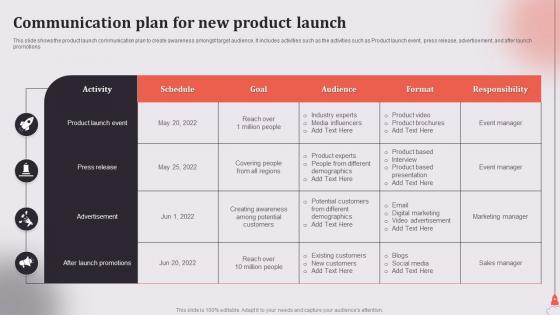
Communication Plan For New Product Launch




Try Before you Buy Download Free Sample Product
 Impress Your
 Audience
 100%
100% Editable
 Save Hours
 of Time


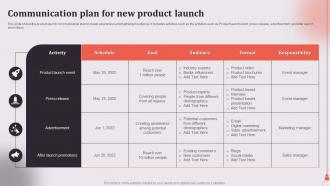
This slide shows the product launch communication plan to create awareness amongst target audience. It includes activities such as the activities such as Product launch event, press release, advertisement, and after launch promotions.
People who downloaded this PowerPoint presentation also viewed the following :
Communication Plan For New Product Launch with all 6 slides:
Use our Communication Plan For New Product Launch to effectively help you save your valuable time. They are readymade to fit into any presentation structure.





FAQs for Communication Plan For
You'll need clear objectives and target audiences first - honestly, figuring out who you're talking to makes everything else click into place. Then nail down your key messages, pick your communication channels, and set a timeline. Success metrics are crucial too (how else will you know if it worked?). Think party planning - why are you doing this, who's coming, what's the message, how do you reach them, when's it happening. Oh, and assign owners for each piece! Nothing disappears faster than tasks nobody owns. Start with mapping your stakeholders though - that's your foundation right there.
Honestly, communication plans are lifesavers because they stop those awkward "wait, who's doing what?" moments. Everyone knows their role and when stuff's due, so fewer things fall through the cracks. Regular check-ins help you catch problems early instead of scrambling later. Your stakeholders stay in the loop without constantly bugging you - which is huge. The trick is being super specific about it. Don't just write "send updates weekly." Actually spell out what info goes where and how. Trust me, the extra planning upfront saves so much chaos down the road.
Honestly, audience analysis is everything. Skip it and you're basically shouting into the wind. Figure out who you're talking to first - what they actually care about, how they like to communicate, what gets them to act. I've watched so many campaigns crash and burn because teams thought they could wing this part (spoiler: they couldn't). Once you nail down their pain points and preferred channels, you can craft messages that actually hit. Build detailed personas before you even think about writing your plan. Trust me on this one.
Quarterly reviews are usually solid, but honestly it depends on your company's chaos level. Moving fast or rolling out new stuff? Check monthly instead. Don't wait for your scheduled review if something big hits - new leadership, project changes, weird audience reactions. Update immediately. I've watched so many teams cling to their annual review schedule while their plan totally stops working. Just set a calendar reminder and keep asking "does our audience still care about this?" That question alone will save you from looking completely out of touch.
Honestly, just start with whatever your team's already using - no need to overcomplicate things. Asana or Trello are solid for mapping out your communication timeline and who's doing what. I personally love how visual they make everything (maybe I'm weird but charts just click for me). Google Workspace is clutch for real-time collaboration on messaging stuff. Slack keeps everyone in the loop without constant email chains. Monday.com's another good option if you want something fancier. The key is picking tools that actually fit how your team works, not just what sounds impressive.
Honestly, cultural differences can totally torpedo your communication plan if you're not paying attention. Some cultures want everything super direct and formal, while others are all about reading between the lines and building relationships first. I've seen people accidentally offend entire teams just by using the wrong tone or timing - it's wild how much this stuff matters. Like, Germans might want detailed written updates while other cultures prefer face-to-face conversations. Do your homework on local norms first. Your best bet? Ask teammates from those regions what actually works there instead of guessing.
Pick 3-4 metrics that actually matter for your goals instead of tracking everything under the sun. Look at engagement first - open rates, clicks, meeting turnout, social shares. That tells you if people care. Then measure outcomes like survey results and whether folks actually did what you asked. Oh, and don't be like me and forget about qualitative feedback until the end! Those comments are usually the most honest stuff you'll get. Start tracking from day one though - you need that baseline data or you're just guessing later.
Okay so honestly, charts and timelines are game-changers for communication plans. People's eyes just glaze over when they see walls of text - I swear nobody reads those anymore. Try color-coding different teams or deadlines, maybe throw in some flowcharts for approval processes. Makes it so much easier to see who's doing what and when. Infographics work great for showing key numbers too. I'd start with whatever section confuses people most and just... make it visual instead. Oh, and keep your visual hierarchy clean so people don't get lost jumping around.
Honestly, the worst thing you can do is try talking to everyone at once - your message just gets watered down to nothing. Figure out your goals first or you're basically wandering around blind. Most people also forget that communication should go both ways... otherwise it's just corporate BS nobody cares about. Oh, and timing matters way more than people think - don't spam everyone but don't disappear either. My take? Map out who actually needs what info and when, then work backwards from there. Way better than just sending random updates and hoping something sticks.
Honestly, just bake feedback into your whole process instead of treating it like an afterthought. Figure out who your main stakeholders are first, then match the feedback method to each person - surveys work for some folks, but others (like me) way prefer just talking it out. Set up checkpoints throughout different phases, not just at the very end. Here's the thing though - you've gotta actually show people how you used their input, otherwise they'll stop caring. Oh, and keep some kind of simple system to track everything so you can spot trends. Makes a huge difference when you can actually prove you're listening and adjusting based on what people tell you.
Start with a messaging framework - your core talking points and tone that everyone references. I made this mistake once where our product launch was a total mess because nobody was on the same page! Get one person or small team to be the final filter before stuff goes live. Regular check-ins with channel owners help too. Shared templates work great for big announcements. Document your must-haves and non-negotiables first, then give that to your team as their guide. Honestly, approval workflows saved us so many headaches once we actually started using them consistently.
Honestly, having a communication plan is like having a fire extinguisher - you pray you won't need it, but you'll be so grateful when you do. Map out your key people and draft your messages now, while your brain actually works. When crisis hits, you can just execute instead of panicking about what to say. Plus everyone knows their role so you're not all bumping into each other sending mixed messages. I learned this the hard way at my last job - we had zero plan and it was a disaster. Practice it though, otherwise it's just paperwork collecting dust.
So basically, it's all about who you're talking to. With internal comms, you can be totally honest about problems, share messy timelines, all that behind-the-scenes drama. External stuff? Way different game. You're dealing with customers and media, so everything has to be polished and on-message. I actually watched someone torpedo a product launch once by accidentally sending the internal version to press - yikes! Internal teams can handle the real talk about delays or budget issues. External audiences just want to know what's in it for them. Just double-check who's getting what before you hit send.
Okay so here's the thing about storytelling - our brains are literally wired to remember stories way better than random facts or bullet points. When you're putting together your communication plan, skip the boring announcements and find real customer success stories instead. Or maybe share some behind-the-scenes stuff, even the messy failure-to-success journeys that actually happened. People connect with that emotional stuff. It makes abstract concepts suddenly click for them. Honestly, I've seen dry corporate messages get completely ignored while a simple story about someone's experience goes viral. Find one good story that proves your main point. Then build everything around that narrative - it's so much more compelling than just stating facts.
Starbucks nailed it during that 2018 racial bias mess - they jumped on it immediately with honest communication and actually closed stores for training. Apple's launch events are insane too (I mean, people literally camp out for those keynotes). Their timing and messaging across platforms is perfect. Oh, and Airbnb's "Belong Anywhere" thing really shows how powerful storytelling gets when it matches what your brand actually stands for. The common thread? They all had clear goals, stayed consistent, and knew exactly who they were talking to. That's honestly half the battle right there.
-
Delighted to see unique and eye-catching PowerPoint designs that are so easy to customize.
-
Their products can save your time, effort and money. What else you need. All in one package for presentation needs!