


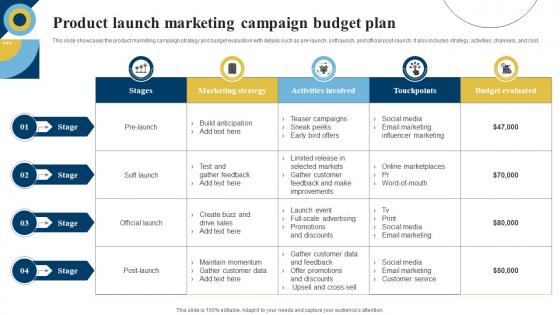
Product Launch Marketing Campaign Budget Plan




Try Before you Buy Download Free Sample Product
 Impress Your
 Audience
 100%
100% Editable
 Save Hours
 of Time


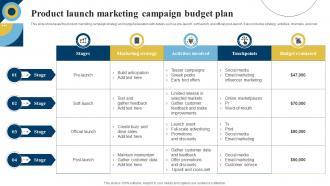
This slide showcases the product marketing campaign strategy and budget evaluation with details such as pre launch, soft launch, and official post launch. It also includes strategy, activities, channels, and cost.
People who downloaded this PowerPoint presentation also viewed the following :
Product Launch Marketing Campaign Budget Plan with all 6 slides:
Use our Product Launch Marketing Campaign Budget Plan to effectively help you save your valuable time. They are readymade to fit into any presentation structure.





FAQs for Product Launch Marketing
Okay so budget-wise, you'll need to think about marketing first - that's usually your biggest expense with ads, content, maybe some influencer stuff. Then there's your final product tweaks, packaging, inventory costs. Don't sleep on staff time either, that adds up fast when you've got multiple teams working on this. PR and events are another bucket to consider. Honestly, I'd also factor in 10-15% extra for random stuff that always comes up - launches are chaotic and something unexpected always happens. Oh, and if your website needs updates, budget for that too. Start planning this out like 3 months ahead of time so you're not scrambling.
Honestly, I'd map out your channels first - digital ads, PR, content, events, whatever makes sense. Research typical costs for your industry because they vary like crazy. For B2B stuff, I usually see 15-25% of projected first-year revenue work well. B2C might need more if you're in a crowded space. Here's what always gets me though - people forget about design work, landing pages, all that behind-the-scenes stuff. It adds up stupid fast. I always build in a 20% buffer because something will definitely go over. Start with your absolute must-haves first, then see what's left for the fun extras.
Honestly, market research is what keeps you from totally screwing up your budget. Figure out where your people actually spend time online first - maybe they're on TikTok instead of LinkedIn, you know? Research shows you what messaging works and what competitors are dropping on ads. Plus you get realistic numbers for conversion rates and acquisition costs. I learned this the hard way after wasting money on the wrong platforms lol. Build your budget after you do the research, not before. Way smarter approach.
Honestly, just follow your audience - if they're glued to their phones all day, throw like 70% of your budget at digital stuff. The tracking alone makes it worth it, plus you can actually see what's working and shift things around fast. Traditional media isn't dead though, especially for hitting older people who still watch TV and read newspapers. I'd probably go 70/30 digital to start, maybe 60/40 if you're being conservative. But here's the thing - don't blow your whole budget on month one contracts. Keep some flexibility so you can double down on whatever's actually moving the needle.
Dude, you NEED a contingency fund - like 10-20% of whatever you're spending. Trust me on this one. Launches always get messy and expensive in ways you can't predict. Maybe your social ads aren't converting so you need to throw more money at them, or some competitor drops a bomb right when you're going live. I got totally screwed on my first launch because we ran out of money by week two - had to go hat in hand to finance and it was embarrassing. Build it right into your budget from day one so you're not scrambling later.
Track your spend against what it actually brings in - that's the only way to know if you're throwing money away. Marketing's easy: cost per customer and conversion rates. PR is trickier but look at media coverage and brand awareness bumps. Development costs are honestly just the price of doing business, so don't stress too much about ROI there. Customer support expenses should match up with satisfaction scores and how many people stick around. Set up tracking from the start (trust me on this), then dump everything into a simple spreadsheet. Review monthly and move money toward whatever's actually working.
Regulatory stuff will hit you hard - compliance costs, patent fees, legal reviews. Customer support's tricky too since you never know how many people will actually show up at launch. Packaging rules are different everywhere if you're going international (trust me on this one). Returns and refunds add up quick, especially with early access programs. Honestly, crisis PR is worth budgeting for because launches get messy. I'd throw an extra 15-20% on whatever you think your "final" number is. There's always something you missed.
Oh man, cross-functional budgeting is such a puzzle. Marketing wants their huge ad campaigns, engineering's always asking for more QA resources, and sales needs training materials and demo stuff. Everyone's got different priorities pulling in different directions. I learned the hard way that you've got to get all these people together super early in the process - like way earlier than feels natural. Otherwise you end up with these awkward conversations where someone's already committed to spending that another team desperately needs. The trick is helping everyone see the bigger picture so they can actually negotiate trade-offs that make sense.
Honestly? Just do the 80/20 thing - throw most of your money at whatever actually reaches your people. Don't get caught up in flashy campaigns that look cool but don't convert (learned that one the hard way). Start simple: organic social, email, maybe one paid channel you can really dial in. Keep 20% as your "oh shit" fund because trust me, you'll need it. Something always breaks or you'll find some random opportunity you want to jump on. Track everything like crazy so you know what's working. Way too many founders waste money on brand stuff when they should be focused on just getting users first.
Oh man, seasonal timing is huge for launch budgets. Holiday seasons? You're looking at paying 2-3x more for ads because literally everyone's fighting for eyeballs. Summer's tricky too - people are checked out on vacation mode. Don't forget about supply chain stuff getting wonky during certain months, plus shipping delays. And honestly, some seasons your audience just doesn't have money to spend. I'd map out your market's seasonal patterns first, then build those cost swings right into your budget from the start. Way better than getting blindsided later.
Honestly, just throw everything into a shared Google Sheet or grab something like Asana. Have people log expenses weekly - daily is way too much and you know nobody's gonna keep that up. Break it down by categories like marketing, events, swag, whatever makes sense for your stuff. The trick is making it dead simple to add things, otherwise people will "forget" (aka be lazy). Oh, and definitely set alerts at like 75% of each budget so you don't get blindsided later. Pick one person to own the whole thing and bug people when they're slacking.
Look at what your testing actually shows you and move money around based on that. Confused users mean you need better messaging. Love the product but can't find it? Put more into awareness stuff. Most people totally ignore this part and wonder why their launch tanks. Don't just dump cash into what's failing though - sometimes you gotta kill entire tactics and focus on what's actually working. Oh, and set aside like 10-15% of your budget upfront for these pivots. Trust me on that one.
So for launch budgets, I'd probably start with whatever your finance people are already using - way easier than fighting them on new software. Monday.com and Asana are solid if you want project tracking built in. PlanGuru's good too if you need serious number-crunching power, though it might be overkill depending on your situation. Honestly? A decent Google Sheets setup works fine when you're starting out - I've seen companies nail launches with just spreadsheets. Main thing is making sure everyone can update costs as they happen and you can see how you're tracking against what you planned to spend.
Honestly, partnerships are a pain because they take forever to negotiate - start way earlier than you think. I'd put aside maybe 10-15% of your marketing budget for chasing these opportunities. But here's the thing: also create a revenue line for potential sponsorship money, just don't count on it until you've got signed contracts. You can get creative with the deals too - product placement, co-branded stuff, event partnerships. Sometimes they'll give you cash, sometimes just marketing reach. Either works if their audience actually matches yours. Budget conservatively on the expense side though. Trust me on that one.
Honestly, most people mess up by spending everything on the actual launch day and forget about all the prep work. Like you need weeks beforehand for PR stuff, getting influencers lined up, creating content - that's where the real work happens. Then everyone focuses on the big flashy event and totally spaces on boring things like training your customer service team (learned that one the hard way). The worst part? Week 2-4 after launch when you need to keep momentum going but you're broke. I'd say budget for the whole 90 days, not just announcement day. Oh and add 20% extra because something always goes wrong.
-
The quality of the templates is as fine as it could get. It was a purchase well made!
-
Nothing beats the well-formatted and professionally designed templates offered. Kudos to SlideTeam for their amazing collection of PPT slides.