


Marketing Budget Plan For Hotel Business




Try Before you Buy Download Free Sample Product
 Impress Your
 Audience
 100%
100% Editable
 Save Hours
 of Time


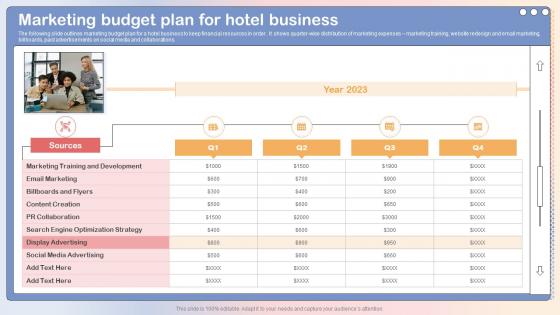
The following slide outlines marketing budget plan for a hotel business to keep financial resources in order .It shows quarter wise distribution of marketing expenses marketing training, website redesign and email marketing, billboards, paid advertisements on social media and collaborations.
People who downloaded this PowerPoint presentation also viewed the following :
Marketing Budget Plan For Hotel Business with all 6 slides:
Use our Marketing Budget Plan For Hotel Business to effectively help you save your valuable time. They are readymade to fit into any presentation structure.






FAQs for Marketing Budget Plan
Okay so break down your marketing budget into five chunks: paid ads (Facebook, Google, whatever), content creation, software/tools, events, and marketing salaries if you have them. I always tell people to stash away 10-15% for random opportunities that pop up - seriously, you'll thank me later. Track your customer acquisition costs too, obviously. Here's what actually works though: list everything you're spending now, then reallocate based on what's bringing in results, not what sounds fancy. Don't get caught up in shiny object syndrome with new platforms.
Look, most companies do 5-10% of revenue but it really varies. SaaS businesses usually spend way more - like 10-20% - while manufacturing stays around 2-5%. Startups need to go aggressive, maybe even above 10% if you're trying to break through. Once you've got brand recognition though? You can dial it back. Honestly, I'd just stalk your competitors first - public companies have to share this stuff in their filings. Then experiment quarter by quarter. Track what it actually costs to get customers and see what works. Don't just throw money at it blindly.
Oh man, the worst thing you can do is set a budget once and never touch it again. Marketing changes constantly! Also don't try to be on every single platform - I made that mistake and burned through cash like crazy. Pick 2-3 spots where your people actually are and go hard there instead. One more thing (this might sound backwards) - never cut marketing when money's tight. That's literally when you need customers most. Oh and always keep like 10-15% extra for when something's working really well or you need to pivot fast.
Honestly, just dig into your old data - it's like having a cheat sheet for where to spend next year. Check which channels actually converted and what you paid to get customers each quarter. I always look back 2-3 years to catch patterns and those seasonal spikes that sneak up on you. Why waste cash on stuff that barely moved the needle? Instead, put more behind what crushed it. Just make a basic spreadsheet comparing what you spent vs what you got back by channel. Sounds boring but it'll totally change how you plan budgets.
Look, market research is basically your cheat sheet for not wasting money. It shows you exactly where your customers hang out and what actually gets them to buy stuff. I learned this the hard way after blowing through a budget on Facebook ads that went nowhere lol. The data tells you which platforms give the best bang for your buck, plus what your competitors are doing. You'll also spot seasonal patterns that can totally save your campaigns. Honestly, just dig into your current customer feedback first - way better than guessing where to spend next quarter.
Honestly? Just follow the money. See which channels actually bring you qualified leads without burning your budget. Most people get distracted by follower counts and other BS metrics that don't pay the bills. Pick your top 2-3 channels and go hard on those instead of trying everything at once. Check where your current customers found you originally - that's usually a goldmine. B2B folks kill it on LinkedIn while e-commerce brands typically see better returns from Facebook and Google ads. Run small tests first, track everything obsessively, then throw more money at what's working. Simple as that.
Honestly, you gotta watch both the money side and how things are actually performing. ROI and ROAS are clutch - they show what revenue you're getting per dollar. Track your cost per acquisition too, that tells you how efficient you are at getting new customers. Engagement stuff matters just as much though. Click-through rates, conversion rates - that's how you know if your creative actually connects with people. Customer lifetime value is huge for the bigger picture. Market share growth too if you can swing getting that data. Monthly dashboard comparing everything to your targets is the way to go. Makes it way easier to switch things up when stuff isn't working.
Keep about 10-20% of your budget unallocated as a flex fund. Super helpful when new opportunities come up or campaigns tank. Don't get locked into those annual contracts - learned that one the hard way. Quarterly chunks work way better for pivoting quickly. Monthly budget reviews are clutch for figuring out what's actually working. Then you can shift money from the dead channels to whatever's driving results. Oh, and honestly? Most people allocate too rigidly upfront. Build in those buffer zones from day one.
Honestly, just start with Google Sheets if you want something simple that everyone can access. HubSpot's really good if you're already using their CRM stuff - same with Salesforce but that one's kinda overkill unless you're a bigger company. I've been playing around with Triple Whale lately for tracking paid campaigns and it's pretty decent. Excel works too if you're into pivot tables (I know, I know, very exciting lol). Tableau's solid for the fancy analytics but might be too much at first. My advice? Pick whatever feels easiest and actually use it consistently. You can always switch later once you figure out what you actually need.
Honestly, I check mine every month but save the big changes for quarterly reviews. Monthly's just to catch stupid spending early - like when I torched my LinkedIn budget on ads that sucked. That was painful. Quarterly is when you actually move money around based on what's working. But here's the thing - if something totally bombs or takes off, don't wait around. Jump in right away and fix it. You don't want to keep bleeding cash on something that's clearly not gonna work.
Honestly, just figure out what's already working and throw more money at those channels. I wasted so much cash chasing shiny new platforms when I should've just doubled down on my best performers. Track everything obsessively - you need to know exactly where each dollar goes. Kill the stuff that isn't working fast, don't get emotionally attached to campaigns. A/B test constantly. Oh and definitely do retargeting - those people already know you exist so they convert like crazy compared to cold traffic. Start by looking at your current spend and pick your top 3 money-makers. That's where you'll see real gains.
Honestly, seasonal trends mess with your marketing budget big time. I'd pump more money into peak seasons when people are actually buying stuff. Take retail - Q4 probably eats up like 40% of your yearly budget, but January? Maybe 5%. Pull up your sales data from the last couple years and map it out month by month. The patterns jump out pretty fast. Then just throw more cash at the high-conversion months and go easy during the dead periods. I learned this the hard way when I blew half my budget in February one year - total waste.
Look, you gotta connect your marketing spend to what your business actually needs - revenue growth, new customers, whatever your main goals are. Otherwise you're just throwing cash at random stuff that looks cool but doesn't do anything. I've watched entire teams blow their budgets on these gorgeous campaigns that brought in literally zero leads (so painful to see). Here's what works: write down your top 3 business priorities first. Then go through where you're spending money and see if it actually maps back to those goals. Track whether it's working or not. Sounds obvious but most people skip this step completely.
Honestly? Work with what you've got - speed and authenticity. Big companies dump cash everywhere but you can pivot fast and get scrappy with local stuff that actually hits. Pick one or two spots where your people actually are instead of being everywhere at once. Content and social are clutch since they reward being creative over having deep pockets. Team up with other small businesses. User-generated content is gold. Don't shy away from getting personal - that's where you beat the corporate vibe. Oh, and seriously just pick one platform first and absolutely nail it there before moving on.
Honestly, new tech is making marketers completely flip their budget strategies. AI tools and automation platforms are where everyone's putting money now - at least you can actually track if they're working, unlike traditional ads where you're just crossing your fingers. The ROI on these usually kicks in pretty fast through efficiency alone. You'll need some budget set aside for experimenting though, since everything changes constantly (kind of exhausting tbh). I'd say pick one or two tools first and prove they work before you start moving big chunks of your budget around.
-
Exclusive and extensive collection of templates. Really helped me create a professional presentation in just no time.
-
It is my first time working with them and that too on a friend's recommendation. I would say, I am not expecting such a worldly service at this low price.