


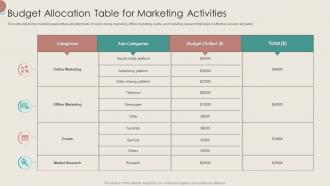
Budget Allocation Table For Marketing Activities





Try Before you Buy Download Free Sample Product
 Impress Your
 Audience
 100%
100% Editable
 Save Hours
 of Time


This slide depicts the marketing expenditure allocation table. It covers online marketing, offline marketing, events, and marketing research that helps in effective resource allocation.
People who downloaded this PowerPoint presentation also viewed the following :
Budget Allocation Table For Marketing Activities with all 6 slides:
Use our Budget Allocation Table For Marketing Activities to effectively help you save your valuable time. They are readymade to fit into any presentation structure.





FAQs for Budget Allocation Table
Honestly, start with your strategic priorities and dig into what actually worked last year versus what was just money down the drain. ROI data doesn't lie. I'd rank must-haves against nice-to-haves first, then work backwards from revenue targets. Don't forget seasonal stuff and build in a buffer - there's always some curveball nobody saw coming. Getting stakeholders involved early saves you major headaches later (learned that one the hard way). Historical spending patterns tell you a lot too, especially if you're brutally honest about results.
Work backwards from your big goals first - that's the only approach that actually works. Score each project on impact vs effort, plus alignment with company stuff. Honestly drives me nuts when teams just chase whatever the loudest person wants! Dependencies matter too since some projects need others to happen first. Build a simple scoring thing with ROI, risk, timeline - the usual suspects. Rank it all and see where your budget cuts off. Oh and definitely stash like 10-15% for random opportunities that'll come up later.
Getting stakeholder input for budget stuff is seriously a game-changer. You'll avoid so much drama later if you just loop people in from the start. I usually hit up department heads and team leads with quick surveys or casual chats - they know what's actually needed vs. what would just be nice to have. People respect budget limits way more when they see the tough choices you had to make. Trust me on this one. The worst budgets I've seen crashed because some exec decided everything alone in their office. Get the input early, make your calls, then circle back to explain your reasoning. Makes everything smoother.
Dude, historical data is like having a cheat sheet for your budget. Pull your actual vs budgeted reports from the last 2-3 years - you'll see which departments always blow their numbers and catch those seasonal patterns that mess with cash flow. I totally got burned ignoring our Q4 spikes one year, not fun. Look for the biggest gaps first since that's where the good stuff is hiding. Once you've got your baseline, just tweak it for obvious changes like new people or big projects. Trust me, it beats guessing every time.
Honestly, just start with Excel or Google Sheets - you probably already have them and they work fine for basic stuff. YNAB is pretty solid if you want something specifically for personal budgeting (I actually really like their approach), or check out Mint if you want free. QuickBooks is the go-to for business but it's kind of overkill unless you really need it. Oh, and if your team needs to work on budgets together, Smartsheet or Monday.com let everyone jump in and make changes. Don't overthink it though - I've watched so many people buy fancy software that just sits there unused.
Yeah, external economic stuff constantly messes with your budget plans. Inflation hits and suddenly you're pushing back non-essential projects or trying to get vendors to extend payment terms. Interest rates are brutal right now too - financing equipment when rates jump 3% is just painful. Market volatility throws off your revenue predictions, which obviously screws with every department's money. Supply chain issues are the worst wildcard though - they'll destroy your careful planning in like two seconds. I'd honestly build in a 10-15% buffer and check your assumptions every quarter instead of once a year.
Honestly, the two big ones that'll kill you are overestimating how much money you'll make and underestimating what stuff actually costs. Don't budget every single dollar either - random expenses always come up. If your business has busy/slow seasons, factor that in too. One thing I learned the hard way: talk to your department heads before locking in their budgets. They actually know what they need way better than you do. Always build in like 5-10% extra for when things go sideways. Check back every quarter to see how you're doing and adjust if needed.
Track your ROI against what you originally planned - that's the most honest way to see if your budget's actually working. Compare where you spent vs where you meant to spend, then check the results. Marketing got extra cash? Did leads actually go up? Honestly, quarterly reviews are where I catch the biggest surprises. Set up regular check-ins and don't feel bad about moving money around mid-year if something's bombing. Just make sure you've got solid KPIs from day one so you're not stuck explaining weird spending decisions later.
So budget allocation is basically your game plan for spending smart. You want to funnel money toward the stuff that actually moves the needle, not those random projects that sound cool but go absolutely nowhere (I swear every company has at least three of these). When you mess up allocation, you're basically lighting cash on fire. Resources get stuck in the wrong places. You miss good opportunities. But get it right? Your ROI shoots up and everything runs smoother. The trick is checking your numbers regularly against what's actually happening, then moving money around when priorities shift.
Look, aligning budget with strategy is honestly just common sense - you put money behind what actually matters. Resources go where they'll make real impact instead of getting scattered everywhere. Decision-making becomes way clearer too since you've got solid criteria for funding stuff. Teams stay focused because their work connects to bigger company goals. I'd probably start by checking how your current spending matches up with your top strategic priorities. You'll spot the gaps pretty quick. Oh and it definitely makes you more accountable - can't just talk about priorities anymore, you're actually backing them up financially.
So basically, nonprofits care about mission impact first, while for-profits chase revenue and shareholder money. With nonprofits, you'll spend like 70-80% on actual programs - donors get super weird if too much goes to "overhead" stuff. For-profits throw way more at sales and marketing since they need growth. Nonprofit budgeting honestly feels more restrictive because everyone's watching every penny you spend on admin costs. Both need emergency reserves though - learned that one the hard way! Oh, and nonprofit boards will question literally every expense that isn't directly helping people. It's intense compared to corporate boards.
So basically you're stress-testing your budget by running different "what if" scenarios before you actually spend the money. Best case, worst case, most likely - that whole thing. It's honestly pretty tedious and you'll be staring at spreadsheets way too long, but it works. You'll spot which budget items are most likely to get hit when things change and figure out where you need extra cushion. I'd try three scenarios for your next quarterly budget. Oh and don't overthink it - just see which line items keep getting squeezed across all the scenarios.
Honestly, monthly is your best bet, but quarterly works too if that's all you can manage. Things shift so fast - what made sense in January could be completely wrong by March, you know? I've watched teams get burned because they stuck with their original plan way too long instead of adjusting. Monthly lets you catch the small stuff early, then do your big deep dives quarterly where you move around the major budget chunks. Oh and actually set those calendar reminders right now or you'll totally forget to do it.
Dude, mismanaging your budget is like the fastest way to torpedo a project. You'll either burn through cash too early or waste it on stupid stuff - I once saw a team drop thousands on software they used maybe twice. Critical work gets starved while random tasks soak up funds. Then you're stuck making cuts, pushing deadlines, and delivering mediocre results that piss everyone off. Your team gets demoralized scrambling with no resources. Always match spending to what actually matters and stash some emergency money aside. Trust me on this one.
Honestly, just show people where the money's going. I know it sounds obvious, but most folks get weird about budgets because they assume you're hiding something. Share your quarterly breakdowns and actually explain why you made certain choices - like why you picked expensive software over cheaper alternatives. The pushback usually melts away once people get the reasoning. Even admitting "yeah, we had to cut training costs to afford this" makes them feel included instead of blindsided. Trust me, the transparency thing works way better than keeping everything locked down.
-
I am not the best at presentations but using SlideTeam’s PPT template made it easier for me. Thank you SlideTeam!
-
The best part about SlideTeam is their meticulously prepared presentations (complete-decks and single-slides both), infused with high-quality graphics and easy to edit. All-in-all worthy products.