

Business Expense Budget Allocation Pie Chart





Try Before you Buy Download Free Sample Product
 Impress Your
 Audience
 100%
100% Editable
 Save Hours
 of Time


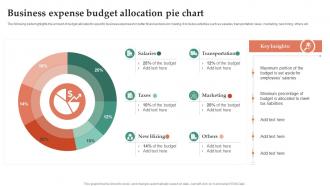
The following slide highlights the amount of budget allocated to specific business expenses for better financial decision making. It includes activities such as salaries, transportation, taxes, marketing, new hiring, others etc.
People who downloaded this PowerPoint presentation also viewed the following :
Business Expense Budget Allocation Pie Chart with all 6 slides:
Use our Business Expense Budget Allocation Pie Chart to effectively help you save your valuable time. They are readymade to fit into any presentation structure.





FAQs for Business Expense Budget
Track your income first, then map out fixed stuff like rent and insurance. Variable expenses are groceries, gas - you know the drill. Honestly, those random expenses like car repairs will destroy your budget if you pretend they don't exist. Holiday gifts too! Build in some wiggle room because unexpected crap always comes up. Here's the thing though - be realistic about how you actually spend money, not how you think you should. Track everything for like a month first. Then make a budget that doesn't feel impossible to stick to.
Honestly, templates saved my life when I started budgeting. Instead of building spreadsheets from nothing, you get all the categories and formulas already done. Google Sheets and Excel have free ones - just search around. I used to waste hours setting everything up manually (ugh, what a mess that was). The good templates do the math for you automatically, plus they'll show charts of where your cash actually goes. Super helpful for seeing patterns. Just find a basic monthly one to start with, then tweak it as you figure out what categories you actually need. Way easier than doing it all yourself.
Okay so what I do is set aside like 5-10% of my paycheck for random stuff that pops up. Keep a simple list somewhere - could be your notes app, whatever - and write down what blindsided you each month. Car stuff, medical copays, that weird plumbing thing. Honestly I used to just panic and throw everything on my credit card which sucked. But after tracking for a while you'll notice patterns. Like oh, my car needs something every few months. Then you can plan for it better or maybe start a separate little fund just for that. Even if you start super basic, just do something today.
Okay so first thing - dig into your actual spending from the last few months. Not what you *think* you spend, but like, your real bank statements. That's your reality check right there. From there, don't go crazy with some massive budget overhaul that'll crash and burn in two weeks (been there, done that). Push yourself maybe 10-15% beyond where you are now. Break the big stuff into smaller monthly chunks. Oh and definitely build in wiggle room for random expenses - they always happen. I track mine weekly so I can course-correct before everything goes sideways. Being honest about your lifestyle while still improving is the whole game.
Honestly, track everything for like two weeks before you even think about making a budget. Most people go way too restrictive and then burn out hard - I've been there! Also don't be that person who makes a budget then never looks at it again (seriously, what's the point?). You'll forget about random stuff like car repairs or Christmas gifts every single time. When you inevitably go over budget, just adjust it instead of doing that "fresh start next month" thing. That never works. Oh and actually see where your money's going first - you'd be surprised how much those little purchases add up.
Honestly, budget templates are a game changer for team stuff. Everyone's literally on the same page with categories and timelines, so no more awkward meetings where someone's like "wait, what does this column mean?" You can track who changed what, share files without drama, and multiple people can work on it at once. The format stays intact which is clutch. Just set up shared access and make sure people know which sections they own - otherwise you'll end up with like 15 versions floating around. Oh and it cuts down meeting time big time since you're not re-explaining the basics every single time.
So budgets are basically just tracking where your money comes from and where it goes. Helps you not blow all your cash on random stuff and actually save for things you want. GPS for money is pretty accurate honestly - shows you the route instead of wandering around broke. Businesses need them too for managing cash flow and seeing if they're hitting their targets. The trick is making it realistic though. Like don't budget $50 for groceries if you know you'll spend $150. Check in on it regularly or it's just useless paperwork sitting in a drawer.
Honestly, I'd start by looking at your lowest monthly income and budget off that - it's like your worst-case scenario safety net. Track your income for maybe 6 months to see if there's any pattern you can spot. The hard part is when you have a good month, don't immediately blow it on upgrading your life (trust me, so tempting). Put that extra cash toward your emergency fund or debt instead. Make two lists: stuff you absolutely need vs things that would be nice to have. That way when money gets tight, you know exactly what to cut first.
You should definitely check out some budgeting apps - they'll save you so much time. Mint's my go-to since it's free and automatically syncs with your bank accounts. YNAB costs money but honestly teaches you solid budgeting habits if you're serious about it. Personal Capital's great too, especially if you want to track investments alongside spending. Even something basic like PocketGuard can totally change how aware you are of your spending habits. The main thing is finding one that connects to your accounts so you're not typing in every coffee purchase manually - ain't nobody got time for that. Just pick whatever feels easy to use and stick with it.
Okay so first thing - write down all your debts with the balances and interest rates. After you cover rent, groceries, all that necessary stuff, whatever's left goes to debt payments. I'd go with the avalanche method honestly - pay minimums on everything but attack the highest interest rate debt with any extra money. Saves you more cash in the long run. Though some people do the snowball method instead (lowest balance first) because it feels more motivating, I guess. Your budget shows you exactly what you can throw at debt each month. Even finding an extra $25 could help speed things up.
I'd say check it monthly, bare minimum. Personally though? I peek at mine every week because money stuff can get out of hand so fast. Monthly works because you'll spot bad spending habits before they wreck you, and you can plan for big expenses coming up. Some people only look quarterly but that's honestly too long - you miss way too much. Oh, and set a phone reminder for the same day each month. Maybe right after rent's due or whatever your biggest bill is. Makes it feel less like a chore when it's just routine, you know?
So fixed expenses stay the same every month - rent, car payments, insurance, that stuff. Variable ones change depending on what you do, like groceries or going out. Here's the thing though - some expenses pretend to be fixed but totally aren't. Like all those streaming services that somehow keep adding up (guilty as charged). Variable expenses are actually your friend when money gets tight because that's where you can cut back. Start by figuring out all your fixed costs first since you can't really negotiate those. Then you'll know what's left for everything else.
Honestly, just trick yourself into saving by making it automatic. Set up a transfer for right after payday - even if it's only like 5% of what you make. That 50/30/20 thing is nice in theory, but let's be real, most people can't jump straight to saving 20%. Start smaller so you don't hate it. The key is removing yourself from the equation entirely - if the money's gone before you see it, you won't miss it. I do this and it's wild how fast you stop noticing. You can always bump up the amount once the habit sticks.
Ugh, the shame spiral around money is SO real - I used to literally hide from my bank app. Then there's lifestyle inflation, which is sneaky as hell. You get a raise and suddenly your "needs" expand to match it. Also that perfectionist thing where one overspend makes you throw the whole budget out the window? Yeah, don't do that. My advice: just track spending for a week first. No judgment, no changes. Automate whatever you can so you're not relying on willpower every day. When you mess up (and you will), don't spiral. Budgets should bend, not snap in half.
Oh man, lifestyle inflation is the worst. You get a raise and suddenly you're buying fancy coffee and upgrading everything "just because you can afford it now." Before you know it, your expenses match your new income perfectly - so you're basically in the same spot financially. Honestly, I learned this the hard way when I got my first real promotion. The trick is being sneaky about it yourself: when you get more money, immediately stash like half of it away before you even see it in your checking account. Otherwise you'll just keep spending whatever you make forever.
-
Topic best represented with attractive design.
-
Great combination of visuals and information. Glad I purchased your subscription.