


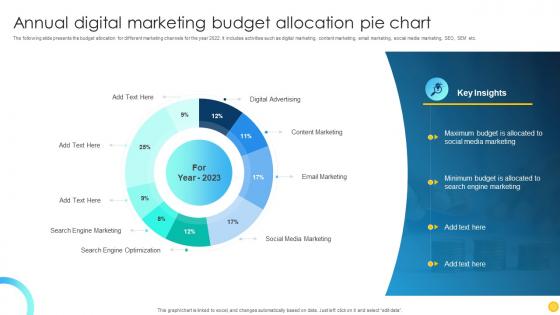
Annual Digital Marketing Budget Allocation Pie Chart




Try Before you Buy Download Free Sample Product
 Impress Your
 Audience
 100%
100% Editable
 Save Hours
 of Time


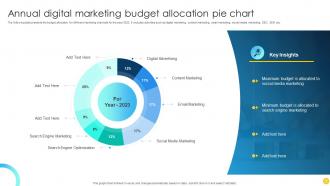
The following slide presents the budget allocation for different marketing channels for the year 2022. It includes activities such as digital marketing, content marketing, email marketing, social media marketing, SEO, SEM etc.
People who downloaded this PowerPoint presentation also viewed the following :
Annual Digital Marketing Budget Allocation Pie Chart with all 7 slides:
Use our Annual Digital Marketing Budget Allocation Pie Chart to effectively help you save your valuable time. They are readymade to fit into any presentation structure.





FAQs for Annual Digital Marketing Budget
Key factors include business goals, target audience size, industry competition, seasonal trends, and available resources. These considerations enable organizations to strategically allocate funds across channels like social media, search advertising, and content marketing, with many companies finding that data-driven budget planning delivers improved ROI and sustainable growth.
Businesses should prioritize digital marketing channels based on target audience behavior, conversion rates, customer acquisition costs, and ROI metrics from previous campaigns. While search engine marketing and social media advertising often deliver immediate results, companies increasingly find that combining content marketing, email campaigns, and paid advertising creates synergistic effects, ultimately maximizing reach and revenue across diverse customer touchpoints.
Digital marketing budget allocation typically ranges from 7-12% of total company revenue, with B2B companies often allocating 2-5% while B2C businesses may invest 5-10% or more. This percentage varies significantly by industry, growth stage, and competitive landscape, with many startups and e-commerce companies finding that higher allocations deliver accelerated customer acquisition and market penetration.
Businesses can effectively measure digital marketing ROI through conversion tracking, customer lifetime value analysis, attribution modeling, marketing mix modeling, and cohort analysis. These methodologies enable companies to trace revenue directly to specific campaigns, channels, and touchpoints, with many organizations finding that multi-touch attribution delivers the most comprehensive view of campaign performance and budget optimization opportunities.
Audience targeting serves as the foundation for strategic budget allocation, enabling marketers to prioritize high-value segments, optimize channel selection, and maximize ROI through data-driven spending decisions. By identifying specific demographics and behaviors, organizations can allocate resources more effectively across platforms, with many finding that targeted campaigns deliver significantly better conversion rates and lower acquisition costs.
Small businesses can optimize limited digital marketing budgets by focusing on high-ROI channels like social media marketing, email campaigns, content marketing, and targeted local SEO strategies. These approaches enable cost-effective customer acquisition, enhanced brand visibility, and measurable engagement metrics, with many small retailers and service providers finding that strategic budget allocation across these channels delivers significantly better conversion rates and sustainable growth compared to traditional advertising methods.
Key metrics include conversion rates, cost per acquisition, return on ad spend, click-through rates, and customer lifetime value. These measurements enable businesses to optimize resource allocation across channels, identify high-performing campaigns, and adjust strategies in real-time, with many organizations finding that comprehensive tracking ultimately delivers improved ROI and strategic competitive advantage.
Seasonal trends significantly influence digital marketing budget allocation by requiring strategic shifts in spending timing, channel emphasis, and campaign intensity throughout the year. Retailers typically increase budgets during holiday seasons, travel companies amplify spending during peak booking periods, and B2B organizations adjust allocations around industry conferences, ultimately enabling businesses to maximize ROI and capitalize on predictable consumer behavior patterns.
Emerging technologies impacting digital marketing budgets include artificial intelligence for personalization, augmented reality experiences, voice search optimization, blockchain for transparency, and advanced marketing automation platforms. These technologies streamline campaign management, enhance customer targeting, and deliver measurable ROI improvements, with many organizations finding that strategic technology investments ultimately reduce overall marketing costs while significantly improving conversion rates.
Companies ensure digital marketing budget agility by implementing quarterly reviews, maintaining flexible budget reserves, using performance-based allocation models, and adopting real-time analytics tracking. Through dynamic budget shifting between channels like social media, search, and content marketing, organizations can respond to market opportunities while minimizing waste, ultimately delivering enhanced ROI and competitive responsiveness.
B2B digital marketing typically allocates larger portions to LinkedIn advertising, content marketing, and account-based marketing platforms, while B2C strategies prioritize social media advertising, influencer partnerships, and broader audience targeting across Facebook and Instagram. B2B campaigns focus on longer sales cycles with higher per-lead investments, whereas B2C emphasizes volume-driven conversions, ultimately requiring different cost-per-acquisition models and strategic resource distribution.
Businesses leverage data analytics to guide budget allocation by tracking conversion rates, customer acquisition costs, and channel performance metrics across campaigns. Through predictive modeling and attribution analysis, organizations identify high-performing channels, optimize spending distribution, and reallocate resources toward strategies delivering the strongest ROI, ultimately maximizing marketing efficiency and revenue growth.
Justifying increased digital marketing spend requires demonstrating clear ROI through historical performance data, competitive analysis showing market share opportunities, and detailed forecasting of revenue impact from proposed budget increases. Successful strategies include presenting case studies from similar industries, showcasing attribution models that connect spend to conversions, and emphasizing long-term customer acquisition costs versus lifetime value, ultimately delivering measurable growth and competitive advantage.
Creatives and content production typically consume 20-30% of digital marketing budgets, encompassing video production, graphic design, copywriting, photography, and interactive content development. These investments directly impact campaign performance across channels, with many organizations finding that higher-quality creative assets deliver significantly better engagement rates, conversion outcomes, and overall return on advertising spend.
Under-allocating digital marketing budget creates competitive disadvantage, reduced online visibility, limited customer acquisition, decreased brand awareness, and missed revenue opportunities. In today's economy, businesses face losing market share to competitors with stronger digital presence, while struggling with higher customer acquisition costs and reduced scalability, ultimately hampering growth potential and long-term sustainability.
-
I discovered some really original and instructive business slides here. I found that they suited me well.
-
Excellent Designs.