Human Resource Budget Breakdown Pie Chart
Try Before you Buy Download Free Sample Product
Audience
Editable
of Time
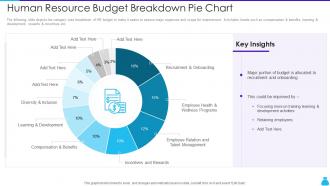
The following slide depicts the category wise breakdown of HR budget to make it easier to assess major expenses and scope for improvement. It includes heads such as compensation and benefits, learning and development, rewards and incentives etc.
People who downloaded this PowerPoint presentation also viewed the following :
Human Resource Budget Breakdown Pie Chart with all 7 slides:
Use our Human Resource Budget Breakdown Pie Chart to effectively help you save your valuable time. They are readymade to fit into any presentation structure.
FAQs for Human Resource Budget
Key components of creating an effective human resource budget include salary and benefits allocation, recruitment costs, training and development expenses, performance management systems, and compliance requirements. These elements work together by enabling strategic workforce planning, optimizing talent acquisition processes, and ensuring competitive compensation structures, with many organizations finding that comprehensive HR budgeting delivers improved employee retention and operational efficiency.
Organizations align their human resource budget with business strategy by prioritizing talent investments that directly support strategic objectives, analyzing workforce gaps against future needs, and allocating resources to critical areas like skills development, retention programs, and strategic hiring. This strategic alignment enables companies to optimize talent acquisition costs, enhance employee productivity, and build competitive advantages, with many organizations finding that integrated HR-business planning delivers measurable returns on workforce investments.
Workforce planning serves as the foundation for human resource budgeting by forecasting staffing needs, identifying skill gaps, and projecting recruitment, training, and compensation costs. Through strategic workforce analysis, organizations can anticipate hiring timelines, budget for employee development programs, and allocate resources for retention initiatives, ultimately enabling more accurate financial planning and competitive talent acquisition in an increasingly dynamic labor market.
Variable staffing needs significantly complicate HR budget planning by creating fluctuating costs for recruitment, training, temporary staff, and benefits administration throughout the year. Organizations must build flexibility into their budgets through contingency funds, strategic workforce planning, and partnerships with staffing agencies, ultimately enabling them to scale efficiently while maintaining operational continuity and competitive talent acquisition.
HR budget effectiveness should be measured through cost-per-hire, employee turnover rates, time-to-fill positions, training ROI, and employee satisfaction scores. These metrics enable organizations to assess recruitment efficiency, retention success, and development impact, with many companies finding that tracking these indicators ultimately delivers better talent acquisition, reduced operational costs, and enhanced workforce productivity.
Technology and automation significantly influence HR budgeting by streamlining payroll processing, automating benefits administration, and reducing manual administrative costs. These solutions enable organizations to reallocate resources from routine tasks to strategic initiatives, with many companies finding that automated HR systems deliver faster processing, improved accuracy, and ultimately enhanced operational efficiency.
Common HR budgeting challenges for employee training include measuring ROI on skill development investments, balancing immediate operational needs with long-term workforce capabilities, predicting future skill requirements, and allocating resources across diverse training modalities. Many organizations find that strategic workforce planning, coupled with phased implementation approaches, enables more accurate budget forecasting while delivering enhanced employee capabilities and competitive advantage.
Organizations should approach benefits and compensation budgeting by conducting market salary research, analyzing total compensation costs including healthcare and retirement contributions, and aligning packages with strategic talent goals. Through benchmarking against industry standards, companies streamline recruitment, enhance employee retention, and maintain competitive positioning, with many finding that transparent, well-structured compensation budgets ultimately deliver improved workforce satisfaction and reduced turnover costs.
Managing unexpected HR-related expenses requires establishing emergency funds, implementing flexible staffing models, cross-training employees for versatility, and maintaining strong vendor relationships for cost-effective solutions. Through strategic workforce planning and budget monitoring, organizations can quickly adapt to unforeseen costs like sudden turnover or compliance changes, ultimately maintaining operational efficiency while minimizing financial disruption.
Labor market trends significantly influence HR budget allocations by driving adjustments in compensation packages, recruitment strategies, talent retention programs, and skills development initiatives. Organizations experiencing tight labor markets typically reallocate resources toward competitive salaries, enhanced benefits, and employee upskilling programs, with many companies finding that strategic budget shifts enable better talent acquisition and reduced turnover costs.
Remote work significantly impacts HR budgeting through reduced office space costs, technology infrastructure investments, modified compensation strategies, and new employee wellness programs. While organizations save on facilities and utilities, they must allocate resources for digital collaboration tools, cybersecurity measures, and virtual engagement initiatives, with many companies finding that strategic rebalancing delivers enhanced talent retention and operational flexibility.
Diversity and inclusion initiatives can be funded through dedicated training programs, employee resource group support, inclusive recruitment partnerships, bias mitigation tools, and leadership development allocations. Organizations increasingly integrate D&I funding across multiple budget categories rather than isolating it, with many companies finding that strategic investment in these areas ultimately delivers improved employee engagement, broader talent pools, and enhanced organizational performance.
Compliance and regulatory changes significantly reshape HR budget priorities by requiring increased investment in legal training, policy updates, system modifications, and specialized personnel. Organizations typically reallocate resources toward compliance technology, employee education programs, and regulatory expertise, with many companies finding that proactive compliance investment ultimately reduces costly penalties and enhances operational efficiency.
Forecasting enables HR budget planning by predicting future workforce needs, compensation trends, training requirements, and talent acquisition costs based on business growth projections and market conditions. Through predictive analytics and historical data analysis, organizations can strategically allocate resources, minimize unexpected expenses, and ensure adequate funding for critical initiatives, ultimately delivering better workforce planning and competitive talent management.
HR departments demonstrate ROI by tracking key metrics like employee retention rates, time-to-hire reductions, productivity improvements, and training program outcomes that directly impact revenue. Through comprehensive analytics, organizations can quantify how strategic HR investments reduce turnover costs, accelerate talent acquisition, and enhance workforce performance, ultimately delivering measurable cost savings and competitive advantage.
-
“Thank you to the SlideTeam. Your presentations look really skillful and have made my life so much easier.”
-
I really liked their customized design services. I got my desired template made by their expert team. Thank You!