


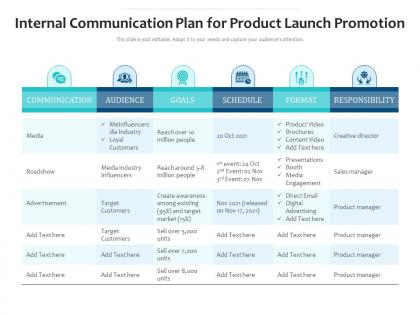
Internal communication plan for product launch promotion




Try Before you Buy Download Free Sample Product
 Impress Your
 Audience
 100%
100% Editable
 Save Hours
 of Time


Our Internal Communication Plan For Product Launch Promotion are topically designed to provide an attractive backdrop to any subject. Use them to look like a presentation pro.
People who downloaded this PowerPoint presentation also viewed the following :
Internal communication plan for product launch promotion with all 2 slides:
Use our Internal Communication Plan For Product Launch Promotion to effectively help you save your valuable time. They are readymade to fit into any presentation structure.
FAQs for Internal communication plan for
Start with figuring out who actually needs to hear what and when. Map your key messages to the right channels - email for some stuff, Slack for quick updates, maybe all-hands for bigger announcements. Pick someone to own each piece (otherwise nothing gets sent, trust me). Build in ways for people to give feedback too. The trick is keeping it simple enough that everyone will actually use it. I've seen so many overcomplicated communication plans that just sit in a drawer somewhere. Oh, and schedule regular check-ins to tweak what's not working.
Oh man, you should definitely try Slack or Teams first - instant messaging is a game changer. Video calls help too when you need that face-to-face vibe. Project management stuff like Asana keeps everyone updated so nobody's like "wait, what meeting?" which honestly happens way too much. The transparency thing is huge. You can set up automated updates and use your company intranet for big announcements. Don't go crazy though - pick one tool, let people get used to it, then add more later. Trust me, overwhelming everyone at once never works.
So here's what I'd track - email opens, intranet views, meeting turnout, survey responses for the engagement side. Then for actual results, run pulse surveys to see if people get it, watch how fast news travels between teams, and check if they're doing what you asked. Honestly though? High open rates are pretty meaningless if nobody understands the message. I learned that the hard way at my last job. Pick maybe 3-4 metrics that actually connect to what you're trying to achieve. Monthly check-ins work well - not too often but you won't miss major issues either.
Honestly, you've gotta walk the walk first - be transparent and actually listen when people talk. Try monthly Q&As or just wandering around having real conversations (sounds old school but trust me). The biggest thing? Make sure nobody gets burned for speaking up. I can't stress this enough - follow up on feedback people give you, or they'll just stop trying. Maybe start small with one regular meeting and see how it goes. Oh, and those town halls everyone talks about? They actually work if you don't make them feel like corporate theater.
Look, you really can't build a decent internal comms strategy without knowing what your people actually want to hear about. Feedback shows you their preferred channels, which topics they care about, and what's completely missing the mark. Honestly, those quarterly company-wide emails? They're probably not cutting it if that's all you're doing. The trick is making feedback collection continuous - not just that annual survey everyone dreads. Oh, and start simple: just ask your team how they like getting updates and what information they feel like they're missing right now.
Honestly, you've gotta hit people with the same info in different ways. I'm totally the "give me bullet points or I'm out" type, but some folks need those long detailed emails to feel informed. Try mixing it up - quick Slack updates, maybe some visual stuff for people who learn that way, town halls when you need everyone's attention. Oh and definitely ask your team what they actually prefer instead of guessing. Some people process way better when they can sit with written info, others just want you to tell them face-to-face. Cover all the bases and you'll actually reach everyone instead of just the people who communicate like you do.
Ugh, the worst thing is when departments just don't talk to each other - like, ever. Then you've got unclear messages floating around and terrible timing on everything. Plus people are drowning in emails (seriously, 50 a day??) and there's never any real feedback happening. What works better: pick the right channels for different stuff, set up regular check-ins between teams, and keep messages super clear. Oh, and make it two-way! People need to actually respond and ask questions instead of just getting bombarded with announcements from above.
Think of it as your game plan for not letting people freak out during big changes. Map out who needs what info and when - otherwise you'll have rumors flying everywhere. I learned this the hard way once! Start with your different groups (managers, front-line staff, whatever) and figure out their specific needs. Build your timeline around the major milestones so you're staying ahead of the chaos instead of constantly putting out fires. Honestly, the whole "consistent messaging" thing sounds boring but it actually saves you tons of headaches later.
Honestly, skip the corporate BS and focus on what actually matters to your people. Project updates hit different when they're about *their* work. Team wins, real explanations for decisions that affect them daily - that's gold. Behind-the-scenes stuff works too, especially when leadership drops the PR mask and talks honestly about challenges. I've seen colleague spotlights completely crush generic announcements every time. Oh, and here's what I'd do first - just ask your team what they want to hear about. Sounds obvious but most companies never bother. You'll probably get answers that surprise you.
Honestly, email isn't enough anymore. People absorb info differently - some need visual dashboards, others want to hear announcements, and plenty just want something written they can save for later. Timing's huge too! Don't send updates at 5pm on Friday when nobody's paying attention. Keep the language simple (skip the corporate speak) and put your main points right at the top since most people skim anyway. Oh, and actually ask for feedback on what's working. Then - this is key - you've got to change things based on what they tell you.
So newsletters are basically your go-to for keeping everyone connected and in the loop with company stuff. They work because people get into a rhythm - they know when updates are coming and what to expect. Celebrating teams and highlighting wins? That honestly does wonders for morale. The trick is making them actually worth reading instead of boring corporate nonsense (you know the type). I'd start by asking your team what they'd actually want to see - like, what would make them excited to open it instead of just deleting it? Build from there and you'll be golden.
Honestly, you've gotta be way more intentional about communication now. Start doing weekly team calls and monthly all-hands since nobody's randomly chatting anymore. Use different tools for different things - Slack for quick stuff, video calls when things get complicated, shared docs for updates. I'd also do those recorded video messages, they're surprisingly helpful. The whole coffee machine conversation thing? Gone. So you need scheduled touchpoints and really detailed project updates. Multiple channels work better than just email blasting everyone. It's basically about creating the information flow that used to happen naturally.
Get your crisis comms sorted way before anything goes wrong. Build a team with clear jobs - who writes what, who gives the thumbs up, who hits send. Templates are your friend here, trust me. When chaos hits, you don't want to be writing from scratch while everyone's freaking out. Hit people through multiple channels because honestly? Some folks just don't check their email. Email, Slack, texts, whatever works. Oh, and keep talking even when you've got nothing new. "Still figuring this out, update at 3pm" sounds way better than dead silence.
Oh man, this is such a real problem! Different cultures have completely different expectations around hierarchy and directness. Some teams want super formal communication, others are way more casual. Plus there's all the obvious stuff like language barriers and time zones, but also things like religious holidays and whether people actually feel comfortable speaking up in meetings. Honestly, I'd survey your teams first to see what they prefer. Then maybe create some style guides that work with these differences instead of trying to force everyone into the same box - that never works anyway.
Honestly, visuals are a game changer for team communication. Most people just absorb info better when there's a chart or slide to look at instead of dense paragraphs. I mean, who actually reads those long emails anyway? Graphs make complicated data way clearer, and your team won't zone out during meetings as much. Even something simple like a quick infographic helps people remember stuff later. Next time you're doing a team update, throw in at least one visual - I bet you'll notice people actually paying attention for once.
-
I discovered this website through a google search, the services matched my needs perfectly and the pricing was very reasonable. I was thrilled with the product and the customer service. I will definitely use their slides again for my presentations and recommend them to other colleagues.
-
Great quality product.
-
Unique and attractive product design.
-
Commendable slides with attractive designs. Extremely pleased with the fact that they are easy to modify. Great work!
-
Design layout is very impressive.
-
Presentation Design is very nice, good work with the content as well.
-
Perfect template with attractive color combination.
-
Easily Editable.
-
Attractive design and informative presentation.