


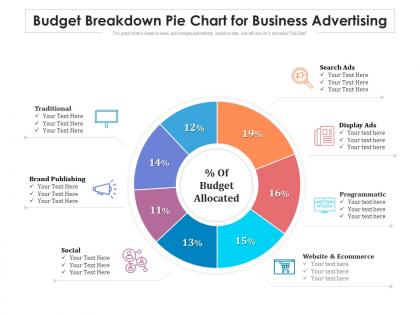
Budget breakdown pie chart for business advertising




Try Before you Buy Download Free Sample Product
 Impress Your
 Audience
 100%
100% Editable
 Save Hours
 of Time


Our Budget Breakdown Pie Chart For Business Advertising are topically designed to provide an attractive backdrop to any subject. Use them to look like a presentation pro.
People who downloaded this PowerPoint presentation also viewed the following :
Budget breakdown pie chart for business advertising with all 2 slides:
Use our Budget Breakdown Pie Chart For Business Advertising to effectively help you save your valuable time. They are readymade to fit into any presentation structure.
FAQs for Budget breakdown pie chart
Okay so first thing - figure out your main categories based on how you actually spend, not what some finance guru says you should do. I always start with income, then fixed stuff like rent and insurance. After that, variable expenses like groceries and utilities. Here's what trips everyone up though: those random yearly or quarterly payments that come out of nowhere! Set aside a category for those. Oh and definitely add miscellaneous because your car will break down or whatever. Don't get too detailed or you'll hate tracking it after like two weeks.
Honestly, visual tools are a game changer for budgets. Your brain just processes charts and graphs so much faster than spreadsheet rows. I love pie charts for seeing where your money actually goes - way better than staring at numbers. Bar graphs are great too since they'll show you what categories are totally out of whack. Plus if you need to show this stuff to your boss or whoever, they won't zone out like they would with a boring report. I'd start simple - just throw your main expenses into a pie chart first. You'll be shocked how clear everything becomes when it's visual instead of just... math everywhere.
Honestly? Track your spending for like 2 weeks before you even touch a budget. Otherwise you're just making stuff up. Most people forget about random expenses - car repairs, birthday gifts, that stupid Netflix subscription you forgot about. Also don't be crazy restrictive with entertainment money because you'll hate it and quit. I learned this the hard way lol. Build in some buffer for when you inevitably overspend on groceries or whatever. Make realistic categories first, then stick to them.
Personal budgets are about your lifestyle stuff - rent, groceries, fun money, retirement. Business budgets? Totally different beast. You're tracking revenue, operating costs, marketing spend, equipment purchases. I mixed these up constantly when I started freelancing and it was a mess lol. Try the 50/30/20 rule for personal stuff, but business needs its own categories entirely. Equipment breaks at the worst times, so budget for it. Keep them separated though - seriously. Different bank accounts, different spreadsheets, whatever works. You'll thank me during tax season when you're not digging through personal Starbucks receipts looking for actual business expenses.
OMG yes, budgeting apps are a total game changer! I used to spend forever categorizing every little purchase - such a waste of time. Now I just connect my accounts and everything gets sorted automatically. The visual charts actually make it interesting? Like you can finally see where all your money disappears to (spoiler: probably takeout lol). I'm obsessed with YNAB but Mint works great too. Seriously, just try linking one account this week. You'll wonder why you waited so long to automate this stuff instead of doing it manually like some kind of masochist.
Honestly, budget breakdowns are a game-changer because you can see exactly where your cash is going. Like instead of lumping everything under "marketing - $50K," split it into ads, events, contractor fees, whatever. This way you'll catch trends early - maybe your Facebook ads are killing it while events totally bomb. Then you can shift money around instead of being locked into your first estimate (which let's be real, is usually wrong anyway). I'd say break things into like 5-10 categories minimum so patterns actually show up.
Honestly, start with that 50/30/20 thing - needs, wants, savings. Works pretty well as a baseline. Then just rank everything by what's actually urgent vs what can wait. Try zero-based budgeting if you're feeling ambitious (basically questioning every single expense like you're starting fresh). Sounds awful but you'll probably discover you're spending money on weird stuff you forgot about. Look at your past few months to see where your money actually goes - not where you think it goes. Always pad it with buffer money because something random will break. Oh, and don't just set it once - check in monthly or it'll get wonky fast.
Honestly, cover your must-haves first - rent, utilities, minimum payments on debt, groceries. That stuff can't wait. After that, put money toward savings and retirement before you touch anything fun. I learned this the hard way lol, used to blow through paychecks wondering where it all went. Whatever's left after those priorities? That's your dining out and entertainment money. Oh, and treat savings like it's a bill you have to pay, not something you'll do "if there's money left." The 50/30/20 thing is pretty solid to start with.
Ugh, unexpected expenses are the WORST for budgets. Your car dies and suddenly you're stealing money from groceries or entertainment just to cover it. Medical bills? Same thing. Everything gets shuffled around and your whole plan goes out the window. I swear it's like dominoes - one thing hits and suddenly you're overspending everywhere. That's actually why I always try to stick some buffer money in there from the start, even if it's just like $50. Saves you from that panicked "where am I gonna find this money" moment.
Look, historical data is like having a crystal ball for your budget. Pull up your last 2-3 years of spending and you'll see crazy patterns - like how marketing always explodes in Q4 or office supplies vanish every March (where DO all those pens go?). You'll spot seasonal stuff you forgot about and see where you consistently blow past estimates. Way better than just throwing numbers at categories and hoping they stick. The patterns that show up year after year? That's gold for actually realistic budgeting instead of wishful thinking.
Check your budget monthly and see where you're way off. I used to completely ignore my "miscellaneous" spending until it was eating like 30% of my budget lol. Start with the biggest gaps since those matter most. But here's the thing - don't just shuffle money around without figuring out WHY you overspent. One-time emergency or are you just bad at estimating grocery costs? Be honest about your actual habits, not what you think they should be. Weekly check-ins help if monthly feels too loose.
Dude, your brain is basically working against you when it comes to money. Emotions kick in and suddenly you're stress-shopping or being way too optimistic about what things actually cost. I'm terrible at this - I'll pinch pennies all month then blow my tax refund on random stuff because it feels like "free money." Your mind also plays tricks on you about how much you really have available. Plus tracking expenses just feels awful sometimes, so we avoid it. Honestly, the best thing is setting up automatic transfers and stuff that happen without you having to think about it.
Excel or Google Sheets are your best bet to start - you've probably got access already and can set up whatever categories you need. YNAB's great if you want something made for budgeting, or Mint for the free route. QuickBooks if it's business related. Honestly though? I've seen people crush their budget tracking with just a basic spreadsheet template. Sometimes the simple approach works better than all the bells and whistles. Pie charts are perfect for visual breakdowns - super easy to make in Excel. Your company might have Tableau too if you want to get fancy with it. Just start with what you've got and see how it goes.
Dude, cultural differences totally change how people handle money. Asian families often pool everything together and think about the whole family first. Americans? We're more like "my money, my goals." Religious stuff matters too - Muslims avoid interest-based investments, and some cultures save for specific ceremonies or even their grandkids. Honestly, I learned this the hard way working with international clients. Don't just assume everyone budgets like you do. Always ask about their family's approach to money first - saves so much awkwardness later.
Honestly, charts beat spreadsheets every time for budget stuff. People's brains just grab visual info way faster than scanning through rows of numbers. When you show a pie chart, everyone immediately spots the weird stuff - like wait, why are we dropping 40% on office supplies? Bar graphs work great too, especially comparing different teams or months. I mean, you can still keep the detailed breakdowns for the finance nerds who want every line item. But for meetings or quick check-ins, visuals tell the story instantly. Nobody wants to sit there doing math in their head while you're presenting.
-
Excellent design and quick turnaround.
-
Use of icon with content is very relateable, informative and appealing.
-
Use of different colors is good. It's simple and attractive.
-
Easy to edit slides with easy to understand instructions.