

Building 5G Wireless Mobile Network Powerpoint Presentation Slides




Try Before you Buy Download Free Sample Product
 Impress Your
 Audience
 100%
100% Editable
 Save Hours
 of Time


5G Wireless Mobile Network will allow telecom operators to deploy 5G by assessing different parameters such as cost, market, and technology readiness. Grab our professionally designed Building 5G Wireless Mobile Network template that will cover slides about 5G, an upcoming technology opportunity, along with objectives of 5G, industry expectation of 5G, and contribution of 5G to the global economy. The template covers slides depicting uniqueness related to 5G in terms of its design specifications, comparative assessment, and unique features such as latency, speed, intelligent connectivity, heterogeneous network, and use cases in the context of 5G. The template covers slides regarding value creation and enablers with 5G deployment in terms of economic benefits, enterprise opportunity, enhanced mobile broadband, and fixed wireless access. It caters to slides on various 5G value enablers such as resilient networks, horizontal APIs, operator cloud, network slicing, etc. It covers slides about cost determination for 5G by assessing cost-impacting factors such as network capacity, network coverage, network flexibility, network energy efficiency, and network equipment sourcing for 5G. Download our 5g technology ppt templates now.
People who downloaded this PowerPoint presentation also viewed the following :
Content of this Powerpoint Presentation
Slide 1: This slide displays title i.e. 'Building 5G Wireless Mobile Network' and your Company Name.
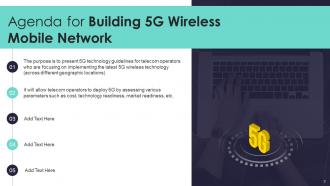
Slide 2: This slide presents agenda.
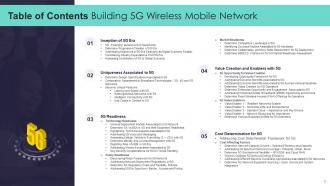
Slide 3: This slide exhibits table of contents.
Slide 4: This slide depicts title for five topics that are to be covered next in the template.
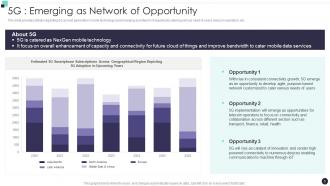
Slide 5: This slide provides details regarding 5G as next generation mobile technology and emerging as network of opportunity catering various need of users.
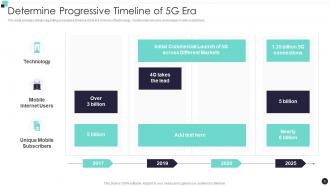
Slide 6: This slide provides details regarding progressive timeline of 5G era in terms of technology, mobile internet users and unique mobile subscribers.
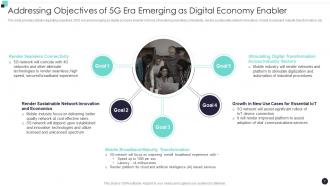
Slide 7: This slide provides details regarding objectives of 5G era and emerging as digital economy enabler.
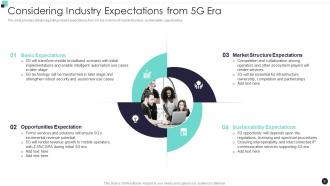
Slide 8: This slide provides details regarding industry expectations from 5G era in terms of market structure, sustainability, opportunities.
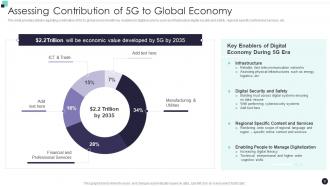
Slide 9: This slide provides details regarding contribution of 5G to global economy with key enablers to digital economy.
Slide 10: This slide depicts title for six topics that are to be covered next in the template.
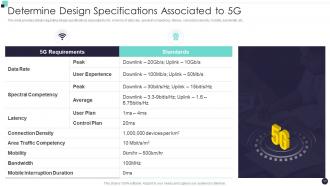
Slide 11: This slide provides details regarding design specifications associated to 5G in terms of data rate, spectral competency, latency, etc.
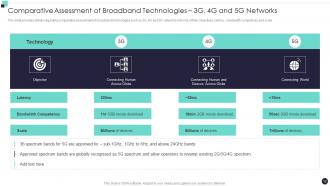
Slide 12: This slide provides details regarding comparative assessment of broadband technologies such as 3G, 4G and 5G networks.
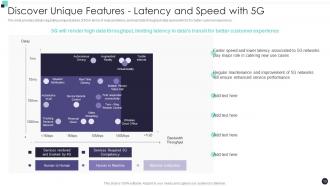
Slide 13: This slide provides details regarding unique features of 5G in terms of reduced latency and high data throughput data speed.
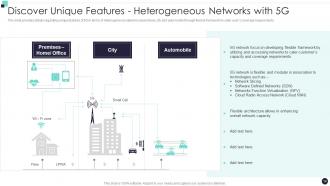
Slide 14: This slide provides details regarding unique features of 5G in terms of heterogeneous networks at premises, etc.
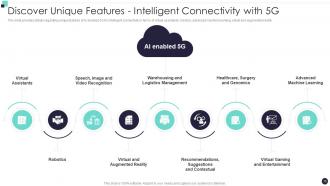
Slide 15: This slide provides details regarding unique features of AI enabled 5G for intelligent connectivity in terms of virtual assistants, etc.
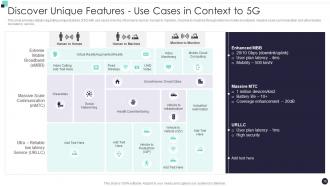
Slide 16: This slide provides details regarding unique features of 5G with use cases in terms of human to human, human to machine, etc.
Slide 17: This slide depicts title for ten topics that are to be covered next in the template.
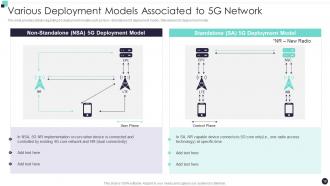
Slide 18: This slide provides details regarding 5G deployment models such as Non – Standalone 5G deployment model , Standalone 5G deployment model.
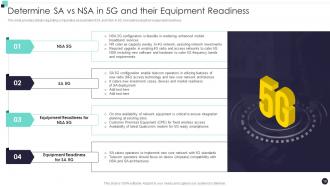
Slide 19: This slide provides details regarding comparative assessment of SA and NSA in 5G and addressing their equipment readiness.
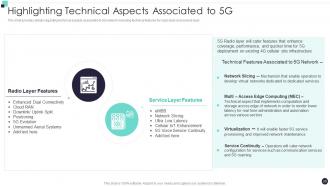
Slide 20: This slide provides details regarding technical aspects associated to 5G network including technical features for radio layer and service layer.
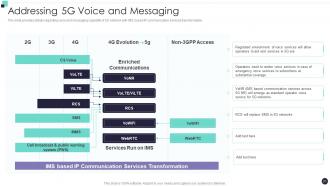
Slide 21: This slide provides details regarding voice and messaging capability of 5G network with IMS based IP communication services transformation.
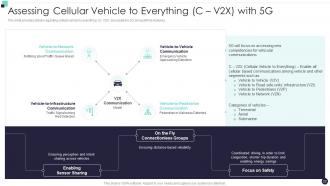
Slide 22: This slide provides details regarding cellular vehicle to everything (C- V2X) associated to 5G along with its features.
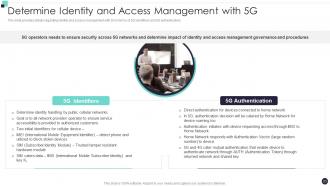
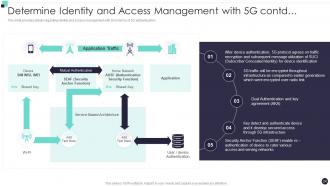
Slide 23: This slide provides details regarding identity and access management with 5G in terms of 5G identifiers and 5G authentication.
Slide 24: This slide provides details regarding identity and access management with 5G in terms of 5G authentication.
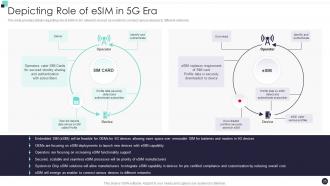
Slide 25: This slide provides details regarding role of eSIM in 5G networks and act as enabler to connect various devices to different networks.
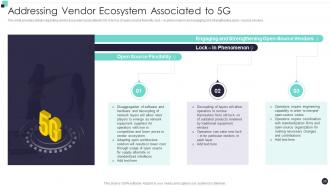
Slide 26: This slide provides details regarding vendor ecosystem associated to 5G in terms of open-source flexibility, etc.
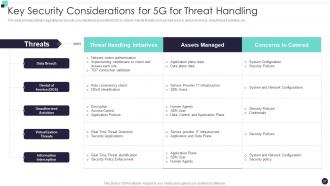
Slide 27: This slide provides details regarding key security considerations associated to 5G in order to handle threats.
Slide 28: This slide depicts title for four topics that are to be covered next in the template.
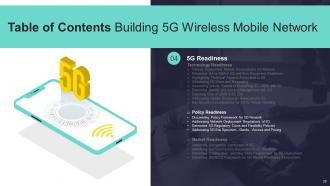
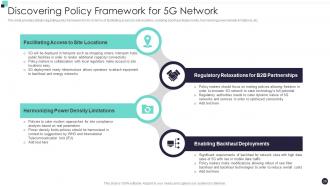
Slide 29: This slide provides details regarding policy framework for 5G in terms of facilitating access to site locations, etc.
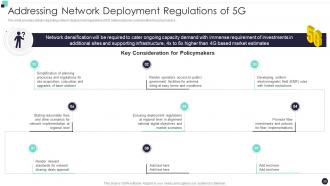
Slide 30: This slide provides details regarding network deployment regulations of 5G addressing key consideration for policymakers.
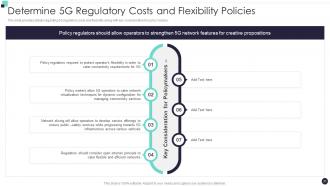
Slide 31: This slide provides details regarding 5G regulatory costs and flexibility along with key consideration for policy makers.
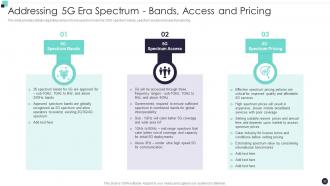
Slide 32: This slide provides details regarding various 5G era spectrum in terms of 5G spectrum bands, spectrum access and spectrum pricing.
Slide 33: This slide depicts title for four topics that are to be covered next in the template.
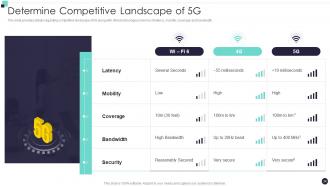
Slide 34: This slide provides details regarding competitive landscape of 5G along with other technologies in terms of latency, mobility, coverage and bandwidth.
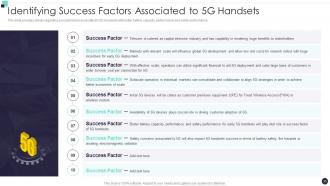
Slide 35: This slide provides details regarding success factors associated to 5G handsets with better battery capacity, performance and safety performance.
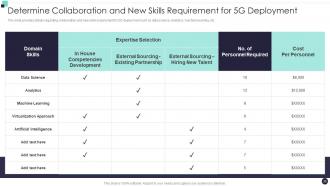
Slide 36: This slide provides details regarding collaboration and new skills requirement for 5G deployment such as data science, analytics, machine learning, etc.
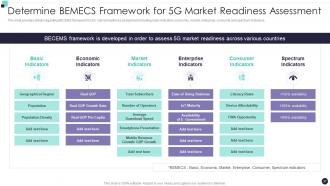
Slide 37: This slide provides details regarding BECEMS framework for 5G market readiness assessment.
Slide 38: This slide depicts title for eight topics that are to be covered next in the template.
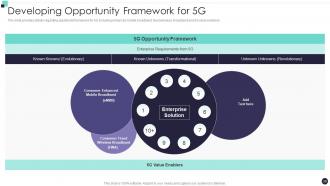
Slide 39: This slide provides details regarding opportunity framework for 5G including enhanced mobile broadband, fixed wireless broadband and 5G value enablers.
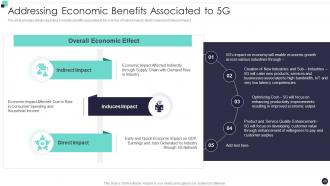
Slide 40: This slide provides details regarding economic benefits associated to 5G in terms of indirect impact, direct impact and induced impact.
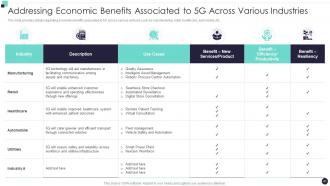
Slide 41: This slide provides details regarding economic benefits associated to 5G across various verticals such as manufacturing, retail, healthcare, automobile, etc.
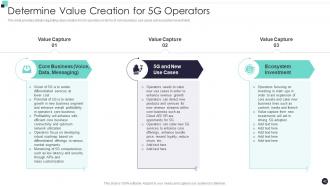
Slide 42: This slide provides details regarding value creation for 5G operators in terms of core business, use cases and ecosystem investment.
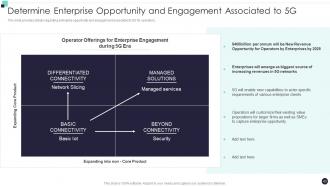
Slide 43: This slide provides details regarding enterprise opportunity and engagement associated to 5G for operators.
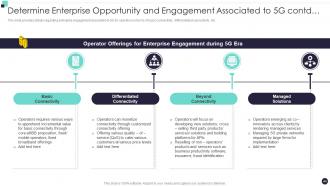
Slide 44: This slide provides details regarding enterprise engagement associated to 5G for operators in terms of basic connectivity, differentiated connectivity, etc.
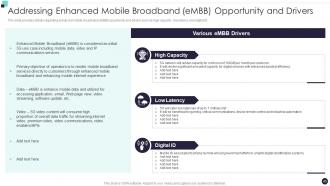
Slide 45: This slide provides details regarding enhanced mobile broadband (eMBB) opportunity and drivers such as high capacity, low latency and digital ID.
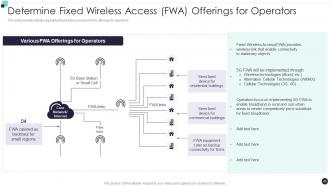
Slide 46: This slide provides details regarding fixed wireless access (FWA) offerings for operators.
Slide 47: This slide depicts title for five topics that are to be covered next in the template.
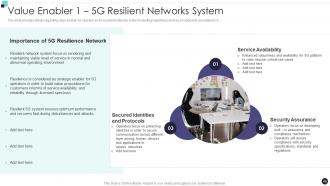
Slide 48: This slide provides details regarding value enabler for operator as 5G resilient networks system including importance and key components associated to it.
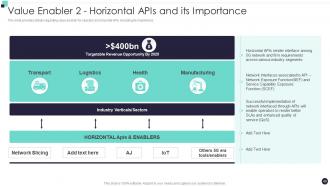
Slide 49: This slide provides details regarding value enabler for operator as horizontal APIs including its importance.
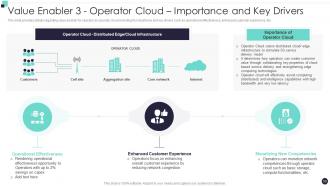
Slide 50: This slide provides details regarding value enabler for operator as operator cloud.
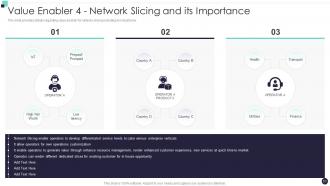
Slide 51: This slide provides details regarding value enabler for network slicing including its importance.
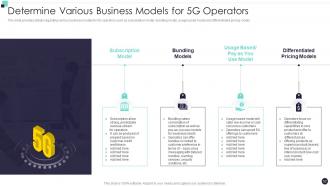
Slide 52: This slide provides details regarding various business models for 5G operators such as subscription model, bundling model, etc.
Slide 53: This slide depicts title for seven topics that are to be covered next in the template.
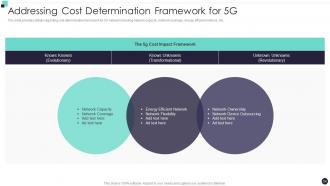
Slide 54: This slide provides details regarding cost determination framework for 5G network including network capacity, network coverage, energy efficient network, etc.
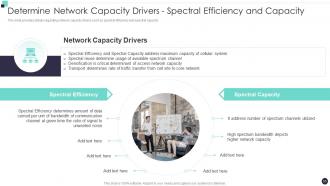
Slide 55: This slide provides details regarding network capacity drivers such as spectral efficiency and spectral capacity.
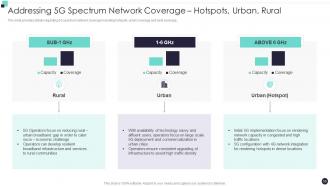
Slide 56: This slide provides details regarding 5G spectrum network coverage including hotspots, urban coverage and rural coverage.
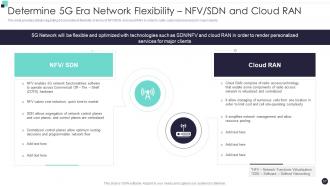
Slide 57: This slide provides details regarding 5G era network flexibility in terms of NFV/SDN and cloud RAN in order to cater customized services for major clients.
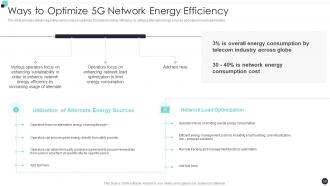
Slide 58: This slide provides details regarding various ways to optimize 5G network energy efficiency by utilizing alternate energy sources.
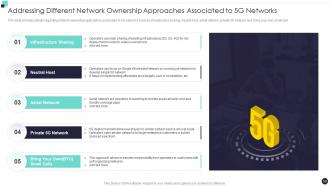
Slide 59: This slide provides details regarding network ownership approaches associated to 5G networks.
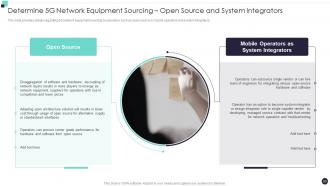
Slide 60: This slide provides details regarding 5G network equipment sourcing by operators such as open source or mobile operators and system integrators.
Slide 61: This is the icons slide.
Slide 62: This slide presents title for additional slides.
Slide 63: This slide depicts 30-60-90 days plan for projects.
Slide 64: This slide exhibits weekly timeline.
Slide 65: This slide shows roadmap.
Slide 66: This slide shows about your company, target audience and its client's values.
Slide 67: This slide exhibits yearly timeline.
Slide 68: This slide displays puzzle.
Slide 69: This slide depicts posts for past experiences of clients.
Slide 70: This slide displays Venn.
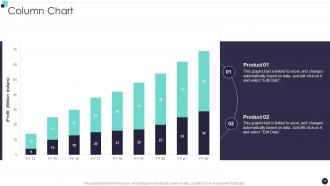
Slide 71: This slide exhibits yearly profits column charts for different products. The charts are linked to Excel.
Slide 72: This slide exhibits ideas generated.
Slide 73: This is thank you slide & contains contact details of company like office address, phone no., etc.
Building 5G Wireless Mobile Network Powerpoint Presentation Slides with all 78 slides:
Use our Building 5G Wireless Mobile Network Powerpoint Presentation Slides to effectively help you save your valuable time. They are readymade to fit into any presentation structure.








FAQs for Building 5G Wireless Mobile Network
Okay so 5G is insanely fast - like 10-100x faster than 4G. You could literally download a whole movie in seconds. But honestly? The speed isn't even the coolest part. It's the latency that's mind-blowing - drops from 50ms to just 1-10ms. That means zero lag for gaming, plus it opens up crazy stuff like remote surgery and self-driving cars that actually work. Oh, and AR apps won't be garbage anymore! If you're building anything that needs real-time responses, you'll definitely want to plan around 5G.
So 5G is pretty much a game-changer for IoT stuff. Way faster speeds and almost zero lag, which means your smart home devices actually respond when you want them to. The crazy part? It can handle like a million devices per square kilometer - 4G maxes out at a few thousand, which honestly explains why my Ring doorbell is so slow sometimes. Real-time apps become actually viable too. Think self-driving cars that don't hesitate at intersections or doctors doing remote surgeries without worrying about connection hiccups. If you're setting up any IoT projects, definitely plan around 5G capabilities.
Dude, the costs are absolutely brutal - we're talking massive infrastructure investment. Then you've got countries fighting over spectrum like it's the last slice of pizza. Security concerns create tons of political drama, especially around Chinese vendors. Rural areas? Total headache since there's no money in covering sparse populations. Government subsidies help, plus carriers can share infrastructure costs. Hybrid networks work too - blend 5G with existing 4G instead of ripping everything out. Start with cities first, they're the low-hanging fruit. Oh, and get your regulatory paperwork moving early because that approval process drags on forever.
Dude, 5G is seriously changing mobile gaming and VR stuff. Response times drop below 10ms - no more annoying lag when you're trying to clutch. You can actually stream console-level games straight to your phone now without those ridiculous downloads. Cloud gaming finally works like it should. VR gets crazy good because your headset doesn't have to do all the heavy lifting anymore - just sends the processing to the cloud. Honestly, I was skeptical at first, but there's literally zero delay between moving your head and seeing it happen. Worth downloading some 5G gaming apps just to mess around and see what I mean.
Okay so edge computing is basically moving all that data processing super close to where you actually are instead of shipping it off to some cloud server halfway across the world. 5G makes this insane because you're getting millisecond response times. Like, imagine trying to use AR or having a self-driving car that has to wait for "loading..." - total nightmare. The magic happens when 5G's crazy speeds team up with local processing power. No more waiting for your data to travel to Nebraska and back. Honestly, if you're building anything that needs real-time responses, you'd be nuts not to think about edge infrastructure right from the start.
Dude, 5G is gonna be huge for those industries. Healthcare gets real-time remote surgeries and instant patient monitoring - which is honestly pretty wild when you think about it. Autonomous cars will finally be able to talk to each other safely, no more of this "maybe it'll work" stuff. Manufacturing gets crazy smart too. Every machine can communicate instantly, so production gets optimized in real-time. The whole thing comes down to split-second decisions that just weren't possible before. If you're working in any of these areas, definitely start brainstorming how instant connectivity could shake up what you're already doing.
So basically, 5G opens up way more attack points because everything's getting connected now. Network slicing is cool but hackers might jump between those virtual networks if there's bugs. Supply chain stuff is sketchy too - honestly, the whole Huawei situation shows how messy vendor trust gets. Oh, and monitoring's trickier since everything's more spread out than old networks. Keep your patches updated and stick with vendors who aren't shady about their security practices. It's kind of a trade-off between all the fancy new features and actual safety.
So here's the thing with 5G - those super high frequencies they use in cities? They're basically blocked by everything. Walls, trees, even heavy rain will mess with the signal. It's honestly kind of ridiculous how finicky it is compared to 4G. Cities end up needing way more cell towers because of this, even though you'd think they'd have better coverage. Rural areas get the lower frequency 5G that travels much farther but isn't nearly as fast. If you're doing any network planning stuff, just plan on needing tons more access points for urban areas.
5G's actually happening in some pretty cool places right now. Self-driving cars need it most - Waymo and those guys can't function without crazy fast response times. Smart cities are jumping on it for traffic control, emergency stuff. Remote surgery is wild, they're doing real trials with doctors operating from miles away. Manufacturing's testing robotic automation, plus AR for when machines break down. Oh and gaming companies keep pushing cloud gaming, though honestly your home internet probably sucks anyway so
-
Thanks to SlideTeam, we have an ideal template to present all the info we need to cover. Their slides give our numbers and projections a more clear and enchanting look.
-
Amazing product with appealing content and design.