

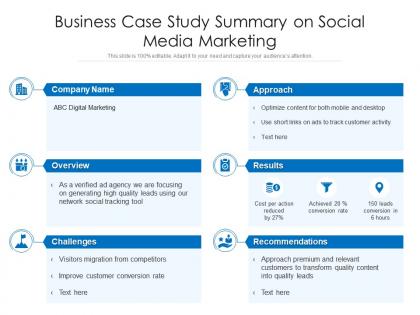
Business case study summary on social media marketing




Try Before you Buy Download Free Sample Product
 Impress Your
 Audience
 100%
100% Editable
 Save Hours
 of Time


Our Business Case Study Summary On Social Media Marketing are topically designed to provide an attractive backdrop to any subject. Use them to look like a presentation pro.
People who downloaded this PowerPoint presentation also viewed the following :
Business case study summary on social media marketing with all 2 slides:
Use our Business Case Study Summary On Social Media Marketing to effectively help you save your valuable time. They are readymade to fit into any presentation structure.
FAQs for Business case study summary on
The primary goals included increasing brand awareness, driving website traffic, generating qualified leads, boosting customer engagement, and expanding social media following across key platforms. Through strategic content creation and targeted advertising, the campaign aimed to enhance brand visibility, streamline customer acquisition processes, and ultimately deliver measurable ROI while strengthening competitive positioning in an increasingly digital marketplace.
The target audience's demographics, behaviors, and platform preferences directly influenced platform selection by determining where they were most active, engaged, and receptive to messaging. For example, B2B campaigns targeting executives favored LinkedIn for professional networking, while retail brands chose Instagram and TikTok for younger consumers, ultimately ensuring maximum reach and engagement rates.
Key performance indicators measured included engagement rates, reach and impressions, click-through rates, conversion rates, and return on ad spend (ROAS). These metrics enable businesses to track brand awareness, audience interaction, and revenue generation across platforms, with many organizations finding that combining vanity metrics with conversion data delivers comprehensive campaign insights and strategic optimization opportunities.
Creative strategy enhanced social media marketing effectiveness by establishing distinctive brand positioning, developing compelling visual narratives, and creating shareable content that resonated with target audiences. Through strategic storytelling and consistent messaging across platforms, organizations streamlined audience engagement, accelerated brand recognition, and delivered measurable increases in conversion rates, ultimately enabling competitive advantage in increasingly crowded digital landscapes.
Budget considerations included cost-per-click targets, audience reach optimization, content production expenses, platform-specific advertising rates, and performance tracking tools investments. These constraints influenced channel selection, creative formats, and campaign duration, with many organizations finding that strategic budget allocation across high-performing platforms delivers better ROI than spreading resources too thin.
The case study utilized comprehensive social media management platforms like Hootsuite, Buffer, and Sprout Social for scheduling and monitoring, alongside analytics tools including Google Analytics, Facebook Insights, and native platform dashboards. These integrated solutions enabled streamlined content distribution, real-time performance tracking, and detailed audience engagement analysis, with many organizations finding that combining management and analytics tools delivers enhanced ROI measurement and strategic optimization capabilities.
Audience engagement varied significantly across social media channels, with visual platforms like Instagram and TikTok delivering higher interaction rates through stories, reels, and user-generated content, while LinkedIn excelled for B2B engagement and Facebook maintained strong community-building capabilities. These insights reveal that successful brands tailor content formats to each platform's strengths, with many companies finding that diversified channel strategies increase overall reach and customer touchpoints.
User-generated content served as authentic social proof that amplified campaign reach through organic sharing, peer recommendations, and genuine customer testimonials across multiple platforms. This approach significantly enhanced credibility by showcasing real experiences rather than branded messaging, with retail brands and hospitality companies finding that UGC delivers higher engagement rates and builds stronger community trust.
The social media strategy aligned with broader marketing objectives by reinforcing brand messaging, driving traffic to key campaigns, and supporting customer acquisition goals across multiple touchpoints. Through strategic content planning, targeted advertising, and cross-platform integration, brands like Nike and Starbucks seamlessly connect social engagement with sales funnels, ultimately delivering measurable ROI and enhanced customer lifetime value.
Common execution challenges include budget constraints limiting ad reach, algorithm changes reducing organic visibility, content creation bottlenecks, and difficulty measuring ROI across platforms. Many brands find that maintaining consistent engagement while adapting to platform updates, coordinating cross-channel messaging, and scaling quality content production ultimately requires strategic resource allocation and agile campaign management approaches.
Crisis management strategies in this case study involved rapid response protocols, transparent communication channels, stakeholder engagement frameworks, and real-time monitoring systems to address emerging issues. Through proactive social listening and coordinated messaging across platforms, the organization maintained brand reputation, minimized negative sentiment, and restored customer confidence, while transforming potential setbacks into opportunities for deeper audience engagement and trust-building.
Social media marketing campaign analytics typically reveal demographic trends including age distribution shifts, geographic engagement patterns, gender-based content preferences, income level correlations, and device usage behaviors. These insights enable organizations to refine targeting strategies, optimize content delivery, and enhance audience segmentation, with many brands finding that demographic data drives significantly improved conversion rates and customer acquisition costs.
The brand's voice evolved by embracing authentic storytelling, real-time engagement, and platform-specific content strategies while maintaining consistent core messaging across channels. Through personalized interactions, user-generated content integration, and responsive community management, brands like Nike and Starbucks successfully transformed from broadcasting to conversational approaches, ultimately delivering stronger customer relationships and enhanced brand loyalty.
The campaign leveraged micro-influencers across targeted demographics, strategic brand partnerships with complementary companies, affiliate marketing networks, and cross-promotional collaborations with industry leaders. These partnerships amplified reach by expanding audience touchpoints, enhancing credibility through trusted voices, and creating authentic engagement, with many brands finding that influencer-driven content generates significantly higher conversion rates and sustainable community growth.
Key lessons include establishing clear metrics before campaign launch, maintaining consistent brand voice across platforms, engaging authentically with audience feedback, leveraging user-generated content strategically, and adapting quickly to platform algorithm changes. These insights enable organizations to streamline their social media approach, enhance audience engagement, and ultimately deliver measurable ROI, with many brands finding that consistent application of these principles significantly improves their competitive positioning.
-
Excellent products for quick understanding.
-
Best Representation of topics, really appreciable.