


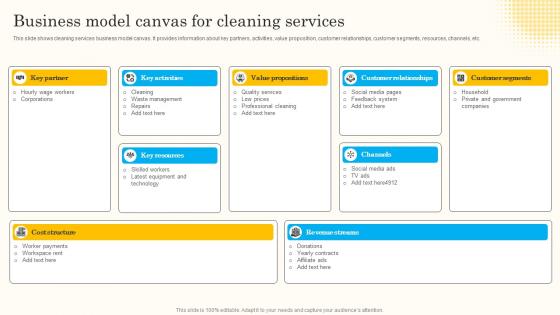
Business Model Canvas For Cleaning Services




Try Before you Buy Download Free Sample Product
 Impress Your
 Audience
 100%
100% Editable
 Save Hours
 of Time


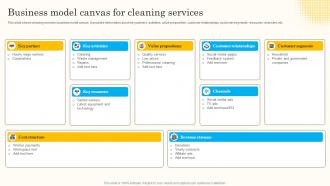
This slide shows cleaning services business model canvas. It provides information about key partners, activities, value proposition, customer relationships, customer segments, resources, channels, etc.
People who downloaded this PowerPoint presentation also viewed the following :
Business Model Canvas For Cleaning Services with all 6 slides:
Use our Business Model Canvas For Cleaning Services to effectively help you save your valuable time. They are readymade to fit into any presentation structure.





FAQs for Business Model Canvas
So there are nine blocks total: Customer Segments, Value Propositions, Channels, Customer Relationships, Revenue Streams, Key Resources, Key Activities, Key Partnerships, and Cost Structure. The layout actually makes sense once you see it - your Value Propositions connect directly to Customer Segments, while Key Activities and Resources back up everything you're promising. Channels and Customer Relationships sit right in the middle (which is pretty logical). Revenue and costs anchor the money stuff. Honestly though, just reading about it is kinda useless. You'll get it way faster by actually filling one out. I'd start with figuring out who you're serving first, then work through what value you're giving them.
Get on the phone with your actual customers - seriously, this makes all the difference. Ask them what problems you're solving and what results they're seeing. Don't just assume you know who they are or what they need. The value proposition canvas is clutch for mapping this stuff out properly. Look at the jobs they're trying to get done, their pain points, and what wins they want. Then figure out how your product creates those pain relievers and gains. I can't stress this enough though - validate everything with real feedback and data, not just your best guesses.
Honestly, the Business Model Canvas is a game-changer for getting teams aligned. You know how meetings can turn into people just talking past each other? This thing puts everything visual so you can literally point and say "we're not on the same page here." Forces everyone to get concrete instead of throwing around vague business buzzwords (guilty as charged sometimes). Nine boxes might sound simple, but it's brilliant - suddenly you're debating actual value props instead of just "strategy" whatever that means. Next planning session, throw one up on the wall. You'll be shocked how fast decisions happen when the whole picture's right there.
So basically, fill out each section of the canvas with your best guesses about customers, value props, all that stuff. Then go test the scariest assumptions first - usually who'll actually buy this thing and why they'd want it. Honestly, I've seen too many people skip this step and regret it later. Make new versions as you learn more and things change. The whole visual layout thing is clutch because you'll spot where your logic doesn't make sense. Oh, and definitely get out there and talk to real people who might actually pay you. That's where the magic happens.
Your customer segments? That's where everything starts. I mean, how can you know what value to offer if you don't know who you're talking to? Once you nail down 2-3 specific customer types, the rest of your canvas practically fills itself out. You'll know which channels they actually use, what messaging hits different, how they want to interact with you. I've watched teams try to do this backwards - they end up with this weird, vague canvas that doesn't really make sense. Get specific about your customers first, then work outward from there.
Your Business Model Canvas isn't something you create once and forget about. Market changes constantly - new competitors pop up, customers want different things, tech evolves. When that happens, figure out which parts of your canvas need updating. Revenue streams might shift, or your value prop needs work. I swear, companies mess this up all the time by treating it like gospel. Review yours every quarter at minimum. But honestly? If something major hits your industry, don't wait - adjust immediately. The whole point is staying flexible enough to adapt quickly.
Don't be vague - that's the killer mistake I see everywhere. Like writing "great customer service" instead of actually explaining what makes you different. Also, people fill these out once and never touch them again, which is honestly pretty useless. Your business changes, so update the damn thing! Test your riskiest assumptions first with real customers, not just your team sitting around guessing. I can't stress this enough - get out there and validate stuff before you build anything. Otherwise you're just making expensive mistakes later. Oh, and treat it like a living document, not homework you finish once.
So the Business Model Canvas is actually perfect for strategic planning - just walk through all nine blocks systematically. Your team can see exactly where you are now versus where you need to be. Honestly, it beats those endless strategy meetings that go absolutely nowhere (we've all been there). Get a big physical canvas and have everyone move sticky notes around - people actually engage when they're up and moving. Map out the gaps between different elements, spot your dependencies. Oh, and definitely review it quarterly or you'll forget about it completely. Trust me, it keeps everyone focused on what actually moves the needle.
Honestly, Miro and Mural are total lifesavers for this stuff - especially if you're working with a remote team. Google Slides works fine too if you're just doing it solo. There's this Value Proposition Canvas thing that pairs really well with the business model one, goes deeper into customer stuff. Oh, and definitely check out "Business Model Generation" - tons of real examples in there. Strategyzer has some decent online templates if you want to get fancy with it. I'd say just start with whatever your team already knows how to use, then maybe upgrade later if you need more features.
Revenue streams are like the spine of your whole business model - they touch literally everything else. Think about it: subscription revenue needs totally different customer relationships than one-time sales do. I've watched founders completely flip their entire approach once they realized their revenue plan didn't work with their actual resources. Your costs change big time depending if you're going for high volume or premium pricing. Honestly, just sketch out 2-3 different revenue ideas first and trace how each one would mess with your other building blocks. It's wild how much shifts when you change that one piece.
Honestly, mapping out competitor canvases is like having x-ray vision into their whole business model. You'll see exactly how they make and spend money, plus where they're dropping the ball. I always start with 2-3 direct competitors - sounds boring but trust me, patterns jump out immediately. Maybe they're all ignoring mobile users or burning cash on fancy offices while you could go lean. You might even find weird partnership opportunities you never thought of. The best part? Once it's all sketched out, their "secret sauce" becomes pretty obvious and you can do it better.
Dude, just throw it up on a wall during your next meeting. Seriously. People get SO much more engaged when they can actually see how everything connects - your customers, revenue, value prop, all of it. It's way better than trying to explain abstract stuff verbally. I've seen stakeholders go from glazed-over looks to actually pointing at specific boxes and giving real feedback instead of those useless "looks good" comments. Think blueprints vs. just describing a house, you know? The visual just clicks for people. Plus you'll get way better discussions about what trade-offs actually make sense.
Netflix totally nailed this - went from mailing DVDs to streaming by rethinking their whole business model around digital delivery and data. Uber mapped out how drivers and riders needed completely different value props in their two-sided marketplace. Airbnb realized they weren't selling rooms, they were selling "belonging anywhere" (honestly kind of cheesy but it worked). Even P&G used it for their crowdsourced innovation stuff. The key thing? These weren't just startups winging it - they actually worked through each piece systematically. You should probably map out your current model first before trying anything crazy.
So the Business Model Canvas is actually perfect for this. You map out all your assumptions - customers, value props, revenue - then test each piece with lean experiments. Way better than those massive business plans nobody reads, honestly. Quick tests beat lengthy documents every time. When experiments show you're wrong (and they will), pivoting is super simple since everything's visual. Just fill out the canvas with your best guesses first. Then figure out which assumptions are riskiest and test those. It's like having a blueprint you can actually change without rewriting everything.
The Canvas works great for getting the big picture, but it's not gonna cut it for complex stuff. Financial modeling? Nope. Detailed competitive analysis? You'll need other tools. Honestly, those nine boxes are pretty limiting when you're dealing with multi-sided platforms or heavy regulatory requirements - there's just too much nuance to cram in there. Think of it more like sketching out ideas rather than creating detailed blueprints. I'd use it for initial brainstorming with your team, then switch to financial projections and SWOT analysis when you need to dive deeper. It's a starting point, not the whole toolkit.
-
Crisp and neat slides. Makes it fun and easier to curate presentations.
-
Extensive range of templates! Highly impressed with the quality of the designs.