


Business Model Canvas For Mobile Application Development Company




Try Before you Buy Download Free Sample Product
 Impress Your
 Audience
 100%
100% Editable
 Save Hours
 of Time


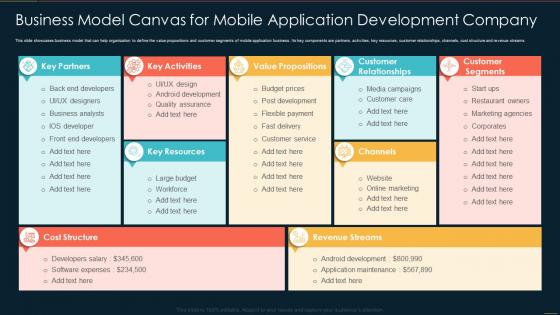
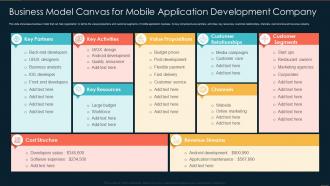
This slide showcases business model that can help organization to define the value propositions and customer segments of mobile application business. Its key components are partners, activities, key resources, customer relationships, channels, cost structure and revenue streams
People who downloaded this PowerPoint presentation also viewed the following :
Business Model Canvas For Mobile Application Development Company with all 6 slides:
Use our Business Model Canvas For Mobile Application Development Company to effectively help you save your valuable time. They are readymade to fit into any presentation structure.





FAQs for Business Model Canvas For Mobile
So the Business Model Canvas breaks down into 9 pieces - Customer Segments, Value Propositions, Channels, Customer Relationships, Revenue Streams, Key Resources, Key Activities, Key Partnerships, and Cost Structure. Think of it as your whole business on one page, which honestly makes workshops way less painful. Everything connects though - like your value prop has to actually match who you're targeting. I always tell people to nail down Value Propositions and Customer Segments first, then build out from there. Makes the rest click into place easier. It's clutch for pitches too.
Dude, the Business Model Canvas is clutch for startups. It gets all nine pieces of your business onto one page - customer segments, value props, revenue streams, everything. Way better than writing some 40-page business plan that nobody reads anyway. You'll spot holes in your thinking fast, and pivoting becomes way easier. Your team gets it instantly when you show them. I'd fill one out ASAP, then revisit it monthly as you figure out what actually works with customers. Trust me, it saves so much headache down the road.
Yeah, it's super adaptable actually. Tech companies load up the key resources section with IP and data stuff, while manufacturers focus more on physical assets and supply chains. Service businesses have totally different cost structures than product ones - learned that the hard way when I was helping my cousin with his consulting thing. Works for restaurants, SaaS companies, even nonprofits. The nine boxes stay the same but you just swap in whatever fits your industry. Honestly, I'd start by mapping out how successful companies in your space do it first. Gives you the patterns to work with.
Figure out who actually has the pain point you're solving and will pay money for it. Don't go super broad like "millennials" - that's useless honestly. Instead think "working parents 25-35 who drive to work daily." Way more actionable. Talk to these people early to test if you're even right about what they need. Pick segments that are big enough to actually matter but focused enough that you can craft something they really want. I'd stick with maybe 2-3 max so you don't end up all over the place. The specificity is what'll save you time later.
Your value prop is literally the foundation everything else gets built on. It shapes who you're targeting, which channels make sense, how you price things - basically every major decision flows from there. Without it? You're just randomly trying stuff and crossing your fingers. Honestly, I've seen so many startups skip this step and wonder why nothing's working. Start by getting crystal clear on the exact problem you're solving. Then figure out why someone would pick you over the ten other options they probably have. Once that clicks, everything else gets way easier.
Honestly, the Business Model Canvas is a game-changer for seeing your whole business at once. Instead of digging through random documents, you get all nine pieces - value props, revenue, partnerships, whatever - laid out visually. Makes it so much easier to catch what's not working. The cool part? You can sketch different versions super quick. Testing new customer segments or revenue ideas becomes way less scary when you're just moving boxes around on paper first. We started doing canvas sessions every few months with the team (pizza definitely helps). It's wild how much clarity you get from that one-page view.
Don't treat it like a one-time thing - the canvas should change constantly as you learn more. Also, being vague kills the whole point. Writing "great service" in your value prop box? Useless. Get specific about what makes you different. Here's what drives me crazy though - people fill these out alone in their office instead of talking to actual customers first. Your assumptions mean nothing without validation. Oh and stop obsessing over making it look perfect! Just use sticky notes, keep it messy, and update it when you get real feedback. The pretty version comes later.
Partnerships are basically the glue holding your whole business model together. They mess with almost every part of your canvas - what activities you'll handle in-house, which resources you actually need to buy vs get from others, how much stuff costs. Plus they can totally change what you're offering customers. I've watched companies do complete 180s just because they found the right partner (wild how that works). The trick is mapping out exactly how each partnership hits your other blocks. Don't just throw partner names in that one box and call it done - trace how they ripple through everything else.
Totally! The Business Model Canvas works great for nonprofits, you just gotta switch up a few parts. Replace "revenue streams" with funding sources - grants, donations, those annoying fundraising galas. Your value prop becomes the social impact instead of making money. Customer segments get tricky because you're actually serving two groups: the people you help AND the donors writing checks. Honestly took me forever to realize that donor piece when I first tried this. But once you flip from thinking profit to impact, everything clicks. Map it out with those tweaks and you'll see how your whole operation connects.
Try Miro or Mural if you want something fancy - they're great for real-time collaboration with sticky notes and all that. Google Jamboard works fine too if you're cheap like me lol. Your team can drop comments and images right on the canvas, which makes getting feedback so much smoother. There's also Strategyzer's official BMC tool if you need the fancy validation features. Short sentences work. But honestly? Just use whatever platform your team already knows. The actual brainstorming process matters way more than which tool you pick.
Quarterly reviews are the bare minimum, but honestly the best teams I've seen treat it like a living doc. When big stuff happens - new competitors, market changes, customer feedback that makes you go "oh shit" - that's when you should pull it out immediately. Do a quick monthly check too. Are your core assumptions still true? Because let me tell you, nothing's worse than realizing your canvas has been wrong for months. Block out 2 hours this Friday and just walk through each section with your team. Don't let it become wall art.
Yeah, so Airbnb and Uber both used the Business Model Canvas when they were figuring things out early on. Airbnb started with just conferences and events, but the canvas helped them see they could do way more with regular travel. Uber mapped their whole driver-rider thing, which was smart for scaling both sides at once. Even big companies like Nestlé use it now - though honestly startups get way more out of it. It's basically a way to stress-test your idea by working through all nine sections. Forces you to think about stuff you'd probably skip otherwise.
Think of it as your business reality check - revenue streams show money coming in, costs show where it goes out. The real trick? Figuring out if what comes in actually covers what goes out plus some profit. I'd map each revenue stream against its specific costs - sounds boring but it's honestly eye-opening. You'll see which parts of your business actually make money versus just keeping you busy. Short version: high-margin revenue streams are your best friends. Some will surprise you with how little they actually contribute after you factor in all the costs.
Honestly, just start by actually talking to people - like, real potential customers. I know it sounds obvious but so many founders skip this part and wonder why their product flops. Throw together some quick surveys too, maybe test demand with a simple landing page. Build a basic prototype to see if your value prop actually resonates. A/B test the features that matter most. Oh, and don't ignore what competitors are doing - their data can save you time. Here's the thing though: test your scariest assumptions first, not the comfortable ones. Pick one assumption right now and figure out how to test it this week.
Dude, visuals are a game changer for Business Model Canvases. Color coding helps show how different blocks connect. Icons work great for customer segments or revenue streams - way better than boring text walls. I swear people just zone out with text-heavy stuff. Sticky notes are perfect for workshops since you can shuffle things around. Simple sketches or different shapes make concepts click faster. Actually, I learned this the hard way after watching a room full of executives stare blankly at my all-text canvas last year. Your team will get it so much quicker with visuals.
-
Enough space for editing and adding your own content.
-
Great product with effective design. Helped a lot in our corporate presentations. Easy to edit and stunning visuals.