

Business Model Canvas Toyota Business Model BMC SS




Try Before you Buy Download Free Sample Product
 Impress Your
 Audience
 100%
100% Editable
 Save Hours
 of Time


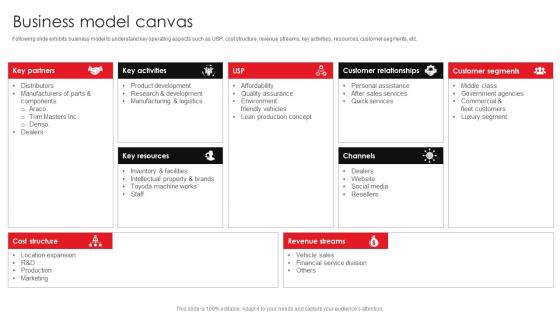
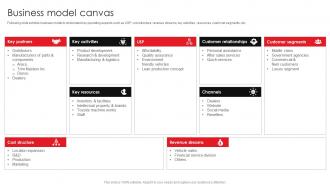
Following slide exhibits business model to understand key operating aspects such as USP, cost structure, revenue streams, key activities, resources, customer segments, etc.
People who downloaded this PowerPoint presentation also viewed the following :
Business Model Canvas Toyota Business Model BMC SS with all 9 slides:
Use our Business Model Canvas Toyota Business Model BMC SS to effectively help you save your valuable time. They are readymade to fit into any presentation structure.








FAQs for Business Model Canvas Toyota Business
Toyota's whole thing is reliability and efficiency - those Corollas literally run forever. Their secret is this continuous improvement philosophy called kaizen, where they make tiny tweaks constantly instead of huge overhauls. Pretty smart actually. The Toyota Production System focuses on lean manufacturing and just-in-time delivery, which keeps costs down while maintaining quality. They'd rather build long-term customer loyalty than chase quick cash grabs. What's interesting is how they nail both cost leadership AND quality differentiation at the same time. Most companies can't pull that off.
Honestly, Toyota's whole thing comes down to their lean manufacturing and kaizen mindset - basically everyone there is obsessed with cutting waste and improving stuff constantly. Their just-in-time production is genius because it keeps inventory costs crazy low. The hybrid tech investments paid off big time too. But what really sets them apart? It's how they've built these insanely tight relationships with suppliers that other companies just can't copy. I mean, the "Toyota Way" sounds cheesy but it actually works. Focus on how they mix operational excellence with innovation - that's where the magic happens and what you can steal for other situations.
Toyota's whole thing is basically never letting you down - they figured out ages ago that unreliable cars kill customer loyalty faster than anything. Quality control is huge for them, plus that kaizen improvement stuff they're always doing. Their dealers are pretty consistent too, which matters more than people think. What's smart is they actually use customer complaints to make better cars instead of just ignoring them. Oh, and their resale values don't tank like other brands. Honestly, it's genius - every car they make either builds or breaks their reputation. You should think about that with your stuff too.
Toyota's whole thing is building these super tight, long-term relationships instead of just buying from whoever's cheapest. Their keiretsu system is wild - they're basically joined at the hip with suppliers like Denso and Aisin, sharing tech and even investing in each other's companies. Creates this crazy web where everyone depends on everyone else, which somehow makes them all innovate faster. They do the same thing with EV and self-driving tech since no one company can figure that mess out alone. When you're mapping their business model, partnerships aren't just a side note - they're the foundation everything else sits on.
So Toyota basically perfected this "just-in-time" thing where parts show up exactly when needed - not sitting around collecting dust in warehouses. Cuts storage costs like crazy. They stick with the same suppliers for years (smart move honestly), and use this kanban system that's basically visual cues telling workers when to make stuff. I actually saw this in action at a factory once - pretty cool how smooth it runs. The main thing though? You can totally use this approach anywhere. Don't stockpile things you won't use right away.
Toyota's got this down to a science, honestly. Most money comes from selling cars, but they're way smarter than that. Financial services is massive for them - loans, leases, insurance, the whole thing. They also sell parts to competitors, which is kinda funny if you think about it. The mobility tech stuff is blowing up too with all these self-driving partnerships. What's brilliant is they don't just sell you a Camry and disappear. They'll finance it, insure it, fix it - basically milk every dollar from that relationship. It's actually genius business strategy when you break it down.
So Toyota basically flipped the script on sustainability - instead of treating it like some checkbox, they made it their whole thing. The Prius is obvious, but it actually runs way deeper. Their supply chain, manufacturing, even how they talk to customers - it's all built around being green. Smart move honestly, because it cuts costs AND drives innovation at the same time. Oh and here's the thing - when you're analyzing this, don't just stick it in the value prop section. Their environmental stuff touches literally every part of the business model. It's everywhere.
So Toyota's pretty smart about this - they go after budget-conscious people who just need something reliable, plus families wanting practical cars. Their hybrid push really clicks with environmentally-minded buyers too. First-time buyers are huge for them, along with rental companies and fleet sales. Honestly, their "boring but bulletproof" reputation works perfectly for what most people actually want. Lexus handles the luxury crowd separately. But yeah, instead of one generic approach, they tweak their marketing for each group. Makes sense when you think about it.
Yeah so Toyota's basically done a complete 180 on their whole business model. They used to be all about "hey, we make cars that don't break down" but now they're pushing themselves as this full mobility company. Wild shift, right? Their revenue streams include subscription stuff, data analytics, even ride-sharing deals now. Plus they're partnering with tech companies and energy providers instead of just car part suppliers. Oh and their customers aren't just regular people buying cars anymore - they're going after cities and big fleet operators too. When you're looking at their business canvas, that's the biggest change to focus on.
Toyota's whole thing is kaizen - they're obsessed with tiny improvements everywhere. The Prius hybrid tech gets all the attention, but honestly they innovate in boring stuff too like supply chains and factory processes. What's smart is they won't innovate just to be flashy. Every change has to cut costs, boost quality, or actually help customers somehow. The real genius? They built innovation into everyone's daily job instead of having some separate R&D team handle it. That's probably why they stay ahead - it's not top-down, it's everywhere.
So Toyota's going all-in on digital stuff but they're smart about it. Their cars now have IoT sensors everywhere, plus they're using AI for predictive maintenance. The whole lean manufacturing thing? Now it's powered by smart factories with real-time analytics. They're also jumping into mobility services - ride-sharing, autonomous vehicles (though honestly everyone's chasing that). Supply chain's totally digitized too for their just-in-time delivery. What's cool is they're not just slapping tech onto everything randomly. Instead, they're building it into what already works well for them. Focus on how the digital pieces strengthen their existing game rather than replacing it.
So Toyota's whole thing is lean manufacturing - they cut out anything wasteful in production. Just-in-time inventory means they're not hoarding expensive parts. Workers constantly suggest improvements through this "kaizen" thing, which honestly sounds exhausting but works. They also team up super closely with suppliers to slash costs everywhere. For your business model? Hunt down waste from the start. Short sentences work too. Build those money-saving tricks right into how you operate instead of trying to add them later when everything's already messy.
So Toyota's basically mastered this thing where they expand globally but don't just slap the same strategy everywhere. Smart, right? They'll push fuel efficiency hard in Europe but focus on durability when they're targeting emerging markets. The manufacturing stays lean across the board, but everything else - suppliers, R&D centers, distribution - gets tailored to each region. It's pretty brilliant actually. They keep their operational excellence intact while tweaking their value props for local needs. Worth looking at how they connect different revenue streams to what each geographic market actually wants.
So Toyota basically hits customers from every angle. Their dealership network is huge - that's still the main way people actually buy cars. But they're also all over digital now with websites, apps, social media for research. TV and radio ads are still a thing too, which honestly makes sense for cars. They do the whole auto show circuit and sponsorships. It's smart how they mix online convenience with the dealership experience since, let's be real, most people want to actually sit in a $30k purchase before buying it.
Toyota's whole thing is building their development around what customers actually tell them. They're crazy about continuous improvement, right? Those kaizen cycles get fed directly by customer insights - dealership feedback, warranty claims, surveys, all of it. Pretty smart if you ask me. They don't just wait to fix problems after launch either. Customer data helps them predict what people want before new models even hit the market. Quick iterations are key. For you - don't just collect feedback and forget about it. Set up channels that pipe customer insights straight into your dev cycles.
-
I faced no difficulty while searching for the slide I wanted. Honestly, the website’s interface is easy to use and can be navigated easily!
-
“The presentation template I got from you was a very useful one.My presentation went very well and the comments were positive.Thank you for the support. Kudos to the team!”