


Business Project Operational Readiness Assessment




Try Before you Buy Download Free Sample Product
 Impress Your
 Audience
 100%
100% Editable
 Save Hours
 of Time


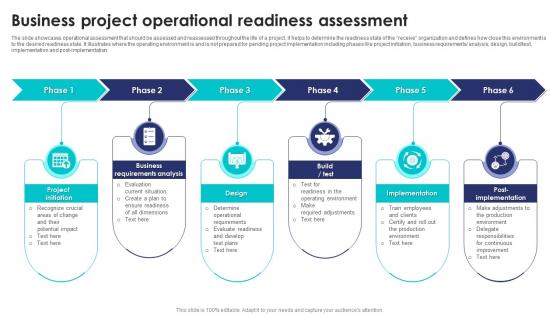
The slide showcases operational assessment that should be assessed and reassessed throughout the life of a project, it helps to determine the readiness state of the receive organization and defines how close this environment is to the desired readiness state. It illustrates where the operating environment is and is not prepared for pending project implementation including phases like project initiation, business requirements analysis, design, build test, implementation and post implementation.
People who downloaded this PowerPoint presentation also viewed the following :
Business Project Operational Readiness Assessment with all 6 slides:
Use our Business Project Operational Readiness Assessment to effectively help you save your valuable time. They are readymade to fit into any presentation structure.





FAQs for Business Project
Ok so operational readiness is basically getting your people, processes, and tech all lined up before you actually need them to work. Staff should know their jobs inside out. Your procedures can't be those boring manuals everyone ignores - they need to actually function in real life. Systems and communication channels have to be rock solid too. Honestly, the governance stuff is probably the most critical part - who makes decisions when shit hits the fan? It's like prepping for a major launch. Test everything first, make sure your team isn't confused, and always have backup plans ready. I'd start by checking these areas and tackle your worst gaps first.
Start with auditing your main areas - systems, processes, people, infrastructure. Use something structured like capability assessments to get real baseline numbers. Documentation and training records are boring but actually super important (learned this the hard way). Survey your teams since they catch stuff leadership totally misses. The whole point? Figure out your strong spots vs weak ones before anything breaks. Honestly, most companies skip this step and regret it later. Once you've got that full picture, prioritize what needs fixing and track how you're doing.
Look, training your people properly is what separates teams that actually work from complete disasters waiting to happen. Your staff needs to know their jobs cold and understand how everything connects - especially the backup plans when stuff inevitably breaks. I can't tell you how many "ready" operations I've watched completely implode because nobody knew what to do during an emergency. Skip the boring slide presentations though. Run actual drills and practice real scenarios. That's what prepares people for the chaos they'll face. Quality and safety depend on it.
Honestly, tech makes such a huge difference for staying operationally ready. You get real-time visibility into everything that's happening, plus automated checks handle the boring stuff. Monitoring tools track your performance metrics while predictive analytics help forecast when you'll need more capacity. Cloud platforms are amazing compared to the old nightmare of manually setting up servers - like night and day. The trick is picking tools that actually play nice with what you already have and give you useful info, not just pretty graphs you'll never look at. I'd start with one critical system first, then build from there once you see what works.
Start with uptime, MTTR, and incident response times - those three will tell you the most. Deployment success rates matter too since nobody wants to be scared of releasing code. Response times and error rates are obvious ones. Here's what people don't talk about enough though: track your on-call burden and how often alerts are waking people up for stupid reasons. Burned out engineers make terrible decisions at 3am, trust me. Don't go crazy trying to measure everything right away. Pick maybe 3-4 things that actually relate to whatever's currently making your life miserable.
Quarterly reviews are the bare minimum, but don't just stick to that schedule. Any big changes - new systems, team turnover, or when something actually breaks - should trigger updates right away. I've watched teams do annual reviews only and their plans become completely useless when shit hits the fan. Treat it like a living document instead of something collecting dust. Oh, and definitely put someone in charge of it with actual calendar reminders, otherwise it'll just keep getting bumped to "next month" forever.
Honestly, most places mess up because they don't have enough resources or nobody knows who's supposed to do what. Half the time your tech team is ready to go but operations is still figuring things out. Documentation? Good luck with that - it's either from 2019 or doesn't exist. People hate change too, even when the new way actually works better. Oh, and communication between teams is usually terrible. Start planning way earlier than you think you need to and make sure everyone agrees on who does what by when. Sounds obvious but you'd be surprised how often that gets skipped.
Honestly, regulations aren't just boxes to check - they literally define what "ready" means for your whole operation. Healthcare can't mess around with patient data or equipment because FDA and HIPAA will come down hard. Finance has SOX breathing down their necks, aviation's got FAA rules up the wazoo. Every industry has its own nightmare of compliance hoops. The smart move? Build that stuff right into your readiness plan from the start. Don't bolt it on later and wonder why everything's moving like molasses. Trust me on this one.
Don't let ops carry all the weight - spread that responsibility around. Bake readiness metrics into everyone's performance reviews. Those tabletop exercises where teams practice disaster scenarios? They're actually pretty engaging once people stop being weird about it. Keep your runbooks current because nothing sucks more than following outdated instructions during an actual crisis. Oh, and celebrate teams who spot problems early instead of just rewarding firefighting heroes. You want people thinking ahead, not just scrambling when stuff breaks. Makes the whole operation way smoother.
Look, scenario planning is basically your emergency playbook before stuff hits the fan. You map out "what if" situations - supply chain crashes, tech goes down, half your team calls in sick. Then figure out how you'd actually handle each mess with what you've got. Honestly, it's one of those things that seems boring until you really need it. The whole point is making you think through where you're vulnerable before it matters. I'd start simple - list your top 5 ways things could go sideways operationally, then walk through realistic responses. It forces you to spot dependencies you probably haven't thought about.
Dude, you absolutely need everyone talking to each other from the start. Silos kill launches - I've seen it happen so many times. Your engineering team might catch something that totally screws up marketing's timeline, or finance spots budget issues that mess with your whole plan. Most failures happen because departments weren't communicating properly. Get those cross-functional meetings going early and don't let them slide. Honestly, it's where the magic happens - catching problems before they blow up during go-live. Keep those channels open throughout the whole process.
Look, you've gotta figure out who actually needs what info first. Executives want the big picture stuff - high-level dashboards they can glance at. Your tech teams need all the nitty gritty details to do their jobs. Customers? Keep it simple with basic status updates. Honestly, most companies just spam everyone with identical reports and wonder why nobody reads them. Set up alerts for when things go sideways, but don't flood people's inboxes with useless noise. Different groups need different info at different times - build around that instead of doing some one-size-fits-all approach that helps nobody.
Honestly, you can't just wing operational readiness and hope for the best. Teams that actually succeed treat it like a real discipline instead of something they'll figure out later. Most failures I've seen? Poor communication between teams, crappy monitoring, or rushing stuff to production without testing properly. But the wins come from investing in automation, writing clear runbooks, and - this is key - actually practicing incident response regularly. Here's what kills teams every time: thinking "works on my machine" means it'll work in production. Spoiler: it won't. Build your readiness checklist now and bake it into every release.
Dude, org structure totally makes or breaks how fast you can react to problems. Flat structures? Way better for quick responses. All those approval layers in hierarchical setups just slow everything down - nobody can move without asking their boss's boss first. Matrix structures are honestly kind of a nightmare because you're juggling different managers pulling you in opposite directions. Team-based or decentralized structures work way better since people can actually make decisions on the spot. Bottom line: if you need your team moving fast during incidents, don't make them climb a corporate ladder just to fix something basic.
Don't treat flexibility and process like they're enemies - build them together from day one. Make your systems modular so they can shift fast without breaking your must-have stability stuff. Solid monitoring helps you catch problems early instead of scrambling later. Honestly, I've watched too many teams go full "break everything for speed" and it's just messy chaos. Figure out what absolutely can't fail first, then build your agility around those solid pieces. Oh, and automate the boring routine work - frees up your people to actually handle the curveballs when they come.
-
I was mind-blown by the services that SlideTeam provided me. Thanks a ton!
-
The Designed Graphic are very professional and classic.