


Operational readiness review powerpoint presentation slides





Try Before you Buy Download Free Sample Product
 Impress Your
 Audience
 100%
100% Editable
 Save Hours
 of Time


Introducing Operational Readiness Review PowerPoint Presentation Slides which helps to design and execute your project. With the help of project lifecycle PPT template, you can create a strategy to ensure the readiness of product dimensions. If you want to assess the project and reduce unnecessary threats, then use this operations readiness and assurance PowerPoint presentation complete deck. There are various performance measures divided based on area, category, and an indicator which you can mention using project transition PPT visuals. There are different vital elements like project initiation, business requirements, implementation, design, post-implementation, etc. which you can showcase using agile operational planning PowerPoint presentation slides. With the help of functional excellence PPT template, you can show the need for operational readiness in business. This project management PPT comprises of a total of nineteen slides that help you to generate an exclusive presentation. Therefore, download this ready-to-use product leadership PowerPoint presentation deck and effectively execute your product.
People who downloaded this PowerPoint presentation also viewed the following :
Content of this Powerpoint Presentation
Slide 1: This slide introduces Operational Readiness Review. State Your Company Name and begin.
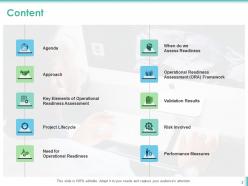
Slide 2: This slide shows Content of the presentation.
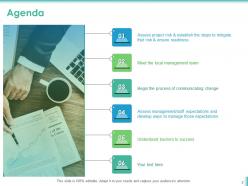
Slide 3: This is an Agenda slide. State your agendas here.
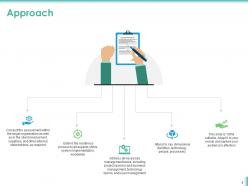
Slide 4: This slide presents Approach with related diagram and icons.
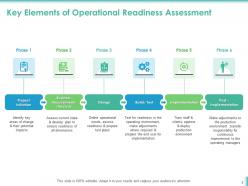
Slide 5: This slide represents Key Elements of Operational Readiness Assessment.
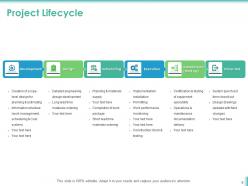
Slide 6: This slide showcases Project Lifecycle describing- Close Out, Commission (Start up), Execution, Scheduling, Design, Development.
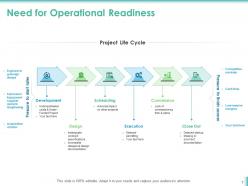
Slide 7: This slide shows Need for Operational Readiness with categories as- Close Out, Commission (Start up), Execution, Scheduling, Design, Development.
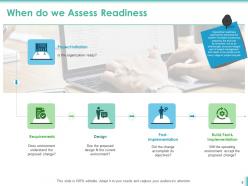
Slide 8: This slide presents When do we Assess Readiness describing- Requirements, Design, Build/Test & Implementation, Post- Implementation, Project Initiation.
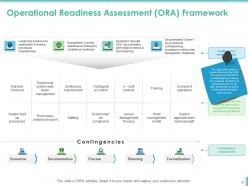
Slide 9: This slide displays Operational Readiness Assessment (ORA) Framework.
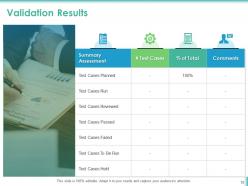
Slide 10: This slide showcases Validation Results in tabular form.
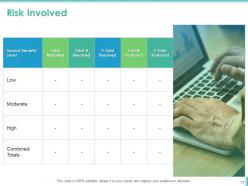
Slide 11: This slide represents Risk Involved with levels of impact.
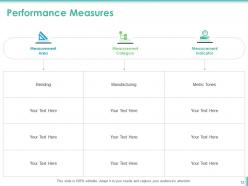
Slide 12: This slide shows Performance Measures with categories and indicators.
Slide 13: This slide displays Operational Readiness Review Icons.
Slide 14: This slide is titled as Additional Slides for moving forward.
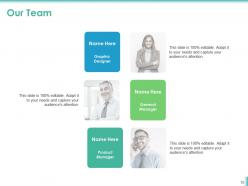
Slide 15: This is Our Team slide with names and designation.
Slide 16: This is About Us slide to show company specifications etc.
Slide 17: This is Our Mission slide with related imagery and text.
Slide 18: This is a Timeline slide to show information related with time period.
Slide 19: This is a Thank You slide with address, contact numbers and email address.
Operational readiness review powerpoint presentation slides with all 19 slides:
Embrace brilliance with our Operational Readiness Review Powerpoint Presentation Slides. Get to hold all the aces in your hand.

FAQs for Operational readiness review
So an ORR is like your last "oh shit, are we actually ready?" check before going live. You're not just making sure stuff is built - you're figuring out if your team can actually run it daily without wanting to quit. Can you handle problems at 2am? Do your processes work when real users start breaking things in creative ways? It's way different from other reviews since you're focused on operations, not just technical boxes being checked. Honestly, I've seen too many launches where this step got rushed. Think of it as your "will this keep me up at night?" reality check.
So ORR is basically checking if your system can actually survive in the wild - like, can you deploy it, monitor it, fix it when it breaks? Other reviews are more about "did we code this right" but this one's asking "will we be screwed at 2am?" You're looking at the boring operational stuff that nobody thinks about until disaster strikes. Deployment scripts, rollback plans, alerts that actually work, who's on call. I learned this the hard way when we shipped something "perfect" but had zero monitoring. It's validating that you can run the thing day-to-day, not just that the code compiles.
Infrastructure capacity, security controls, monitoring/alerting, incident response, and backup recovery - those are your core five. Staffing matters way more than people think though. Can't tell you how many times I've seen launches tank because the one person who knew the system was out sick. Test your rollback plans actually work, check load balancing, make sure integrations aren't gonna crap out on you. Oh and validate you can actually measure everything - sounds obvious but you'd be surprised. Bottom line: if it can break and you can't fix it fast, you're not ready.
Honestly, don't get stuck on a rigid schedule for ORRs. Hit the big milestones instead - after system integration, before your pilot, and definitely before you go live. I've seen teams do them monthly which is just... exhausting for everyone involved. 2-3 times during your project is the sweet spot. Time them around major operational changes or infrastructure updates. Really depends on how complex your project is and what kind of risks you're dealing with. The key is doing them when you genuinely need to check if you're ready, not because some project plan template told you to.
You'll want your ops team, engineering, QA, security, and infrastructure people at the table. Business owners or product managers too - they need skin in the game. If you're in a regulated space, don't skip compliance and risk management (learned that one the hard way). Customer support should be there since they'll catch hell if something breaks. Really depends on your setup, but those are the main players. Pro tip: figure out who actually makes decisions beforehand. Nothing worse than finding a critical issue and then waiting three days for someone's approval to fix it.
Honestly, just focus on the basics that actually tell you something useful. Track your uptime percentages and MTTR when stuff breaks. Error rates and response times matter too. Don't forget deployment success rates - those can bite you later. Oh, and check if your on-call rotation is covered and people know what they're doing during incidents. Your runbooks are probably outdated (mine always are), but at least verify your monitoring catches the important stuff. Pick maybe 5-7 metrics max. Otherwise you'll drown in data that doesn't help when production's on fire.
First thing - nail down what "ready" even means for your team. Success criteria, operational stuff, all of it. Practice those failure scenarios because reviewers love asking "what if this breaks?" and I've watched teams totally bomb that part even after crushing their demos. Get your runbooks and monitoring documented clearly (boring but necessary). Have everyone on the team practice explaining different pieces - can't just rely on your tech lead to carry everything. Oh, and honestly? Go in thinking it's more like a collab session than getting grilled. Makes the whole thing way less stressful.
Honestly, the worst thing you can do is wing it or just go through the motions. Your documentation needs to actually match what's running in prod - I can't tell you how many teams get burned by outdated docs. They'll definitely throw weird failure scenarios at you that you probably haven't thought about. Monitoring and incident response questions trip people up constantly. Oh, and make sure whoever needs to be there is actually there and knows what's going on. Practice the scenarios beforehand because it shows. Don't treat it like some formality - these things matter way more than people think.
Dude, tech is honestly make-or-break for operational readiness. Your monitoring and deployment stuff directly impacts how fast you catch problems and fix them. Outdated or messy integrations? You're gonna hate life later. Focus on three things: can you actually see what's happening in your systems, will everything scale when you grow, and how quickly can you recover from disasters. Oh, and definitely audit what you have now against those areas first - I learned that the hard way. Trust me on this one.
Dude, risk assessment is huge for ORR - it's literally how you catch stuff before it blows up in prod. Map out your system dependencies, find those scary single points of failure, check if your team's actually ready. Basically your structured "what could go wrong" deep dive. This directly feeds your go/no-go call and helps you figure out what's gotta be fixed now vs what you can just watch closely after launch. Oh and document your mitigation plans well - reviewers always grill you on those. Trust me on that one.
Honestly, past ORR results are like cheat codes for your next evaluation. Look for patterns - what keeps tripping teams up? Which departments always need extra prep time? Those lessons learned reports are actually worth reading (I know, shocking). Track how long common issues take to fix and build checklists so you don't make the same dumb mistakes twice. Oh, and start your own knowledge base now - future you will thank present you. The recurring gaps across different projects tell you everything about what to focus on next time.
For project tracking, Jira and Monday.com work well for ORR stuff. Confluence or Notion are solid for storing all your criteria and checklists in one place. But honestly? Don't sleep on spreadsheets - they're still my go-to for smaller teams. If you're at a bigger company, ServiceNow might be overkill but it handles approvals automatically. The real trick is getting everyone to actually use whatever you pick. I'd start with something your team already knows. You can always switch later if it's not cutting it. Oh, and custom dashboards look fancy but they're a pain to maintain.
From day one, assign each ORR finding to someone specific with actual deadlines. I can't tell you how many gorgeous reports just sit there doing nothing because nobody owns the problems. Make your findings super clear so people know exactly what to fix - none of that vague "improve system performance" nonsense. Set up regular check-ins to bug people about progress (nicely though). Here's the trick: tie everything directly to your go-live criteria. When launch depends on closing those gaps, suddenly everyone's motivated to actually do the work instead of just nodding along in meetings.
Honestly, you've got to get everyone thinking it's their problem, not just ops. Celebrate the hell out of teams who catch stuff early - people love recognition. Those "what if" exercises actually work pretty well, especially when leadership joins instead of just telling others to do it. Shared dashboards help but make sure people actually understand what they're looking at (sounds obvious but you'd be surprised). Oh, and blameless post-mortems are huge - nobody's going to speak up if they think they'll get roasted for it. The goal is getting people comfortable surfacing issues before they blow up.
Map your ORR findings straight back to your actual business goals and KPIs. I'd start by sorting each finding - does it hit revenue growth, operational stuff, customer satisfaction, whatever matters most to your company? This part gets skipped all the time and then nobody cares about the results. Prioritize fixes based on business impact, not just how scary the technical issue looks. Build action plans that connect to real outcomes. Oh, and assign owners who can actually move the needle on strategy - not just the people who'll patch the technical problems.
No Reviews