

Operational excellence powerpoint presentation slides






Try Before you Buy Download Free Sample Product
 Impress Your
 Audience
 100%
100% Editable
 Save Hours
 of Time


Showcase the ways of performance improvement with our creatively designed Operational Excellence Powerpoint Presentation Slides. This business operational excellence framework presentation deck covers various professionally designed templates such as company history of operational excellence capabilities, evaluate the existing operational gaps, design an evaluation process, ensure continuous improvement, implementing regional operations, analytics of achieving operational excellence, monitor performance, etc. Furthermore, to cover all the important concepts our designers have included additional templates e.g. meet our team, mission and vision, timeline, target, thank you, area and bar chart, etc. Establish the most effective organization structure with the help of the organization process excellence PPT visuals. The operation management ppt slides have all visually appealing graphics with in-depth researched content. Apart from this with the support of our PPT, you can portray various concepts like strategy deployment, performance management, continuous improvement, organizational excellence, process excellence, leadership people and culture, etc. Download business plan operation strategy PowerPoint templates for the smooth operation of business processes. Create an extraordinary business experience. Drive the elation with our Operational Excellence Powerpoint Presentation Slides.
People who downloaded this PowerPoint presentation also viewed the following :
Content of this Powerpoint Presentation
Slide 1: This slide introduces Operational Excellence. State Your Company Name and begin.
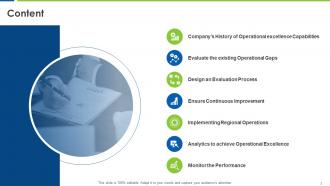
Slide 2: This slide shows Content of the presentation.
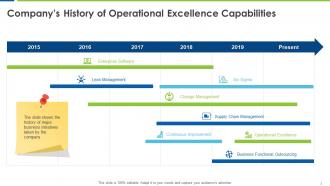
Slide 3: This slide presents Company’s History of Operational Excellence Capabilities.
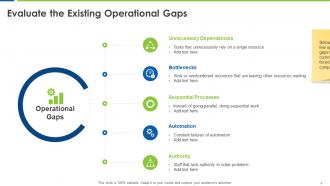
Slide 4: This slide displays Evaluate the Existing Operational Gaps describing- Unnecessary Dependencies, Bottlenecks, Sequential Processes, Authority and Automation.
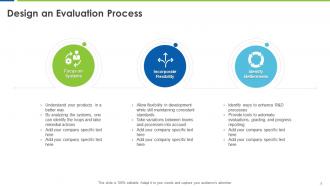
Slide 5: This slide represents Design an Evaluation Process as Focus on Systems, Incorporate Flexibility, Identify Betterments.
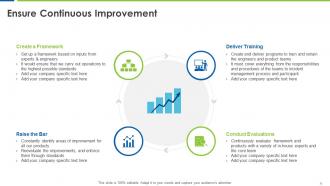
Slide 6: This slide showcases Ensure Continuous Improvement describing- Create a Framework, Deliver Training, Raise the Bar, Conduct Evaluations.
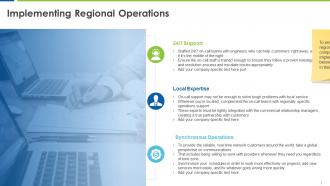
Slide 7: This slide shows Implementing Regional Operations as- 24/7 Support, Local Expertise, Synchronous Operations.
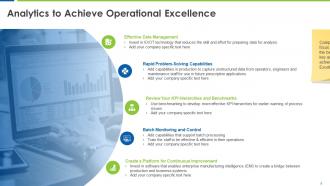
Slide 8: This slide presents Analytics to Achieve Operational Excellence describing- Effective Data Management, Rapid Problem-Solving Capabilities, Review Your KPI Hierarchies and Benchmarks, Batch Monitoring and Control, Create a Platform for Continuous Improvement.
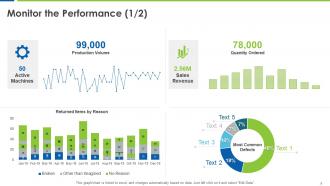
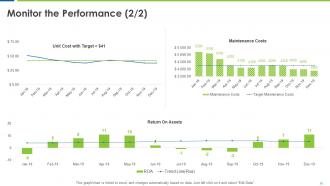
Slide 9: This slide displays Monitor the Performance showing data in graphical form.
Slide 10: This is another slide on Monitor the Performance. You can change the data as per needs.
Slide 11: This slide is titled as Additional Slides for moving forward.
Slide 12: This is About Us slide to show company specifications etc.
Slide 13: This is Meet Our Team slide with names and designation.
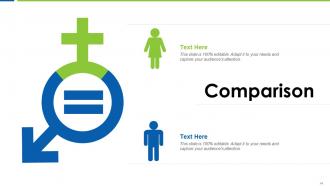
Slide 14: This is a Comparison slide to state comparison between commodities, entities etc.
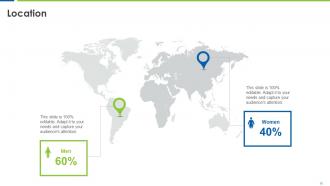
Slide 15: This is a Location slide to show data related with different locations.
Slide 16: This is a Target slide. State your targets here.
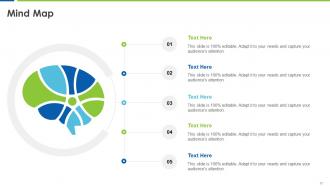
Slide 17: This slide shows Mind Map for representing entities.
Slide 18: This is an Idea or Bulb slide to state a new idea or highlight information, specifications etc.
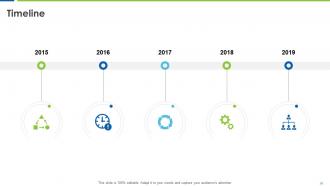
Slide 19: This is a Timeline slide to show data related with time period.
Slide 20: This slide is titled as Post It. Post your important notes here.
Slide 21: This is a Puzzle slide with text boxes to show information.
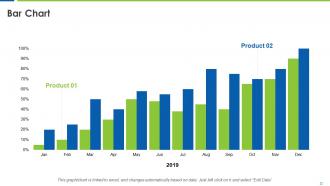
Slide 22: This slide show Bar Chart with two products comparison.
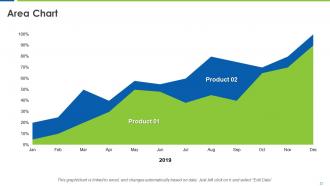
Slide 23: This slide presents Area Chart with two products comparison.
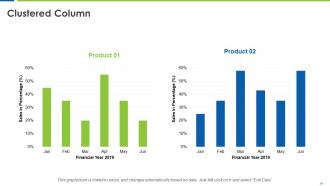
Slide 24: This slide displays Clustered Column chart with data in percentage.
Slide 25: This is a Thank You slide with address, contact numbers and email address.
Operational excellence powerpoint presentation slides with all 25 slides:
Convince folks to check back with you through our Operational Excellence Powerpoint Presentation Slides. Get them to consult you before initiating action.






FAQs for Operational excellence
Focus on continuous improvement, customer value, and getting your team actually engaged. Standardize processes so they're repeatable and measurable - cuts down on errors and random guesswork. Leadership buy-in is critical though. I've watched too many good initiatives crash because management wasn't really committed. Your team picks up on that instantly. Data-driven decisions and eliminating waste are the other big ones. Oh, and start small - map out one key process first. Find the bottlenecks. Quick wins build momentum for the bigger changes later.
Honestly, Lean Six Sigma is just a fancy way to find and fix the stupid stuff that slows you down. It combines Lean (cutting waste) with Six Sigma (fixing quality problems using actual data). The whole thing's pretty systematic - maybe annoyingly so - but that's why it works. Pick one process that's driving you crazy and map out every single step. I guarantee you'll find handoffs that make zero sense. Use tools like value stream mapping to spot where things get stuck, then do root cause analysis to figure out why your quality sucks. Data-driven approach beats guessing every time.
Your team's engagement makes or breaks whether processes actually work. Seriously, they see bottlenecks you'll never spot from your desk. When people care, they'll flag problems early instead of letting things spiral. They also come up with fixes based on real experience - not theoretical stuff that sounds good in meetings. Honestly, most managers miss this completely. Ask your frontline people where things are breaking down and then actually do something with their feedback. They're dealing with these systems every day, so they know what's realistic and what isn't.
Honestly, automation is a game changer for cutting out all that tedious manual stuff. Start with whatever process makes you want to pull your hair out - maybe data entry or inventory tracking. Those repetitive tasks are where you'll see the biggest time savings. I know teams that slashed their reporting time by like 60-70% just by setting up automated workflows. Pretty crazy, right? Quality control is another goldmine since machines don't have off days. Don't go nuts trying to automate everything though. Pick one annoying process first and go from there.
Focus on metrics that actually matter to your customers - cycle time, defect rates, customer satisfaction, first-call resolution. Track efficiency stuff too like resource utilization and cost per transaction. Pick maybe 3-5 that your team can genuinely impact day-to-day. I've watched so many teams obsess over metrics that look cool in presentations but don't change anything meaningful. Start with what customers want most, then figure out which operational numbers drive those results. Don't get caught up in vanity metrics - they're honestly just a distraction from real progress.
So basically, don't let continuous improvement become another top-down thing that makes everyone's eyes glaze over. Build psychological safety first - people need to know they won't get in trouble for pointing out problems. Daily huddles work great for this, or maybe monthly idea sessions. Your frontline people see inefficiencies you'd never notice from behind a desk, honestly they're usually your best source. When someone's idea actually gets implemented, make noise about it! Also be upfront about which suggestions you're pursuing and why. Oh, and this is key - actually give them time to test their ideas instead of just collecting them in some suggestion box that goes nowhere.
Oh man, the change resistance thing is brutal - people just hate switching up their routines. Getting leadership actually on board (not just saying they are) is huge too. Money's always tight, which sucks because you need to spend before you see results. Most teams bite off way more than they can chew right out the gate. Also, nobody really knows how to measure if it's working? Start with something small that'll give you a quick win. Seriously, get the executives to actually commit first or you're gonna be spinning your wheels forever.
Dude, cross-functional teams are seriously the way to go for fixing operational mess. Breaking down those departmental silos makes such a huge difference - people actually talk to each other instead of working in their little bubbles. Different perspectives mean you'll catch problems that would fly right over a single team's head. The speed improvement is crazy too since you're not constantly passing things back and forth between departments. I mean, communication still takes work, but it's so worth it. Just start with your biggest headache area and grab someone from each team that touches it.
Look, supply chain optimization is honestly a game-changer for your operations. You'll slash costs and speed up deliveries by fixing those relationships with suppliers and getting better at predicting demand. No more sitting on tons of inventory or dealing with those "oh crap we're out of stock" moments. Your cash flow improves too since money isn't tied up in excess stuff. Better supplier performance means production runs smoother, customers are happier, and your team isn't constantly putting out fires. My advice? Map out what you've got now and tackle the biggest headaches first.
Don't think of quality, cost, and speed as enemies fighting each other. Map out what you're doing now and find where stuff gets stuck or wasted. Here's the thing - fixing quality problems usually saves money AND time later. Sounds backwards but it's true. Focus on making your whole system flow better instead of tweaking each piece separately. Automate the boring repetitive stuff. Get your team to spot issues early before they blow up. Oh, and measure how all three work together, not just individually. That's where the magic happens.
Honestly, start by mapping out what you're actually doing now - most people jump straight to "solutions" without knowing their real problems. Look for where things get stuck or where you're passing stuff back and forth unnecessarily. Templates and checklists help way more than you'd think for your regular tasks. Automate the boring stuff like scheduling. Cross-train people so you're not screwed when Sarah goes on vacation. Set up ways for customers to tell you when something's wrong early. Oh, and don't try fixing everything at once - that's a disaster. Pick one thing, nail it, then move on.
So data analytics cuts through all the guesswork - you'll actually know what's happening instead of just assuming. Track your performance trends and catch problems before they blow up. It's honestly pretty wild how much clearer everything becomes when you can see the patterns. Just make sure you're focusing on metrics that actually matter to your goals, not just random numbers that look impressive. Oh and your team needs to understand the dashboards too, otherwise what's the point? I'd start with just one area first. Prove it works there, then expand from there.
Honestly? Most people try to fix everything at once and just end up burning out their whole team. Pick one thing that's actually broken and nail that first. Also - and I've seen this so many times - teams get obsessed with hitting every single metric but completely miss why those numbers matter in the first place. Like, congrats, your KPIs look great but your customers still hate you lol. Oh and don't just roll out changes without getting people on board first. Training matters. Start small, do it right, then expand. Way less painful that way.
Honestly, you can't pull off operational excellence without leadership being completely committed. I've watched so many programs crash and burn because executives just talked a big game but didn't back it up. Your leaders have to walk the walk - model the right behaviors, explain why changes matter, and actually put money behind improvement efforts. They need to give teams real decision-making power too. Oh, and celebrating wins is huge (learning from screwups openly matters just as much). Start by getting everyone at the top on the same page about what operational excellence actually looks like for your company specifically.
Honestly, automation and AI are everywhere now - companies are predicting when stuff breaks before it actually does, which is pretty wild. Digital twins are blowing up too, especially in manufacturing. Sustainability metrics matter as much as the usual efficiency stuff now because of all that ESG pressure. What's interesting is they're finally caring about employee experience, not just customer stuff. Also, I keep hearing about real-time workflow optimization but half the time I think people just like saying that lol. My take? Pick one small process to automate first and see how it goes.
No Reviews