


Operations Playbook What Is Operational Excellence




Try Before you Buy Download Free Sample Product
 Impress Your
 Audience
 100%
100% Editable
 Save Hours
 of Time


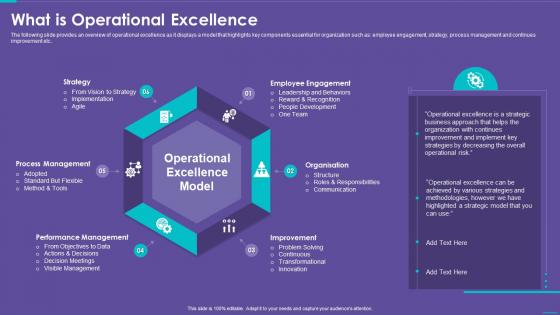
The following slide provides an overview of operational excellence as it displays a model that highlights key components essential for organization such as employee engagement, strategy, process management and continues improvement etc..
People who downloaded this PowerPoint presentation also viewed the following :
Operations Playbook What Is Operational Excellence with all 6 slides:
Use our Operations Playbook What Is Operational Excellence to effectively help you save your valuable time. They are readymade to fit into any presentation structure.





FAQs for Operations Playbook What
Honestly, start with the basics - solid processes, good data tracking, and leadership that actually cares. Most teams mess up because they skip the measurement stuff (it's boring but crucial). Your frontline workers usually catch problems way before managers do, so keep them engaged. Build a culture where people actually want to improve things instead of just going through the motions. Oh, and don't forget change management or everything falls apart later. Pick one area where you already have decent data and get good at that first. Way easier than trying to fix everything at once.
Track the hard numbers first - cycle time, defect rates, customer satisfaction, cost per unit. That stuff gives you real data. But honestly? The soft metrics matter just as much. How engaged are your employees? Are people actually using the new processes or just pretending to? Can your team spot problems faster now? I'd pick maybe 3-5 metrics that actually connect to what your business cares about. Look for consistent trends over 6-12 months - that's when you know if it's really working. Review monthly so you don't get caught off guard.
Dude, engaged employees literally care about doing stuff right the first time. They'll catch problems early, pitch ideas to make things smoother, and actually own their work quality. Compare that to checked-out workers who just phone it in - totally different world. Plus they share knowledge way more and don't bail when things get hectic. Honestly, just ask your team what's bugging them about how things work. I swear, they always know where the real issues are hiding and you'll get some solid ideas for fixing stuff.
Honestly, tech is a game-changer for getting your operations running smoothly. It handles all the boring repetitive stuff automatically and gives you instant data on how things are performing. Plus you'll catch problems way earlier before they blow up into real issues. The best part? Your team can actually focus on meaningful work instead of mindless busy work. But here's the thing - and I learned this the hard way - the technology is only worth it if you nail down your processes first. Figure out what's driving you crazy operationally, then find tools that fix those exact problems. Don't just buy software because it looks shiny.
Honestly, lean methods are worth trying if you want to cut out waste and make things run smoother. Start with value stream mapping - it'll show you where things get stuck. 5S organization is huge too, saves so much time when people aren't constantly searching for stuff. Once your team gets the continuous improvement thing down, it's pretty amazing how much changes. Kanban boards help with workflow, and doing root cause analysis stops the same problems from popping up again. My advice? Pick one annoying process everyone deals with daily and try lean there first.
Honestly, the biggest pain is just getting people on board - everyone's so stuck in their routines, you know? Leadership buy-in is huge too. Without that, you're basically swimming upstream. Oh and don't try to fix everything at once (learned that the hard way). Most teams also obsess over the wrong numbers instead of what actually matters. Communication between departments? Usually a mess. My advice: pick one small thing first, get a quick win so people see it works, then build from there. Makes such a difference when leadership actually shows they care about the changes.
Look, the basic principles don't really change, but applying them? Totally different game depending on your industry. Manufacturing is all about throughput and cutting waste - classic lean stuff. Healthcare though... that's where it gets tricky (and honestly pretty intense). You can't just optimize for speed when people's lives are at stake, you know? The metrics are completely different too. Manufacturing tracks defect rates, healthcare focuses on patient outcomes. My advice? Figure out what "excellence" actually means for YOUR situation first. Don't just copy what worked somewhere else - it might not fit.
Start with retrospectives that people don't roll their eyes at - make them actually do something with the feedback. Let teams try small experiments and don't punish them when stuff doesn't work out. Kaizen sessions are solid too, where everyone focuses on one problem together. But honestly? The real trick is weaving improvement into daily work instead of those quarterly "innovation initiatives" that fizzle out. Create suggestion boxes that aren't black holes. Give people actual time to test their ideas. Pick one team to start - success spreads faster than mandates.
Honestly, data analytics is a game-changer for catching stuff you'd totally miss otherwise. Real-time KPI tracking, predicting equipment failures before they happen, spotting bottlenecks early - all that good stuff. What I love most? It kills the guesswork. You're not just winging decisions anymore, you've got actual numbers backing you up. Plus it shows exactly where you're bleeding money or where tiny changes could make a huge difference. My advice though - don't go crazy at first. Just pick whatever process is driving your team nuts and start tracking some basic metrics around that.
Honestly, the daily standup calls are what saved us when we went remote - catches problems before they explode. Documentation becomes your lifeline, so write everything down (I know, it's annoying but trust me). Get everyone on Slack or Teams for quick updates instead of endless email chains. You'll want consistent meeting schedules too, otherwise things just... drift. Oh, and make your performance dashboards visible to everyone - transparency helps when you can't just walk over to someone's desk. Start by figuring out which of your current processes completely fall apart remotely, then build digital versions that actually work.
Honestly, leadership can totally make or break this stuff. If they're not actually walking the walk, everyone sees through it immediately - I've watched teams completely give up when bosses just pay lip service. You need leaders who model what they preach and actually celebrate wins when they happen. The tricky part? Culture change is slow as hell, so they can't expect overnight results. My advice is finding those informal influencers at different levels who can keep things moving even when leadership gets distracted by the next shiny thing. Those people are worth their weight in gold.
Your supply chain is honestly the foundation for everything else working smoothly. When it's optimized, you'll cut costs, speed up deliveries, and keep customers way happier. Bottlenecks disappear and workflows actually make sense. I've seen companies totally transform just by fixing their supply chain issues first - it affects inventory, vendor relationships, the whole nine yards. Bad supply chain management can wreck even solid operational plans though, so don't sleep on this. Map out what you currently have and tackle your biggest headaches first. Trust me, the improvements ripple everywhere.
Make this stuff part of everyone's daily routine, not some big quarterly thing. Give people actual ownership over their processes - like, let them fix what's obviously broken instead of making them ask permission for everything. I'd focus on tracking the early warning signs rather than just looking at results after the fact. The companies that really get this right? They're almost weirdly excited about tiny improvements. Celebrate those small wins and teach your team how to solve problems themselves. Oh, and when leadership changes don't let everything slide - that's where most places totally lose their momentum.
So you've got a few solid options to start with. Lean Six Sigma is great for fixing processes, and Toyota's Production System really helps cut out waste. Kaizen's more about building that improvement mindset across your team. Don't stress about all the fancy names though - they're way less complicated than they seem. PDCA cycle (Plan-Do-Check-Act) is probably the easiest framework to jump into. Value stream mapping is honestly a game-changer for seeing where things get stuck. Oh, and A3 problem-solving is solid too. But seriously, just pick whatever tackles your biggest headache first. You'll burn out trying to do everything at once.
Honestly, start collecting feedback everywhere - surveys, support emails, random customer chats. Those angry emails? Pure gold. They'll show you exactly where things are falling apart. Sort everything by which part of your business it hits, then map those complaints back to your actual workflows. I'd probably tackle the most frequent issues first since they're annoying the most people. Don't forget to tell customers when you actually fix something based on their input - they love that. Pick your worst three feedback patterns this week and dig into what's really causing them.
-
Awesome use of colors and designs in product templates.
-
Topic best represented with attractive design.