


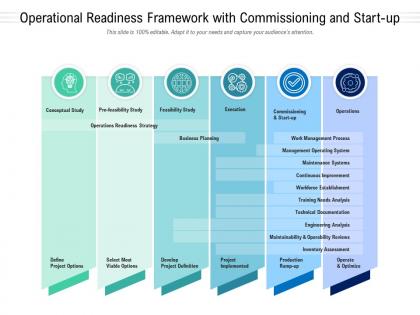
Operational readiness framework with commissioning and start up




Try Before you Buy Download Free Sample Product
 Impress Your
 Audience
 100%
100% Editable
 Save Hours
 of Time


Our Operational Readiness Framework With Commissioning And Start Up are topically designed to provide an attractive backdrop to any subject. Use them to look like a presentation pro.
People who downloaded this PowerPoint presentation also viewed the following :
Operational readiness framework with commissioning and start up with all 2 slides:
Use our Operational Readiness Framework With Commissioning And Start Up to effectively help you save your valuable time. They are readymade to fit into any presentation structure.
FAQs for Operational readiness framework with commissioning
Look, there are four main things you gotta nail down: people, processes, tech, and governance. First figure out what skills your team has and what training they need. Document all your procedures (yeah I know, boring but necessary). Make sure your technology can actually handle whatever you're throwing at it - I've seen too many systems crash on day one. Set up clear decision-making rules so nobody's confused about who calls the shots. Oh, and don't forget risk management, performance tracking, and communication plans. Honestly just audit where you stand on each piece right now. That'll show you exactly what needs work before you launch.
So basically, traditional project management is all about hitting deadlines and staying on budget - getting features shipped. Operational readiness is different though. It's asking "okay cool, but can we actually keep this thing running without losing our minds?" You're planning for the boring stuff that'll bite you later: monitoring, how to handle outages, making sure your team knows what they're doing. Most PMs treat this as an afterthought, which is honestly why so many launches go sideways. The mindset shift? Don't just ask "did we build it?" Ask "can we live with it for the next two years?" Start thinking about ops stuff early, not during your launch week panic.
Honestly, break it down into four buckets: people stuff (training rates, how well they're adapting), process health (are workflows actually smoother, fewer mistakes), tech performance (uptime, speed, does everything connect right), and whether leadership's really on board. Don't go crazy trying to track everything though - that's where most people mess up. Pick maybe 2-3 things from each area that actually relate to your change. Like if your biggest worry is user adoption, focus there first instead of measuring random stuff just because you can. The whole point is spotting problems before they blow up, not creating a spreadsheet nightmare for yourself.
Look, you've gotta connect your metrics to what you're actually trying to accomplish. Growing fast? Track capacity and how quickly you can ship stuff, not just boring uptime numbers. Get leadership involved early to define what "ready" means for each big initiative. Then work backwards from there. Don't forget cross-functional dependencies either - I've seen projects tank because teams weren't talking to each other. Oh, and quarterly check-ins are clutch since priorities always shift. Half the teams I know measure tons of stuff but completely miss what matters.
Honestly, stakeholder engagement will make or break this whole thing. Start early and get buy-in from literally everyone - users, leadership, support teams, the works. Don't just blast them with updates though. Actually listen to what they're worried about and work their feedback into your plans. I've seen too many projects crash right at go-live because someone skipped this step. Those regular check-ins? Schedule them now before everything gets hectic. Trust me, you don't want people pushing back when you're trying to launch.
Honestly, tech can be a game-changer for operational readiness if you do it right. Automation kills those tedious manual tasks, and real-time dashboards give you way better visibility into what's actually happening. Your teams can coordinate better with integrated communication tools too. The key thing is not going overboard - I've seen companies blow tons of money on fancy systems when something simple would've worked fine. Predictive maintenance is pretty cool though, spots problems before they explode. I'd start by finding your worst manual bottlenecks first. That's where you'll see the biggest wins right away.
Honestly, the hardest part is people just hate change - even when their current process is completely broken. You'll spend forever trying to get different departments to actually talk to each other instead of doing their own thing. Plus nobody ever agrees on what "ready" means, which sounds stupid but causes so many headaches. Leadership always thinks this stuff will happen overnight too, so you're constantly fighting for time and resources. Oh, and good luck finding someone who actually wants to own the whole thing. Start with one small team first though - get a few wins under your belt before you try to change everything.
Look, you gotta build risk management into every step of your readiness process - don't just tack it on at the end. During assessments, figure out what could break and how it'd hurt the business. Then create backup plans before you even think about launching. Cross-functional risk workshops are clutch for this stuff. Document your biggest risks in a simple matrix and make sure someone owns each fix. Oh, and seriously - I've watched teams ignore this and pay for it big time later. Never go live until your major risks have solid backup plans. Trust me on this one.
Set clear criteria upfront so you don't end up chasing random stuff later. Mix it up - interviews, docs, actual testing. Don't just pick one method. The biggest mistake I see? Teams forget to loop in everyone. You need ops, dev, security, business people - readiness problems love hiding between departments. Document while you go, not after (trust me on this). Oh and approach it like a conversation, not some formal audit thing. People clam up when they think you're judging them. You want the real story, not whatever they think sounds good.
So basically it gives everyone the same playbook to work from. No more engineering assuming ops will handle something while ops thinks product's got it covered - you know how that usually goes. The framework maps out what each team needs to deliver and when, plus it forces regular check-ins between departments. You'll catch problems way earlier instead of scrambling at the last minute. Honestly, the cross-team dependency mapping alone is worth it. I'd start by looking at where your current handoffs between teams typically fall apart - that's usually where the biggest wins are hiding.
Honestly, I'd start with Jira or Monday.com for task tracking - they're solid for keeping tabs on readiness stuff. For docs, Confluence or Notion work great to keep all your checklists in one place. Monitoring is where you really need to focus though. Datadog and New Relic are awesome, but Grafana dashboards can work if budget's tight. Slack keeps everyone on the same page, but man, too many channels becomes a nightmare quick. Oh, and definitely grab Ansible or Terraform for deployments - saves so much headache later. Start with tools your team already uses, then build from there.
So here's what works - ditch the boring generic training and make everything scenario-based around actual problems you might hit. Cross-training saves your butt when people call out sick (learned this the hard way). Run drills and tabletop exercises that test real operational stuff, not just box-checking nonsense. Honestly, the best approach is figuring out your biggest risks first, then building training around those gaps. Makes the whole thing feel like you're actually prepping for something instead of sitting through another pointless session.
Look, your operational readiness framework will get outdated fast if you don't build in ways to improve it. After incidents or close calls, you've got to actually update your processes - not just write reports nobody reads. I learned this the hard way when our team kept making the same mistakes. Set up quarterly reviews where you change things based on what went wrong. Track metrics that matter. Think of it like tweaking your fantasy lineup each week. The feedback loops are what separate frameworks that work from expensive paperwork. Don't just document lessons learned, act on them.
Honestly, most launches crash because people focus on the tech stuff but totally forget about the human element. Your systems might work perfectly, but if your team doesn't know what they're doing or freaks out about the changes, you're screwed. Training is huge - like, really huge. Communication too. People hate change, so you've got to get them comfortable with new processes before go-live. I'd start figuring out how this'll impact everyone way before you flip the switch. Having the right tools means nothing if nobody can actually use them confidently.
Honestly, just make feedback dead simple or people won't bother. Grab input during readiness checks, after incidents, and in regular retros. Quarterly reviews work great for bigger picture stuff. But here's the thing - skip those long surveys nobody actually completes. Set up quick channels where teams can drop real-time thoughts instead. Make sure someone's actually responsible for acting on what you collect (otherwise it's pointless). The biggest mistake? Not telling people what you changed based on their feedback. Do that and they'll keep participating. Oh, and don't overthink the process.
No Reviews