


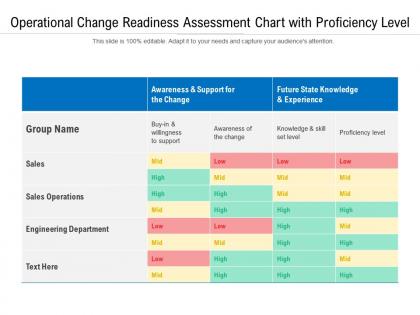
Operational change readiness assessment chart with proficiency level




Try Before you Buy Download Free Sample Product
 Impress Your
 Audience
 100%
100% Editable
 Save Hours
 of Time


Our Operational Change Readiness Assessment Chart With Proficiency Level are explicit and effective. They combine clarity and concise expression.
People who downloaded this PowerPoint presentation also viewed the following :
Operational change readiness assessment chart with proficiency level with all 2 slides:
Give your audience a fulfilling experience. They will find our Operational Change Readiness Assessment Chart With Proficiency Level elevating.

FAQs for Operational change readiness assessment chart
Key indicators include strong leadership commitment, employee engagement levels, adequate resource allocation, clear communication channels, and robust change management processes. Organizations with high readiness typically demonstrate cultural adaptability, existing process improvement capabilities, and stakeholder buy-in across departments, with many companies finding that measured change capacity assessments ultimately deliver smoother transitions and sustained operational improvements.
Assessing employee sentiment during operational shifts involves conducting anonymous surveys, focus groups, one-on-one interviews, pulse checks, and analyzing engagement metrics like attendance and productivity patterns. Through these feedback mechanisms, organizations can identify resistance points, address concerns proactively, and adjust communication strategies, ultimately ensuring smoother transitions and maintaining workforce morale throughout the change process.
**INPUT**: What strategies can be implemented to minimize resistance to operational changes? **OUTPUT**: Effective strategies include transparent communication, employee involvement in planning, comprehensive training programs, phased implementation approaches, and strong leadership support throughout the transition process. These methods streamline adoption by addressing concerns early, building buy-in through participation, and providing necessary skills, with many organizations finding that combining multiple approaches ultimately delivers smoother transitions and sustained operational improvements. [Word count: 60 words]
Leadership drives organizational change readiness by establishing clear vision, securing necessary resources, and fostering a culture that embraces transformation through transparent communication and strategic planning. Effective leaders champion change initiatives by modeling adaptability, addressing employee concerns proactively, and aligning operational adjustments with business objectives, ultimately delivering smoother transitions and sustainable competitive advantage.
Key metrics include employee adoption rates, process efficiency improvements, cost reduction percentages, customer satisfaction scores, and time-to-completion benchmarks. These measurements enable organizations to track progress across departments, identify implementation bottlenecks, and demonstrate ROI, with many companies finding that comprehensive metric frameworks ultimately deliver enhanced operational visibility and sustained competitive advantage.
Technology facilitates smoother operational transitions by automating workflow adjustments, providing real-time performance analytics, and enabling seamless communication across departments during implementation phases. Through cloud-based platforms and digital dashboards, organizations streamline change management processes, reduce manual coordination errors, and accelerate employee adaptation, with many companies finding that integrated technology solutions ultimately deliver faster transition timelines and improved operational continuity.
Best practices for communicating operational changes include establishing clear messaging frameworks, utilizing multiple communication channels, providing role-specific information, creating feedback mechanisms, and maintaining transparent timelines throughout the transition process. Organizations across healthcare, manufacturing, and financial services find that combining town halls with targeted departmental briefings, digital dashboards, and regular progress updates ensures stakeholders remain informed and engaged, ultimately reducing resistance and accelerating adoption.
Cultural factors significantly impact change readiness by influencing employee attitudes, communication patterns, leadership trust, and adaptability to new processes. Organizations with collaborative cultures, open communication channels, and strong change histories typically demonstrate higher readiness levels, while rigid hierarchies or risk-averse environments may require additional cultural preparation before implementing operational transformations.
**INPUT**: What training programs are most effective in preparing staff for upcoming operational changes? **OUTPUT**: Effective training programs include scenario-based simulations, cross-functional workshops, digital learning platforms, mentorship pairings, and hands-on practice sessions with new systems or processes. These approaches streamline adaptation by building confidence, enhancing collaboration, and minimizing resistance, with many organizations finding that combining multiple training methods ultimately delivers faster implementation and sustained operational efficiency. **Word count: 55 words**
Feedback loops can be integrated through regular pulse surveys, cross-departmental review meetings, real-time performance dashboards, and structured stakeholder check-ins throughout implementation phases. These mechanisms enable organizations to identify resistance early, adjust strategies dynamically, and maintain employee engagement, with many companies finding that continuous feedback reduces change failure rates while accelerating adoption timelines.
Risk management serves as a critical evaluation framework for operational change readiness by identifying potential disruptions, assessing resource requirements, and developing mitigation strategies before implementation begins. Through comprehensive risk assessment, organizations can gauge their preparedness levels, prioritize necessary adjustments, and create contingency plans, ultimately ensuring smoother transitions and minimizing costly setbacks during operational transformations.
Employee involvement in change processes enhances readiness by fostering ownership, reducing resistance, and providing valuable ground-level insights into implementation challenges and opportunities. Through collaborative workshops, feedback sessions, and cross-functional teams, organizations like manufacturing companies and healthcare systems find that engaged employees become change champions, ultimately accelerating adoption timelines and improving outcomes.
Organizations should consider market volatility, regulatory changes, technological advancements, competitive pressures, and evolving customer expectations when preparing for operational changes. These external influences require strategic assessment and adaptive planning, with many companies finding that proactive monitoring of industry trends, regulatory landscapes, and consumer behavior ultimately delivers enhanced agility and sustainable competitive advantage.
Change readiness assessments integrate into project management through stakeholder impact analysis, risk evaluation matrices, communication planning frameworks, and milestone-based readiness checkpoints. These methodologies streamline project workflows by identifying resistance early, allocating resources strategically, and establishing feedback loops, with many organizations finding that proactive readiness evaluation ultimately delivers faster implementation timelines and higher adoption rates.
Organizations can leverage change readiness assessment tools, stakeholder analysis frameworks, organizational maturity models, employee readiness surveys, and risk assessment matrices to gauge their preparedness for operational transformation. These frameworks enable businesses to evaluate cultural adaptability, resource allocation, and leadership commitment across departments, with many companies in manufacturing and financial services finding that comprehensive readiness assessments ultimately streamline implementation timelines and minimize resistance.
No Reviews