


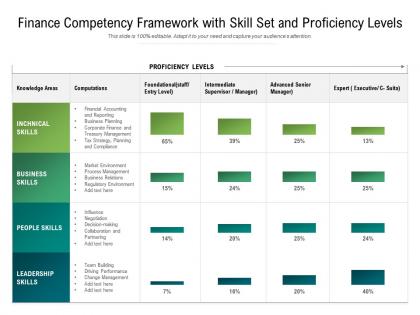
Finance competency framework with skill set and proficiency levels




Try Before you Buy Download Free Sample Product
 Impress Your
 Audience
 100%
100% Editable
 Save Hours
 of Time


Our Finance Competency Framework With Skill Set And Proficiency Levels are topically designed to provide an attractive backdrop to any subject. Use them to look like a presentation pro.
People who downloaded this PowerPoint presentation also viewed the following :
Finance competency framework with skill set and proficiency levels with all 2 slides:
Use our Finance Competency Framework With Skill Set And Proficiency Levels to effectively help you save your valuable time. They are readymade to fit into any presentation structure.
FAQs for Finance competency framework with skill set
So finance frameworks usually cover four big areas: technical stuff (financial analysis, budgeting, reporting), business sense (how finance connects to actual operations), soft skills, and compliance knowledge. Here's the thing though - everyone obsesses over being an Excel god, but honestly? Communication matters way more. You can crunch numbers all day, but if you can't explain a variance report to your marketing team without their eyes glazing over, you're kind of screwed. Most frameworks have different skill levels too, which helps with career planning. I'd start by figuring out what your current role actually needs and work backwards from there.
Skip the boring written tests - they're pretty useless honestly. Give them real financial modeling tasks or budget scenarios that actually match what they'd be doing. Certifications look nice on paper but don't tell you much about whether someone can think through problems. Have their future manager watch them work on actual projects, then do interviews about financial decisions they've made before. Short check-ins help you catch issues early. The trick is testing both the technical stuff and whether they have good business sense - some people are great with Excel but terrible at the bigger picture.
Look, tech basically makes you better at finance stuff without doing more work. All that boring data entry and reconciliation crap gets automated, so you can actually think about strategy instead. AI helps with forecasting - honestly way better than my old gut feelings lol. Dashboards make your presentations look legit too, because nobody wants to see another ugly Excel chart. Cloud stuff means you can pull real-time data from anywhere and actually collaborate with your team. Just don't go crazy buying every new tool you see. Pick what fixes your actual problems first.
So basically these frameworks show you exactly what skills you need for each level - super helpful for figuring out what you're missing. I'd start by checking if your company has one, then be brutally honest about where you stack up. Some gaps might be technical (like pivot tables, ugh) while others are more people-focused like managing stakeholders. The cool part? You can actually use this stuff in performance reviews to show what you've improved on. It's way better than just winging it and hoping for the best. Makes the whole career progression thing feel less random, you know?
So you'll want to check a few things - performance ratings and how fast people get promoted within finance. Training scores are pretty obvious. But honestly? The stuff that really matters is whether people actually stick around and don't hate their jobs. High turnover means your framework sucks, no matter what the other numbers say. Error rates in reporting are huge too since that shows real competency gaps. Oh, and track how long it takes new hires to actually be useful - that's always telling. Pick maybe 3-4 of these that make sense for your company and just watch them consistently.
So basically you work backwards from your business goals to figure out what finance skills you actually need. Like if you're going global, your team better know international accounting and currency stuff. Digital transformation? They'll need systems integration and data analytics skills. Think of it as reverse-engineering your hiring strategy. Map out your big strategic moves first, then see what finance capabilities those require. Check where your current team sits skill-wise - honestly, most companies skip this step and wonder why things don't work out. The framework just becomes your guide for who to hire and what training to prioritize.
Honestly, leadership buy-in is your biggest headache - they'll see it as more HR busy work at first. Staff hate being "assessed" too, which I get. You'll spend forever trying to define competencies that actually match real work instead of some textbook nonsense. Plus keeping everything updated as roles change? Exhausting. Start with a small pilot group though. Show some quick wins before going big. Focus on skills that actually matter for their daily tasks first - not some massive rollout that'll make everyone groan. Trust me on this one.
Honestly, don't wait around for your company to send you to some expensive conference. Subscribe to finance newsletters like CFO Dive – I check mine every morning with coffee. LinkedIn's actually decent if you follow the right people, though you'll have to wade through some garbage posts. Podcasts are my secret weapon during commutes. Monthly chats with your boss about skill gaps? Game changer. Ask what you should focus on next. Virtual webinars work too when you can't travel. The trick is staying consistent with small daily learning instead of cramming everything into one weekend.
First thing - figure out what skills your team actually has vs what they need. Sounds obvious but most people skip this step. Then mix real training with hands-on stuff like stretch projects or letting people work with other departments. Honestly, the classroom training is whatever - people learn way more by actually doing things. Get your junior people paired up with someone who knows their stuff. Oh, and you've got to make time for this or it'll never happen. Everyone's always "too busy" but development can't work if you're constantly putting out fires. Set clear goals and check in regularly.
Don't separate soft skills from your technical stuff - weave them together instead. Like under "Financial Analysis," add something about explaining complex data to non-finance people or challenging sketchy assumptions. Leadership can go right into your budgeting work, collaboration into forecasting. Most finance projects tank because of people problems anyway, not because someone messed up a formula. The trick is showing what each soft skill actually looks like in real finance situations. Map out what you're already good at, then figure out where communication and problem-solving are make-or-break moments.
Ugh, finance regs are such a moving target - you're literally always catching up to new rules. ESG reporting is a perfect example - suddenly everyone needs to understand sustainability metrics when that wasn't even on our radar before. Your tech skills have to keep evolving with every policy shift, which honestly gets old fast. Plus you need that whole "lifelong learner" thing down pat. Risk assessment, compliance reporting, data governance... the list never stops growing. Pro tip though - start buddying up with legal and compliance now. Trust me, you don't want to be scrambling when the next wave hits.
Start by figuring out your main levels - entry, mid, senior, leadership. Junior people need the accounting basics and simple analysis stuff. Senior folks? They're dealing with strategy and managing stakeholders. Most frameworks I've seen are honestly pretty useless because they're too cookie-cutter. Survey your current team first - like, what skills actually matter when you're trying to move up? Build around those real answers instead of some textbook version. Each level should build up from the last one, but focus on different skill sets. Oh, and don't forget the soft skills piece changes a lot between levels too.
Oh totally, leadership matters just as much as the technical stuff in finance frameworks. Higher up you go, success depends more on managing people than spreadsheets - kinda counterintuitive but makes sense. You'll need to influence stakeholders and explain complex budget stuff to people who glaze over at numbers. Most frameworks cover team management, change leadership, executive presence, all that. Honestly, I've seen brilliant analysts stuck because they couldn't communicate with other departments. Technical skills might get you hired, but leadership gets you promoted. Work on both though - can't skip either one.
Honestly, it's like taking inventory of who on your team actually knows what about risk stuff. You'll catch scary gaps early – imagine finding out nobody really gets derivatives while you're knee-deep in them. Helps prioritize training too, or figuring out if you need to hire someone who actually knows their shit. Great for succession planning since you'll know who can step into those critical spots. I've watched teams get burned when someone left and suddenly nobody could run the stress tests properly. My advice? Do that skills audit now, then make a solid plan to plug those holes before they become real problems.
JPMorgan Chase has this really solid framework that maps technical skills to different leadership levels - super clear progression paths. GE's finance model is pretty famous too, balancing hard skills like financial modeling with the softer stakeholder management stuff. Microsoft just redid theirs and honestly, it's become the gold standard for tech companies now. They all focus on technical depth plus business partnership skills, which makes sense. Oh, and check out the Institute of Management Accountants' framework - it's free and gives you a decent template to work with. Way better than starting from scratch.
No Reviews