


Central ideas slideshow examples powerpoint slide show




Try Before you Buy Download Free Sample Product
 Impress Your
 Audience
 100%
100% Editable
 Save Hours
 of Time


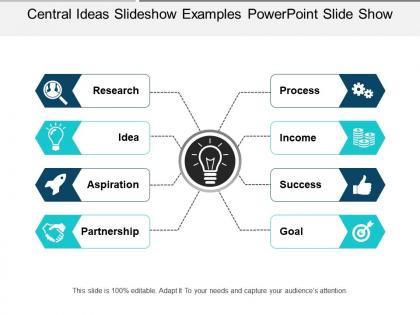
Introducing Central Ideas Slideshow Examples PowerPoint Slide Show which helps you to generate different thoughts and problem-solving ideas to attain the goals. Employ the PPT visual and share your innovative opinions and plannings with others. Take the assistance of this PowerPoint presentation template to showcase the numerous strategies that help to strengthen your business objectives. There are various points like research, ideas, aspirations, partnerships, processes, and targets that you mention in the slide. Use high-quality icons to make your presentation even more practical and descriptive. Included here are the steps that are useful in developing the finances and reputation of the company. You can explain the central message of your project with other stakeholders using this PowerPoint presentation template. With the help of our PPT slideshow, you can showcase the features that are useful in maintaining the performance graph of the organization. Hence, to make your company better than your opponents download this ready-to-use PowerPoint presentation template.
People who downloaded this PowerPoint presentation also viewed the following :
Central ideas slideshow examples powerpoint slide show with all 5 slides:
Inch ahead consistently with our Central Ideas Slideshow Examples Powerpoint Slide Show. Continue to build on the initial advantage.
FAQs for Central ideas slideshow examples
An effective central idea in PowerPoint presentations includes a clear, specific thesis statement, compelling supporting evidence, logical flow between main points, audience-relevant messaging, and a memorable call-to-action. These components work together by creating focused narratives, eliminating content clutter, and maintaining audience engagement throughout, with many presenters finding that well-structured central ideas significantly enhance message retention and audience response rates.
Visuals enhance central idea communication by simplifying complex concepts, improving audience retention, and creating emotional connections through charts, infographics, and compelling imagery. Strategic visual elements like data visualizations and conceptual diagrams help presenters streamline information delivery, with many organizations finding that visual-heavy presentations achieve significantly better engagement rates and message comprehension than text-based approaches.
Techniques for simplifying complex central ideas include visual metaphors, analogies, step-by-step breakdowns, infographics, and progressive disclosure methods. These approaches enhance comprehension by transforming abstract concepts into relatable formats, with many organizations finding that strategic visual storytelling, combined with clear hierarchical information design, ultimately delivers improved audience engagement and better knowledge retention across diverse professional settings.
Color schemes significantly influence how audiences perceive and retain central ideas by creating emotional associations, establishing visual hierarchy, and directing attention to key messages. Professional palettes like blues and grays convey trust and credibility for corporate presentations, while warmer tones enhance engagement in creative pitches, with many organizations finding that strategic color choices improve message clarity and audience comprehension by up to 73%.
Typography emphasizes central ideas through strategic font selection, size hierarchy, weight variation, color contrast, and spacing optimization. These typographic elements guide audience attention by creating visual emphasis on key points, improving readability, and establishing information hierarchy, with many presenters finding that consistent typography choices significantly enhance message clarity and audience comprehension.
Storytelling integration involves crafting narrative arcs through sequential slides, using character-driven scenarios, problem-solution frameworks, and emotional connections that reinforce key messages. Through visual metaphors, case study progressions, and audience journey mapping, organizations enhance engagement, improve information retention, and deliver more persuasive presentations, with many finding that story-driven approaches significantly increase audience connection and message comprehension.
Maintaining consistent central ideas requires establishing clear messaging hierarchies, using recurring visual themes, implementing strategic slide transitions, and reinforcing key concepts through consistent terminology and design elements. Through template standardization and narrative anchoring, organizations can streamline presentation development while ensuring audiences retain core messages, ultimately delivering more impactful communications and enhanced stakeholder engagement across diverse business contexts.
Cultural differences significantly impact global presentations through varying communication styles, visual preferences, hierarchical expectations, and symbolic meanings across regions. While direct cultures favor explicit central messaging, indirect cultures value contextual subtlety, with many multinational organizations finding that adapting presentation approaches for local audiences—through culturally relevant examples, appropriate authority levels, and region-specific visual elements—ultimately delivers enhanced audience engagement and more effective cross-cultural business outcomes.
Central idea slides benefit from hierarchy-driven design, single focal points, strategic white space, consistent visual flow, and clear supporting elements that reinforce the core message. These structural approaches streamline audience comprehension by eliminating distractions, guiding attention systematically, and creating memorable presentations, with many organizations finding that focused slide architecture ultimately delivers stronger engagement and more persuasive business outcomes.
Audience feedback enables refinement of central ideas through post-presentation surveys, real-time polling, Q&A sessions, and engagement analytics that reveal comprehension gaps and interest levels. Organizations increasingly use this data to strengthen messaging clarity, adjust supporting evidence, and enhance visual storytelling, with many finding that iterative improvements based on audience insights significantly boost presentation effectiveness and stakeholder buy-in.
Common pitfalls include overcrowding slides with excessive text, burying the main message in supporting details, using inconsistent visual hierarchies, lacking clear transitions between key points, and failing to reinforce central themes throughout. These presentation challenges can significantly undermine audience comprehension and engagement, with many organizations finding that streamlined, visually coherent presentations deliver stronger business outcomes and more compelling stakeholder communications.
Data and statistics support central ideas effectively through strategic selection, visual hierarchy, and contextual framing that emphasizes key insights over raw numbers. By incorporating clean infographics, limiting statistics to 3-5 per slide, and connecting each data point to specific business outcomes, presenters enhance audience comprehension while maintaining engagement, ultimately delivering more persuasive and memorable presentations.
Software tools that enhance central ideas development include MindMeister for concept mapping, Lucidchart for visual frameworks, Canva for design integration, Miro for collaborative brainstorming, and XMind for structured thinking. These platforms streamline ideation by enabling visual organization, team collaboration, and seamless template integration, with many presentation designers finding that combining mapping tools with design software ultimately delivers more cohesive, impactful presentations.
Presenters should adapt their delivery by aligning tone, pacing, and emphasis with their central message, adjusting energy levels for motivational topics versus analytical approaches for data-driven content. Through strategic voice modulation, purposeful gestures, and targeted audience engagement techniques, speakers enhance message retention and impact, with many finding that matching delivery style to core concepts significantly improves audience comprehension and engagement outcomes.
Educational PowerPoint presentations focus on learning objectives, knowledge retention, and comprehension assessment, while business presentations emphasize strategic outcomes, decision-making, and competitive advantage. Educational central ideas revolve around curriculum standards, student engagement, and academic achievement, whereas business presentations center on revenue growth, operational efficiency, and stakeholder alignment, ultimately delivering measurable organizational results.
-
Informative design.
-
Good research work and creative work done on every template.