

Big idea presentation slides




Try Before you Buy Download Free Sample Product
 Impress Your
 Audience
 100%
100% Editable
 Save Hours
 of Time


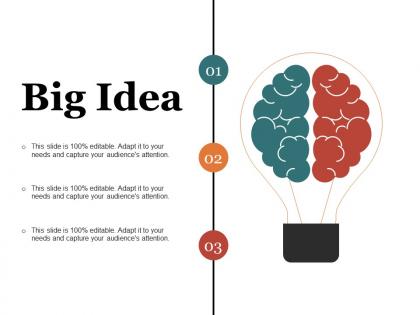
Hands come up with our Big Idea Presentation Slides. They will agree to be associated with your effort.
People who downloaded this PowerPoint presentation also viewed the following :
Big idea presentation slides with all 5 slides:
Our Big Idea Presentation Slides are a compelling draw. Folks can't help but feel highly attracted.
FAQs for Big
Here's the thing - your Big Idea needs to be dead simple, memorable, and actually matter to whoever's listening. I'm talking one clear message, not like five different points crammed together. Write it as one sentence first (seriously, do this before anything else). Can your audience explain it back without getting confused by fancy terms? Good. Does it solve something they're already worried about? Even better. Everything else in your presentation should just back up that main point. I learned this the hard way after watching too many eyes glaze over during my early presentations.
Think of a Big Idea as finding the "so what?" in whatever you're talking about. You're not just dumping facts on people - you're giving them a reason to actually care. Take boring quarterly reports... frame them as "How three tiny decisions completely shifted our direction" and suddenly people lean in. The goal is connecting your content to something bigger that hits people. Could be a universal truth, weird insight, or something that flips conventional wisdom on its head. Honestly, most content fails because there's no deeper meaning. Start here: what's the ONE thing you want stuck in their brain afterward?
Honestly, visuals are game-changers for getting your big idea across. People remember what they can actually see way better than walls of text. Charts and infographics work great, but don't overlook simple sketches or even weird metaphorical images – those can be surprisingly effective. The trick is figuring out which parts of your idea are trickiest to explain with just words. Once you nail that, pick visuals that match your audience's vibe. Complex stuff becomes digestible. Abstract concepts suddenly click. I've seen simple drawings outperform fancy graphics more times than I can count. When people can picture your concept, they'll get it faster and remember it longer.
Dude, stories are like cheat codes for getting people to actually care about your idea. Facts just slide right off people's brains, but wrap that same info in a good story? Now they're hooked. You're giving them real characters and problems they can picture in their heads. It creates this emotional thing that sticks way longer than boring data ever will. I learned this the hard way after bombing a few presentations with just charts and bullet points. Next time you're pitching something big, start with a story that shows the problem, then your solution becomes obvious.
Here's what works for me: ask yourself what's the ONE thing you'd tell someone about this topic if you had 30 seconds. That's usually your big idea right there. Write out 3-4 different ways to explain it, then circle whatever words keep showing up. Those are your key concepts. The theme that keeps popping up when you explore different angles? That's probably it. I always test mine on someone who knows nothing about the subject - my sister's great for this actually. If they nod along and get it, you're golden. If they look confused, back to the drawing board.
Okay so first just dump every idea you have onto paper - don't edit yourself yet. Then look for what connects them all, because that's usually where your big idea is hiding. I like to group similar stuff together and ask myself "what am I actually trying to say here?" Here's what works for me: pretend you're explaining it to someone over coffee. If you can't get it into one clear sentence, you're still in the weeds. The best ideas solve real problems people have. Oh and try the "so what?" test - keep asking why it matters until you hit something that genuinely makes people curious.
Look, knowing your audience is everything when it comes to your Big Idea. Without that foundation, you're just throwing stuff at the wall. Do the research first - surveys, interviews, lurking on their social media, whatever it takes to get inside their heads. What makes them tick? What problems keep them up at night? You can't pitch teenagers the same way you'd talk to CEOs, obviously. The more you understand their world - their language, their culture, their real motivations - the better you can craft something that actually resonates. I always tell people to spend way more time on this step than they think they need to.
Don't overcomplicate it - seriously, people should understand your Big Idea instantly. I've watched so many founders cram every single feature into one messy pitch. Pick ONE main thing you're solving and stick with it. Also? Test it on random people first, not just your team. Your coworkers will smile and nod at whatever you say, but strangers will actually tell you when something sounds confusing. Skip the jargon too - if you need a dictionary to explain your idea, you've already lost them. Oh, and avoid being super vague without real examples. People need to picture how this actually works in their life.
Honestly, getting feedback early saves you from bombing later. Share your rough ideas first - colleagues will spot the jargon and confusing bits you're blind to. I've seen too many smart people crash because they got obsessed with their own clever concepts (guilty of this myself tbh). Don't wait until your slides are perfect. Test your main message first, then the story structure, details last. Each round strips away the unnecessary stuff. People are surprisingly good at telling you what doesn't make sense, you just have to actually ask them.
Look at Steve Jobs with the iPhone - he didn't overwhelm people with tech specs. Instead, he said "this replaces your phone, iPod, and internet device." Boom, done. Simon Sinek's TED talk works the same way, focusing on one big "why" instead of rambling about features. Even MLK knew this - his whole speech painted one clear dream, not ten different policy changes. Honestly, most presentations fail because people try to cram everything in. Pick ONE thing you want them to walk away remembering. That's it. Everything else should just back up that main point. Trust me, your audience will thank you for keeping it simple.
So basically, you want kids doing stuff instead of just sitting there listening, right? Simulations work great. Drag-and-drop activities too. When they can mess around with variables or see what happens when they make different choices, they actually *get* the concept instead of memorizing it. The trick is making sure your interactive thing directly ties to whatever you're teaching - not just random bells and whistles because "engagement." Figure out what part of your big idea trips them up most. Then build something that lets them stumble onto that "aha!" moment themselves. Way more powerful than you just telling them.
Oh totally - culture changes everything about how people receive your idea. Something that feels groundbreaking here might be boring or even insulting somewhere else. Like, ideas about individual success kill it in America but can bomb hard in places where community matters more. Values and social norms are basically filters for how people process what you're saying. Even your jokes or analogies can completely miss the mark across different backgrounds (learned that one the hard way). Test it with different groups early on. You'll want to tweak how you explain it, not necessarily the idea itself.
Start with something that grabs them - a relatable problem or weird statistic works great. Then tell stories to make your point stick. Nobody wants to zone out for 20 minutes, so throw in polls or "raise your hand if..." moments. Break down complex stuff into bite-sized pieces they can actually picture. Visual aids are good but don't go slide-crazy (we've all been there). Keep connecting everything back to their actual job. Honestly, the best talks are when people walk away thinking "okay I can actually do this tomorrow." Circle back to what's in it for them throughout.
Look, data basically transforms your idea from "just trust me on this" to something nobody can argue with. You get real credibility when you show up with actual numbers and research. Plus it helps you figure out who your audience really is and what they want - which is honestly half the battle right there. Presenting becomes way less stressful too since your charts basically make the argument for you. I always tell people to grab some user feedback and market research before they pitch anything. Makes a huge difference. Your big idea goes from sounding like wishful thinking to something that actually makes sense on paper.
Look, your opening basically tells people how to think about what you're saying - like handing them the right glasses to see your idea clearly. People zone out so fast these days, you've got maybe 10 seconds before they're scrolling their phone. Then your closing? That's where you nail down what they should actually DO with your idea. I learned this the hard way in presentations - without solid bookends, even my best ideas just kinda... floated away. Your brilliant concept needs those frame pieces or it'll feel random and forgettable.
-
Very unique and reliable designs.
-
Good research work and creative work done on every template.