

Big idea ecosystem powerpoint templates




Try Before you Buy Download Free Sample Product
 Impress Your
 Audience
 100%
100% Editable
 Save Hours
 of Time


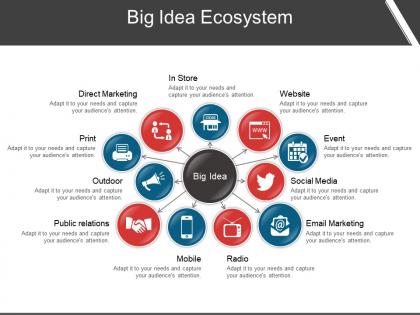
Pick this big idea ecosystem PowerPoint templates PowerPoint presentation and discuss about the suppliers, distributors, consumers, government, processes, products and competitors while creating a business presentation on behalf of your organization. The business ecosystem PowerPoint shape facilitates the user to discuss about the participants who have developed patterns of behavior that streamline the flow of ideas, talent and capital throughout the system. The framework of this entrepreneurship natural system provides the user a platform wherein the social and economic environment which may be affecting the local or regional entrepreneurship can also be discussed for creativity, innovation and enhancing the greater chances of success.The template can also be availed by a group of companies including start-ups and one or more coordination entities which shares similar goals and decide to form a network or an organization in order to explore the economies of scale combined with flexibility and entrepreneurial drive. Our Big Idea Ecosystem Powerpoint Templates are ideal for conveying information. It helps conduct the assembly.
People who downloaded this PowerPoint presentation also viewed the following :
Big idea ecosystem powerpoint templates with all 5 slides:
Get folks indulging in healthy exercise with our Big Idea Ecosystem Powerpoint Templates. Instigate them to jog.

FAQs for Big idea
Look, you need three things to make this work: diverse talent, solid infrastructure, and the right culture. Talent means mixing people from different backgrounds - not just the same old crowd. Infrastructure covers funding, mentorship, spaces where people can actually collaborate. But culture? That's the real game-changer. People have to feel okay taking risks and screwing up sometimes. Otherwise nobody tries anything interesting. I'd honestly start by figuring out which of these three is your biggest weak spot right now.
Honestly, collaboration is where the real breakthroughs happen. When you mix different perspectives, wild stuff emerges that nobody would've thought of solo. Like, your blind spots become obvious when someone with a totally different background jumps in. Their expertise fills your gaps, yours fills theirs. The best teams I've seen actively hunt for people who think nothing like them - then they create these regular brainstorming sessions where no idea's too crazy. Cross-pollinating between departments or industries? That's where innovation lives. Don't just stick with your usual crew though.
Honestly, tech is a total game-changer for scaling up. Cloud stuff means you don't need crazy upfront costs - just scale when you need to. AI handles all the boring repetitive work that used to need whole teams. Plus you can hit global markets instantly through digital platforms, which is wild when you think about it. Social media does half the work spreading your ideas around. The data side shows you what's actually working so you're not just guessing. My advice? Figure out what's slowing you down most, then find whatever tool fixes that specific problem first.
Look, stakeholders are what make or break your big ideas. Investors bring the cash. Mentors share their war stories and connections. Your customers? They'll tell you if your concept actually works or if you're just fooling yourself. Partners can open doors to markets you'd never reach alone. Honestly, most people wait too long to build these relationships - you want them in your corner before you're scrambling for help. Map out who you need at different stages. Some will matter more early on, others become crucial later. It's like building your personal board of advisors, except some of them pay you.
Honestly, start with making people feel safe to speak up - nobody's gonna pitch crazy ideas if they think they'll get roasted. Those quiet team members? Pay attention to them, seriously. Some of the best ideas I've heard came from people who barely talk in meetings. Set up brainstorming sessions where you don't immediately shut things down. Ask about actual customer problems instead of just "how do we make this faster." Oh, and follow-through is huge - give someone ownership of the good ideas with real budget to test them out.
Ugh, resource constraints are brutal - that's always the first thing that'll hit you. Getting everyone on the same page is somehow even worse though. People have their own agendas and timelines, you know? Get executive buy-in early or you're toast. Quick wins are your best friend for building credibility. Don't try to boil the ocean right away either - pick one problem and nail it first. Oh, and hire someone to actually manage the community stuff. I learned that one the hard way. Success metrics upfront help too, but honestly the stakeholder alignment thing never really gets easier.
Look, diverse thinking is what makes ideas actually pop off. You throw different perspectives together and they clash in the best way - suddenly you're getting solutions nobody saw coming. Same-minded groups? Total echo chambers. They just keep recycling the old stuff. But mix in people with different backgrounds and expertise, and they'll call out your blind spots faster than you can blink. I know it sounds weird, but seek out the voices that confuse you a little. That awkward friction between viewpoints? That's literally where breakthrough ideas come from. It's like - the discomfort means you're onto something good.
Don't get caught up in just view counts - those numbers can be pretty deceiving. What you actually want to track is whether your idea spreads AND sticks. Look at engagement rates and how fast people adopt it. Are they sharing it? Building on it in their own stuff? The viral coefficient matters, but so does retention - like, do people actually follow through or just scroll past? I'd start with maybe 2-3 metrics that directly connect to what you're trying to accomplish with the idea. You can always add more later, but honestly the sustained engagement over time tells you way more than a big impression number ever will.
Honestly, mentorship programs are game-changers for keeping your ideas fresh and moving forward. You get this cross-pollination thing happening where experienced founders share what bombed vs. what actually worked. Having someone who's survived the startup chaos before? Total lifesaver - they'll catch those blind spots you can't see yet. Your network explodes too since mentors introduce you to their people, investors, other entrepreneurs. The best part though is how they'll challenge your assumptions and push your thinking way beyond where you started. I'd say find mentors who've tackled similar strategic challenges to what you're facing.
Honestly, diversifying your funding is huge - don't rely on just grants or just investors. Mix it up with different revenue streams so you're not screwed if one dries up. Partnerships will save your ass too, plus they make the whole thing less lonely lol. The community feedback thing is probably the most overlooked part though. Actually listen to what users need instead of assuming you know. I'd start by looking at where your money comes from right now and figure out what's missing. Oh, and those partnerships? They're not just about money - they expand your reach in ways you wouldn't expect.
Dude, culture is like this huge invisible lens that filters everything. It decides what problems you'll even see, plus what solutions feel realistic. Democracy emerging from a super rigid hierarchy? Never gonna happen. Religious stuff, social norms, how people communicate - all of it affects whether your idea gets shot down or takes off. I've seen brilliant concepts totally bomb because they went against what people deeply believed. Oh, and the economic system matters too - forgot that part. Before you launch anything big, really dig into the cultural vibe first. You'll avoid looking completely out of touch.
Look at Silicon Valley - Stanford pumps out talent, VCs throw money around, and everyone's cool with failing spectacularly. Perfect recipe, honestly. Israel built their whole "Startup Nation" thing off military tech expertise and university partnerships. Boston's killing it in biotech with Harvard, MIT, and all the pharma companies basically living on top of each other. The pattern? None of this happened fast. These places spent decades building networks where ideas and money bounce between universities, companies, and investors. Can't just copy-paste it somewhere else and expect magic.
Honestly, cross-industry collabs are where the magic happens. You get these weird partnerships - like Tesla working with gaming companies for car entertainment - and suddenly breakthrough innovations appear that nobody saw coming. Healthcare meets tech, automotive teams up with gaming... it sounds random but it totally works. Each industry drops their unique expertise and resources into the mix. Your traditional methods bump into their crazy unconventional solutions, and boom - problem solved in ways you'd never think of alone. I'd start by finding industries dealing with similar headaches but attacking them completely differently than you do.
Dude, feedback is like the lifeblood of any big idea. Get input from users, stakeholders, experts - even the haters honestly. It'll help you spot blind spots and test if your assumptions actually hold up. Yeah, it sucks when someone pokes holes in what you thought was genius. But that outside perspective? That's what turns rough concepts into something that actually works. Don't just ask people who'll blow smoke up your ass either - you need diverse voices giving you real talk. Set up regular check-ins with your target audience throughout the whole process.
Honestly, most people just stare at one spreadsheet and wonder why they're always behind the curve. You need to pull together different data sources - search trends, social media buzz, sales weirdness, customer complaints that keep popping up. I'd start by figuring out what data you actually have lying around, then see what's missing. Set up dashboards that show you what's coming, not what already happened. The real trick is spotting shifts before your competitors do. Predictive models help, but don't overthink it at first.
-
Easy to edit slides with easy to understand instructions.
-
Wonderful templates design to use in business meetings.