


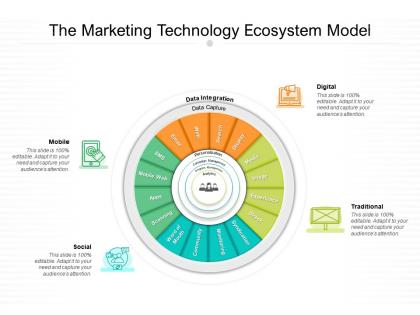
The marketing technology ecosystem model




Try Before you Buy Download Free Sample Product
 Impress Your
 Audience
 100%
100% Editable
 Save Hours
 of Time


You will find our The Marketing Technology Ecosystem Model to be of admirable assistance. They are a handy asset to have around.
People who downloaded this PowerPoint presentation also viewed the following :
The marketing technology ecosystem model with all 2 slides:
Our The Marketing Technology Ecosystem Model have foresight. Their creators are focused ahead.
FAQs for The marketing
Okay so basically you need four main pieces: your data stuff (CRM, CDP), the tools that actually do things (email, social, ads), analytics, and content management. Your CRM is like the hub that connects everything. Then you've got marketing automation, attribution tools, personalization engines - they do the actual work. Integration is huge though - if they can't talk to each other, you're screwed. Honestly, I'd map out what you already have first. Most people don't realize how much their tools overlap. It's kinda like having three can openers but no decent knife, you know?
Honestly, most marketing tools connect pretty easily these days through APIs and those pre-built connector things. Your CRM and email platform should be your first priority - get those talking to each other. Then you can add analytics and whatever else you need. I'd map out what data needs to go where before you start though, saves you headaches later. Legacy systems are still a pain sometimes but whatcha gonna do. Don't try connecting everything at once or you'll lose your mind. Just focus on fixing your biggest annoyances first.
Analytics is what makes all your marketing tools actually worth the money you're spending on them. It shows you which channels are bringing in real customers, not just vanity metrics. You can optimize campaigns as they're running and personalize stuff for each customer. Most importantly, it connects all those random touchpoints so you see the complete customer journey - honestly, this part's a game changer. Without it, your tools just collect data that sits there doing nothing. I'd start by figuring out what data you're actually collecting versus what you need to make smarter decisions.
Honestly, map out what you're actually doing now and figure out where leads are slipping through the cracks. Don't get distracted by flashy tools - I've watched teams blow money on fancy attribution stuff when they couldn't even track if people opened their emails lol. Pick based on your biggest headaches first. Make sure whatever you choose plays nice with other tools since they'll need to connect eventually. Oh, and start small! Grab one or two essentials, test them out with a pilot before signing any yearly contracts. You can always add more later once you know what actually works.
Honestly, you've gotta focus on AI personalization - it's everywhere now. Third-party cookies are done for, so first-party data platforms are huge. Conversational marketing is blowing up too with chatbots and voice stuff. Everyone's obsessed with customer data platforms right now, trying to get all their messy data in one place (which, fair enough). Marketing automation is getting way better at not sounding robotic. Oh, and attribution modeling that actually tracks people across different channels. Start looking at your current tools now though - seriously. The stuff that plays nice with what you already have will be worth its weight in gold later.
Dude, you gotta track stuff that actually connects to money coming in. Attribution tracking is huge - shows you which tools are really working. Customer acquisition cost and lifetime value are your best friends here. Most companies totally overthink this whole thing tbh. Just do simple before/after comparisons on conversion rates, how long your sales cycle takes, qualified leads. Get UTM tracking set up and make sure your CRM actually talks to your marketing tools so you can see the whole customer path. Honestly? Start measuring now even if it's messy - you need that baseline data to prove ROI down the road.
Honestly, integration is gonna be your biggest pain point - nothing ever connects as smoothly as they promise. Your team will probably drag their feet on adopting new stuff too, which is super frustrating but totally normal. Costs spiral way faster than you think once you add training and customization (learned that one the hard way). Data migration? Yeah, that's always a mess and takes forever. I'd say pick one tool first, make sure it actually works with your setup, then slowly build from there. Don't try to overhaul everything at once or you'll hate your life.
Dude, AI is everywhere in marketing tech now - probably doing way more than you think. It's running personalization engines, scoring leads, optimizing content, predicting customer behavior. Even handles chatbot responses and figures out the best times to send emails. The crazy part? Most of it happens without you noticing. What's really game-changing is how it automates complex stuff while personalizing at massive scale. No human team could match that manually. My advice: look at whatever repetitive tasks you're doing now and see where smarter automation makes sense. That's your quickest win right there.
Honestly, data minimization is where I'd start - just grab what you actually need for campaigns. Access controls are huge too so random people aren't poking around customer info. Encrypt everything, obviously. We nearly got burned last year because someone skipped this step, ugh. GDPR and CCPA compliance isn't optional if you're targeting those areas. Security audits should happen regularly - like, put them on your calendar. Train your team properly because most data breaches happen when people don't know what they're doing. Oh, and document all your processes. Sounds boring but it'll save you later.
Marketing automation is honestly a game changer - it sends the perfect message when people are actually ready to hear it. So like, someone abandons their cart? They automatically get a follow-up email. Downloads something? Another targeted message goes out. The whole thing adapts to what each person's doing on your site, which feels pretty cool when you see it working. Your emails and content basically customize themselves based on where someone is in their buying journey. Oh and definitely start simple - maybe just do welcome emails first. I learned that the hard way trying to set up everything at once!
Look, your CRM is like the brain of all your marketing stuff - everything connects back to it. Customer info, what they've bought, how they found you, it all lives there and feeds your email campaigns and ad targeting. Without it you're just guessing at everything, which honestly sucks when you're trying to grow. It helps you figure out who to target and actually see what's bringing in sales. My advice? Start simple - just get all your customer data flowing into one spot instead of having it scattered everywhere. You'll thank yourself later.
Honestly, just start with the free stuff - Google Analytics, Mailchimp's basic plan, Canva. That's literally zero dollars and covers most of what you need. Pick one thing to focus on first though, like email marketing, because trying to do everything at once is exhausting. Once you're making money, then you can justify paying for tools that actually solve problems you're having. I always tell people to prove each tool is worth it before adding another one. The whole "shiny object syndrome" thing is real with marketing tools. Start small, see what moves the needle, then build from there as your budget grows.
Honestly, multiple marketing tools can boost your results big time, but the setup is kind of a pain. You get this awesome complete picture of how customers move through your funnel - from email to social to ads and back. That part's genuinely game-changing. The downside? Integration takes forever and your team has to learn like five different dashboards. When stuff breaks, good luck figuring out which platform is the problem. I'd start with maybe 2-3 tools that actually sync well together. Then add more once everyone's not completely overwhelmed by the current setup.
Dude, seriously - start flexible from the beginning. Pick platforms that won't die when your user base explodes or you need to connect new stuff. APIs should play nice together, and stay away from those proprietary systems that trap you forever. I've watched so many startups fall in love with some "amazing" tool that becomes their worst enemy during growth spurts. Go modular so you can actually swap things out later. Oh, and document everything (I know, boring but crucial). Also audit your tech stack regularly - future you will be so grateful when it's time to migrate or add new integrations.
So outbound is when you're basically interrupting people - cold emails, ads, that kind of stuff. Inbound is the opposite - you create good content and let people find you through SEO, blogs, social media. I mean, both work but inbound feels less pushy to me. Most companies I know mix them though. You could start by looking at how your customers actually find you now and figure out what's missing. Like, are you getting enough organic traffic or do you need to be more proactive about reaching out? Really depends on your specific situation.
No Reviews