


Marketing technology stack diagram




Try Before you Buy Download Free Sample Product
 Impress Your
 Audience
 100%
100% Editable
 Save Hours
 of Time


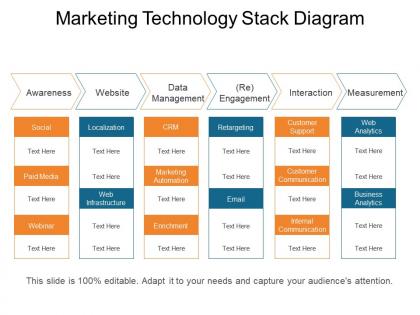
Incorporate this Marketing Technology Stack Diagram PowerPoint presentation to conduct and improve your marketing activities. This grouping of technologies PPT layout can be used to discuss the importance for marketers to have a clear understanding of which technologies are most fundamental to their business goals. Also, how technology can assist in accelerating their business growth can be illustrated with the aid of the marketing technology stack PowerPoint theme. The steps of making the marketing process easier using technical tools can be showcased with the stack diagram PowerPoint template. The steps namely awareness, website, data management, re-engagement, interaction, and measurement can be highlighted with this technical marketing PPT theme. The components like a webinar, social media, CRM, marketing automation, email, customer support, internal communication, business and web analytics can be elucidated with this marketing strategy PowerPoint layout. Therefore download this sales analytics PPT template to track your brand’s marketing campaign effectiveness.
People who downloaded this PowerPoint presentation also viewed the following :
Marketing technology stack diagram with all 5 slides:
Initiate incentives for growth with our Marketing Technology Stack Diagram. Applaud attempts to hasten development.
FAQs for Marketing
Okay so you really just need five things to get started. CRM first - Salesforce or HubSpot work great for tracking leads and customers. Marketing automation handles your email campaigns and all that nurturing stuff. Google Analytics is a no-brainer for seeing what's actually working. Content management system for your website and landing pages, obviously. Oh and social media tools, though honestly that whole space moves so ridiculously fast it makes my head spin. Just start with these basics and you can always add fancier tools later when things get crazy.
Honestly, connecting your CRM to marketing tools is a total game-changer. All that messy customer data suddenly makes sense for targeting campaigns. You can auto-segment people by what they've bought or where they are in your funnel - saves so much time. Lead scoring gets way better too when everything talks to each other. I'd start with just syncing your email platform first (we made that mistake of trying to do everything at once). Once you see which emails actually make money instead of just getting opens, you'll be hooked on the data.
Look, analytics is basically your marketing GPS - it connects everything and shows what's actually moving the needle. Track customers across channels, see which campaigns bring in real money, catch patterns you'd miss otherwise. Without it? You're just guessing and wasting budget tbh. It pulls data from your CRM, email stuff, social platforms, website - gives you the complete story. Oh and start with attribution tracking first! That's where everyone screws up and ends up with useless data. Trust me on this one.
Honestly, just figure out where people are actually dropping off in your customer journey first. That's where you throw your money. I used to get sucked into fancy features I never touched - total waste. Way better to grab tools that play nice together than amazing standalone ones that can't talk to each other. Trust me on this one. Go after your biggest headaches, not whatever your competitors are bragging about on LinkedIn. And pick something you'll actually use consistently. Best tool in the world won't help if you forget it exists after two weeks.
Honestly, the worst part is when your tools refuse to talk to each other - you end up with customer info scattered everywhere and doing everything twice. Your team will probably hate learning new systems too. I swear people would rather do things the hard way than change their routine. Budget-wise, those monthly fees sneak up on you fast. My advice? Pick maybe 2-3 core tools first and actually train people properly on them. Figure out how your data connects before you go crazy adding more stuff. Way easier than trying to fix a mess later.
Okay so marketing automation is basically magic - you set up emails that trigger based on what people actually do on your site. Like someone abandons their cart? Boom, automatic email. You can segment audiences, personalize stuff without doing it manually (thank god), and nurture leads through drip campaigns. Honestly, the personalization thing is what gets me excited because customers think you're being super attentive when really it's just good automation. You'll want to start small though - maybe just welcome emails first, then add win-back campaigns for inactive customers later.
Honestly, multi-channel marketing is what holds your whole tech setup together. You've got to meet people where they actually hang out - email, social, text, whatever. Otherwise you're basically yelling at an empty room while everyone's somewhere else (which sucks). The magic happens when all your tools actually talk to each other. Your CRM should know what someone did in your emails, and your ads need to reflect how people behave on your site. That's where you see real results. I'd start by looking at what channels you're currently using - probably more than you think - and figure out how to connect them better.
Dude, prioritize security when picking martech tools - data breaches will absolutely wreck your customer trust and cost serious money. Check their encryption, compliance stuff like GDPR and SOC 2, plus where they're storing your data. We got burned at my last company picking a sketchy tool without doing our homework first. Total nightmare. Read everything about data ownership agreements too - the fine print matters way more than you'd think. Oh, and definitely loop in your IT team early to make a security checklist. Trust me, it's worth the extra work upfront.
Look at three key areas to see if your martech stack's actually doing its job. Operational stuff first - how fast you're processing leads, setting up campaigns, syncing data between tools. Engagement metrics matter too: email opens, conversions, how many people complete your customer journeys. ROI's obviously critical - cost per acquisition and marketing attribution tell the real story. But here's the thing that drives me crazy: most people get obsessed with vanity metrics that don't mean anything for the bottom line. Focus on what actually drives revenue and makes your team more productive. I'd do monthly check-ins to catch trends early and ditch tools that aren't pulling their weight.
Honestly, martech is a game-changer for personalization because it pulls together all your customer data from different places. Your CRM talks to your email tool, website analytics, social platforms - suddenly you've got this complete picture of each person. Purchase history, what they browse, their preferences, everything. From there you can automatically create audience segments and send targeted messages based on where they are in the buying process. Cart abandoners get one type of email, while your VIP customers get something totally different. The tricky part is actually getting your tools to sync up properly - I'd start by checking what data's flowing between platforms first.
So AI personalization is getting really good now - not just basic stuff but actually predicting what customers want. CDPs are pretty much mandatory at this point for pulling all your data together. Privacy tech is blowing up since cookies are basically dead (thank god honestly). Chatbots don't suck anymore either, they're actually helpful now. But here's the thing - don't just buy random tools that sound cool. First figure out what you've already got, then find stuff that plays nice with it. Otherwise you'll just create more headaches for yourself down the line.
Map out your data flow first - that's the real game changer. Pick tools that actually connect through APIs instead of just grabbing the "best" in each category. I've watched companies get stuck with like 15 platforms that never talk to each other, which is honestly a nightmare. Zapier works for basic stuff, but you'll need proper API connections for anything complex. Start with maybe 3-4 tools that play nice together, then expand. Way better than trying to force everything to work later.
Honestly, all-in-one platforms are a lifesaver for tracking customer stuff - everything flows together nicely and reporting actually makes sense. Way less time wrestling with integrations. Best-of-breed tools are more flexible though, you can cherry-pick the perfect tool for each job. But then you're juggling multiple vendors and contracts, which gets messy fast. Your team size matters most here. Stretched thin? Go all-in-one first. You can always optimize later when you have bandwidth. I learned this the hard way lol.
Honestly, your marketing tech stack can totally make or break how well your team actually works together. When everything connects properly, your content team knows what's crushing it, sales can see lead quality, and marketing finally proves they're not just burning money. But man, disconnected systems are the worst - you'll have people constantly going "wait, which dashboard are we looking at again?" Pick tools that actually talk to each other. Yeah, it might cost more upfront, but trust me, the headache you'll save is worth every penny.
Honestly, AI has become like the glue holding all your marketing tools together. Most of it runs in the background - personalizing emails, optimizing your ad spend, figuring out which leads are worth chasing. The crazy thing? You're probably already using it without knowing. HubSpot, Salesforce, Adobe - they've all got AI stuff built right in now. Instead of buying more tools (which, let's be real, nobody needs), just dig into what you already have. I bet you'll find features you didn't even know existed. It's pretty much doing the heavy lifting so you don't have to constantly babysit every campaign.
-
Very well designed and informative templates.
-
Innovative and attractive designs.