


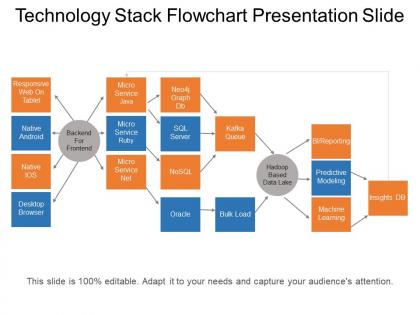
Technology stack flowchart presentation slide




Try Before you Buy Download Free Sample Product
 Impress Your
 Audience
 100%
100% Editable
 Save Hours
 of Time


Highlight commendable efforts with our Technology Stack Flowchart Presentation Slide. Ensure efficient folk get their due.
People who downloaded this PowerPoint presentation also viewed the following :
Technology stack flowchart presentation slide with all 5 slides:
Applause is never grudging with our Technology Stack Flowchart Presentation Slide. Folks will eagerly appreciate your brilliance.




FAQs for Technology stack
So you've got four main pieces to worry about: frontend (what users actually see), backend for all the server stuff, database for storing everything, and infrastructure to host it all. React or Vue work great for frontend. Backend - honestly just pick whatever your team already knows, whether that's Node.js or Python or whatever. Don't overthink it. PostgreSQL or MongoDB for your database, then throw it all on AWS or Azure. Oh and you'll need monitoring tools and CI/CD pipelines eventually, but that's kinda the boring stuff. Start simple with one tech per layer that you're comfortable with, then build from there as you go.
Yeah, your tech stack definitely affects speed - like JavaScript vs Go for heavy stuff, or how React's virtual DOM works compared to plain JS. But here's the thing: good architecture usually beats fancy tech choices. I've seen crappy Node apps get smoked by well-tuned Rails setups. Go with what your team actually knows well and what fits your specific use case. Don't get caught up chasing performance stats if you can't even build it properly, you know?
Look, team expertise is everything - don't pick some fancy tech stack if your devs have never touched it before. After that, think about your actual product needs, how much it needs to scale, and your timeline. Budget's a factor too since some stuff gets expensive fast. But honestly? Most startups way overthink this decision. I've watched teams debate for weeks when they should've just started coding. Pick whatever gets your MVP out the door quickest without completely screwing yourself over later. You can always rebuild parts once you've got actual users paying you.
Dude, having a clear tech stack saves you from those endless "what should we use for this?" debates that just kill productivity. Your team can actually jump into projects without spending half the day figuring out the setup. Code reviews become less painful too since everyone knows what they're looking at. I swear I've watched teams argue about tooling for literal weeks - such a waste. Document whatever you're using somewhere accessible and stop chasing every trendy framework that shows up online. Trust me, you'll build way more stuff when you're not constantly switching tools.
Look, microservices are pretty sweet for flexibility - different teams can ship independently, pick their own tech stack, scale just the parts that need it. Way less stepping on each other. The flip side though? God, the complexity will make you want to cry sometimes. Network calls everywhere, debugging across like 6 different services when something breaks, data sync issues. Your AWS bill might shock you at first too. Honestly just start with a monolith unless you're already feeling those specific pain points. You can always chop it up later when you actually need to.
So cloud basically flips everything - instead of "can we build this?" it's "should we even bother building it?" You end up designing around their managed stuff like databases and auth services rather than doing it yourself. Honestly pretty freeing once you stop being a control freak about it. Everything gets more modular since you're just connecting their services together. But yeah, then you're stuck worrying about vendor lock-in and those sneaky data transfer fees that add up quick. I'd start by figuring out what you actually need to build custom vs what you can just use off the shelf.
Think of integration tools as your digital middleman - they connect all your apps without creating chaos. So instead of your CRM directly talking to email, analytics, billing, etc. (which gets messy fast), everything goes through one hub. You can monitor data flows from a single spot, debug problems easier, and add new tools without breaking stuff. Honestly, it's the difference between managing 20 separate connections vs. one clean system. Way less headache and you won't be up at 2am fixing broken links between apps.
Honestly, open source runs pretty much everything now. React, Node.js, PostgreSQL, Kubernetes - most of the tools you're already using are open source. Makes sense too since you get flexibility, save money, and tap into huge communities for support. No vendor lock-in either, which is clutch. The ecosystem moves crazy fast compared to waiting around for some proprietary company to roll out updates. I'd say go for it, but just stay on top of security patches and maintenance yourself - that part's on you now.
Honestly, adding AI to your app means rebuilding pretty much everything. Your data pipelines need to handle way more volume now. You'll want TensorFlow or PyTorch, plus way beefier servers since model training eats resources like crazy. The annoying part? Now you're juggling regular app stuff AND model inference at the same time. Deployments get messy fast. Oh and scaling becomes this whole dynamic thing instead of predictable traffic patterns. My advice though - figure out where AI actually helps users first. Don't just throw models at problems because it's trendy.
So front-end is basically what users actually see and click on - React, Vue, Angular, plus your HTML/CSS and JavaScript stuff. Back-end handles all the behind-the-scenes work: databases, APIs, server logic. You've got Node.js, Python/Django, Ruby on Rails for that side. Honestly? The whole distinction gets messy with frameworks like Next.js doing both. Front-end is all about making things look good and work smoothly for users. Back-end deals with data processing and keeping everything secure. Just pick whatever fits your project - and what your team already knows, because learning curves suck.
Honestly, just hit up their GitHub and check the commit history from the past year - that'll tell you everything. Major company backing? Good sign. Decent job market for those skills? Even better. I always look at how fast they're pushing releases and whether the maintainers actually respond to issues. Documentation quality matters too, trust me on that one. The worst thing is picking something trendy that dies off because the core team burned out or lost funding. You really don't want to be stuck explaining dead tech in interviews two years from now.
Dude, your tech stack choice is everything. Pick something too fancy or monolithic and you're screwed when you need to scale. I've watched entire teams get stuck because they went with whatever was trendy instead of what actually works. Python or Node.js with modular setups? Way smarter - gives you room to grow. Database decisions matter too. NoSQL vs SQL completely changes how you handle traffic spikes. Honestly, I'd go simple first. Stick with proven stuff and always think about adding features later or handling way more users. Trust me on this one.
Honestly, tech trends pretty much steamroll entire industries. Once containerization or serverless gets momentum, you'll see new deployment and monitoring practices pop up everywhere. Companies that drag their feet end up stuck with expensive legacy systems - and good luck finding devs who want to touch that old stuff. It changes security protocols, workflows, team structures, the works. AWS and the other big cloud players usually signal what's coming next, so I always watch what they're promoting. Kind of annoying how fast everything moves, but that's the game.
Honestly, the worst part is watching your team struggle with the learning curve while everything moves at a snail's pace. Data migration will make you want to pull your hair out. And don't even get me started on legacy systems - I've watched devs bang their heads against API integration for literal weeks. Here's what actually works: pilot everything first. Train your team hard before you need them to perform. Document like crazy, but also have backup plans ready. Oh, and never do the whole thing at once - that's just asking for trouble. Phase it out instead.
Start with modular components that aren't super tightly coupled - trust me, I've watched teams struggle for months trying to rip apart systems that were basically held together with digital duct tape. Microservices and standardized APIs are your friends here. Oh, and containerization makes swapping stuff out way less painful. You'll definitely accumulate some technical debt over time (we all do), so plan regular cleanup sprints. I'd map out your current dependencies first. Figure out what's most likely to need updating in the next year or so.
-
Easily Editable.
-
Thanks for all your great templates they have saved me lots of time and accelerate my presentations. Great product, keep them up!