


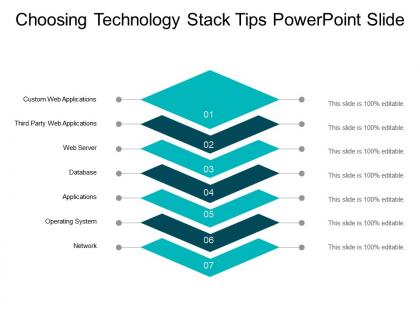
Choosing technology stack tips powerpoint slide




Try Before you Buy Download Free Sample Product
 Impress Your
 Audience
 100%
100% Editable
 Save Hours
 of Time


Our Choosing Technology Stack Tips Powerpoint Slide are genuinely gilt edged. They give you a golden chance.
People who downloaded this PowerPoint presentation also viewed the following :
Choosing technology stack tips powerpoint slide with all 5 slides:
Get the deal of the day with our Choosing Technology Stack Tips Powerpoint Slide. All the aces will fall your way.



FAQs for Choosing technology stack
Honestly, just go with whatever your team already knows best. Learning some trendy new framework while you're trying to hit deadlines is basically asking for trouble. Look at your actual needs too - how fast does it need to be, will it need to scale, does it play nice with your current stuff? Community support matters way more than people think because you WILL get stuck on something weird at 2am. Oh and hiring later - if you pick something super niche, good luck finding devs who know it. I'd just make a quick pros/cons list for your top few options and let the team weigh in.
Dude, your framework choice totally impacts load times and scaling. React and Vue are flexible but you'll make tons of setup decisions. Angular's got everything built-in though it's overkill for small stuff. Next.js is honestly killing it right now - their performance optimizations are chef's kiss. Bundle size matters big time. So does whether you're doing SSR or client-side rendering, plus how the framework splits code when your app gets bigger. Just match it to what your team knows and project size. Trust me, picking wrong will come back to haunt you during scaling.
Honestly, community support can totally save your ass when you're stuck. Hit a weird bug? Active communities on Stack Overflow or GitHub usually have someone who's dealt with it already. React and Django are gold for this - massive user bases mean tons of libraries and tutorials. Smaller tech might have die-hard fans, but good luck finding help at 2am on a Sunday. I always check how fast people actually respond in their forums before diving in. Recent activity is key - dead communities are basically useless when you're on a deadline.
Dude, licensing costs will absolutely destroy your budget if you're not careful. Don't just look at upfront fees either - those "free" open-source options sometimes end up costing way more in support than just buying something that works. Oracle is the worst offender here, their enterprise stuff gets insane as you grow. That said, cheap isn't always smart. Sometimes paying for solid commercial tools saves you from pulling your hair out later. Make a spreadsheet with everything - licensing, support, training, infrastructure - over like 3-5 years. Trust me on this one.
Check GitHub stars and Stack Overflow buzz first - you want tech that's not dying anytime soon. The backing company matters way more than most people think, so make sure there's actual financial support. Look at development activity and roadmaps too. Can you realistically bail if things go south? That's huge. Your team's skills are probably the biggest factor though - pick something they can actually grow into. Also consider hiring - finding devs who know obscure frameworks is a nightmare. Oh, and job postings are a decent indicator of staying power.
Dude, definitely look at what integrations you'll need before picking your stack. Some frameworks have sick SDKs for stuff like Stripe and AWS that'll save you tons of time. Others? You're basically coding everything yourself which sucks. Make a list of the third-party services you need now, plus what you might add later. Then dig into which tech stacks actually support them well. GitHub's your friend here - check if the SDKs are actively maintained. Trust me, you don't want to find out six months in that the integration you need barely works or has crappy docs.
So basically, monoliths lock you into one tech stack for everything – which honestly isn't always bad since your team won't be juggling five different languages. Microservices are the opposite. You can pick whatever works best for each piece, but then you're dealing with multiple databases and deployment headaches. I'd say figure out what your team can actually handle first. Like, do you really want to debug issues across three different frameworks at 2am? Sometimes boring and simple wins. But if you need that flexibility and have the bandwidth for complexity, microservices might be worth it.
Honestly? Go with what your team already knows well. If they're JavaScript pros, stick with Node.js or React instead of making them learn Go from scratch - unless you've got like 3+ months for training (which, let's be real, most projects don't). But don't get totally trapped by current skills either. Think about your timeline and whether learning something new actually fits your long-term plans. I'd pick something that builds on what you have while maybe adding one thing the team's genuinely excited to try. That way you're not starting from zero but still growing.
Check each technology's vulnerability history first - how fast do they actually fix security bugs? Your team needs to realistically keep up with patches too. Authentication frameworks and encryption matter obviously, plus scan for recent CVEs. Honestly, some frameworks are just disasters waiting to happen (looking at you, certain JS libraries). If you need SOC2 or HIPAA compliance, that'll narrow things down fast. Stick with mature tech that has solid community backing instead of shiny new stuff. Don't skip running a security audit on your final picks before committing.
Honestly, stick with what your team already knows. Learning new tech mid-MVP is a disaster waiting to happen - trust me on this one. Boring frameworks with solid docs will save your sanity. They handle all the tedious backend stuff while you build actual features people care about. Don't over-engineer (yeah, I see you eyeing that fancy microservices setup). Pick tools that won't make you rewrite everything when you inevitably pivot. Save the cutting-edge stuff for version 2. Reliable beats shiny every time for MVPs.
Track the technical stuff first - response times, error rates, throughput, resource usage. Those are what'll bite you if they tank. But honestly, the business side matters just as much. How fast can your devs ship features? Can you actually hire people who know your tech stack? (That one's brutal with some frameworks.) Maintainability costs add up quick too. Oh, and scalability - measure how your setup handles growth. Set your baselines right after you implement, then check quarterly. Catches problems before they explode.
So cloud compatibility is basically what decides if your tech stack will actually work or become a nightmare. Different frameworks and databases play nice with some cloud providers but not others - learned this the hard way on a project last year. AWS has its favorites, Azure pushes theirs, GCP does the same thing. You'll want to pick stuff that either has native support or at least decent docs for deployment. Otherwise you're stuck wrestling with config issues when you should be scaling. Honestly, going with each provider's managed services usually saves you a ton of headaches down the road.
Honestly, it's kind of a mixed bag either way. Open-source gives you way more control, but good luck when something breaks at 2am. Proprietary stuff usually has decent support and docs, though you're stuck with whatever they decide to build next. I've watched teams get screwed by both - abandoned open-source projects and vendors who suddenly tripled their pricing. My take? Mix them based on what your team can actually handle. Figure out what's absolutely critical first, then go DIY on the stuff where you won't panic if it implodes.
Dude, seriously prioritize good docs and usability. I got burned by this one framework that seemed perfect but had garbage documentation - wasted weeks figuring out basic stuff. When the docs are clear and the API makes sense, everything moves faster. Your team won't hate you during implementation, debugging actually works, and new people can jump in without pulling their hair out. Honestly, the prettiest framework means nothing if you can't figure out how to use it. Try building something tiny with it first - like spend 30 minutes just messing around. You'll know pretty quick if it's worth your time.
Honestly, WebAssembly is worth watching for anything performance-heavy. Deno and Bun are shaking up the JavaScript runtime space too - Node's not going anywhere but competition's good. AI integration is everywhere now (kinda exhausting but whatever). Serverless has grown way beyond just Lambda stuff. Rust keeps creeping into backend work, which makes sense. My take? Don't jump on every trend but pick one or two that fit what you're already doing. When you've got some free time, mess around with small experiments. Way better than scrambling to learn something when you actually need it for work.
-
Attractive design and informative presentation.
-
Appreciate the research and its presentable format.