


Technology solutions strategies presentation powerpoint





Try Before you Buy Download Free Sample Product
 Impress Your
 Audience
 100%
100% Editable
 Save Hours
 of Time


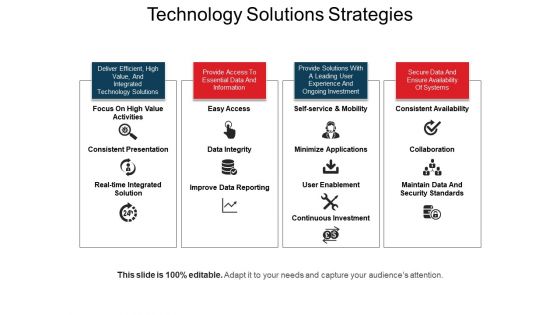
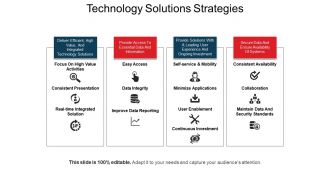
Here is a professionally designed PowerPoint slide for Technology Solutions Strategies which aids in a company’s stability and growth. Technology Solutions Strategies PowerPoint helps you deliver efficient, high value and integrated technology solutions. Technology solution strategy slides helps you develop data integrity among the organization, along with providing easy access to essential data and information. This also improves data reporting and increases the data bundle of the organization and helps them analyze it later. Use our technology solutions strategies presentation slide to provide solutions with a leading user experience and ongoing investment. Having said that, there are enormous long-term benefits for your organization with our software solution strategy slides. The plunge into an IT System to aid in managing your strategy or performance management process is a decision that shouldn’t be taken lightly. Information technology solution slide gives you in detail ways to provide solutions with leading user experience and ongoing investment. Douse feelings of anger with our Technology Solutions Strategies Presentation Powerpoint. Don't allow conditions to get inflammatory.
People who downloaded this PowerPoint presentation also viewed the following :
Technology solutions strategies presentation powerpoint with all 5 slides:
Bring about a festive buzz with our Technology Solutions Strategies Presentation Powerpoint. Get folks eagerly awaiting the event.


FAQs for Technology solutions
Definitely start with cloud infrastructure and data analytics - those are game changers. Customer experience automation is huge too. Cybersecurity though? Don't be like half these companies that wait until they get hacked. Mobile optimization isn't optional anymore, obviously. AI integration can be worth it if it actually fits what you do (not just for the sake of it). Oh, and train your people on this stuff! Best tech in the world won't help if nobody knows how to use it. Pick whatever gives you the biggest bang for your buck first.
Look for your most boring, repetitive stuff first - data entry, basic customer questions, that kind of thing. Don't try to automate your entire business right away (I've watched companies completely lose their minds doing that). Pick maybe two processes to test out. See if they actually work and save you time. Train your people on whatever you pick - this part's huge because someone's gotta know how to fix things when they break. And trust me, they will break sometimes. Oh, and definitely keep a manual backup plan ready to go.
Honestly, cloud computing completely changed how businesses think about tech. Instead of buying expensive servers upfront, you just rent what you need when you need it. Scale up instantly, deploy stuff in minutes rather than waiting months. Your team can work from literally anywhere too (pandemic taught us that lesson the hard way). The coolest part? You can test new ideas without dropping massive cash on infrastructure first. Experiment cheap, fail fast. I swear, companies still stuck in the old "we own everything" mindset are getting left behind while their competitors move at lightning speed.
Look, security can't be something you bolt on later - trust me, I've seen that go badly. First thing: figure out what data you're actually moving around and how sensitive it is. Zero-trust setup is your friend here, plus encrypt literally everything. Your cloud folks need to hit compliance standards too, obviously. The trick is picking security tools that don't make your dev team hate you (been there). Automation is clutch because then you're not constantly choosing between moving fast and staying safe. Find solutions that actually help innovation instead of killing it.
Honestly, pick one specific problem and fix that first - don't try to overhaul everything. Get your key people on board early and figure out exactly how you'll measure success. I swear, half the companies I know get distracted by flashy tech without asking what they're actually trying to solve (classic mistake). Figure out how it'll work with what you already have. Training is huge - doesn't matter how good the tech is if nobody uses it. Start small, see what happens, then expand from there. Way less risky that way.
Dude, it really depends on your industry. Healthcare moves super slow because of all the compliance stuff and patient privacy - they can't afford to mess up. Finance has similar regulations but they'll actually take risks for competitive advantage. Manufacturing is all about efficiency and connecting machines, while retail just wants to know everything about their customers. The regulatory stuff honestly controls way more than most people think. Don't bother copying what works in other industries - you'll just waste time. Find companies in your exact sector and see what they're doing instead.
Track both the money stuff and how things actually work day-to-day. ROI matters, obviously, but also check user adoption rates and system uptime. I've watched companies get obsessed with cost savings while completely ignoring that their team hates the new software - such a waste. Customer satisfaction scores tell you a lot too. How fast can you roll out features? Can you pivot when the market shifts? Those show if your tech actually makes you more agile. Pick maybe 4-6 metrics that fit your goals and review quarterly. Don't go overboard with tracking everything.
Definitely, but you gotta be smart about it. Cloud tools are your best friend here - they'll give you all that enterprise stuff without breaking the bank. CRM systems, automation software, AI analytics, the works. Here's the thing though - you can actually move way faster than those big guys because they're stuck dealing with endless approval chains and corporate BS. Pick one area that's eating up tons of your time and automate the hell out of it first. Then build from there. Don't be afraid to test something for a month and dump it if it sucks. That's your superpower right there.
Honestly, the worst part is dealing with ancient systems that fight every new thing you try to add. Your team will hate you at first - people get really attached to doing stuff the old way, even when it sucks. CFOs freak out about the upfront costs too. Healthcare and finance companies have it rough because they can't break anything without getting sued or fined. Most infrastructure wasn't designed for this stuff anyway, so that's fun. Start tiny though - pick one broken process and fix it. Once people see it actually works, they'll stop being so weird about change. Don't try to revolutionize everything on day one.
Honestly, IoT changes everything - you go from managing separate systems to dealing with thousands of connected devices all talking to each other. The data streams alone will make your head spin. My advice? Don't try to connect every single thing right away (I've seen companies crash and burn doing that). Pick one real problem IoT could actually fix, then figure out what you need tech-wise. You'll definitely need better security since you're not just protecting servers anymore - now it's sensors, cameras, whatever. Oh and your data setup will need a complete overhaul. Start small though.
Give people actual time to play around with stuff - Google's 20% thing worked for a reason. Set up hackathons or little innovation spaces where they can experiment without someone breathing down their neck about profits. Your leaders need to use the new tools too, not just talk about them. Mix your tech people with business folks on teams and give them real budget for quick prototypes. Here's the thing though - don't add more processes. Remove barriers instead. And honestly? Celebrate when things don't work out. That's where you'll actually build an innovation culture, not from the successes.
Honestly, start with modular stuff that can swap in and out easily - avoid those massive all-in-one systems like the plague. We got burned by legacy software that basically held us hostage for years. Cloud platforms are your friend, plus anything with solid APIs that actually get updated regularly. Don't go all-in on one vendor either (learned that one too). Budget some money for testing new tools - your team needs to stay sharp anyway. The whole point is keeping your options open instead of boxing yourself into some tech nightmare you can't escape later.
Yeah, automation's definitely changing things at work. Jobs with lots of repetitive tasks usually get hit first. But creative roles? Those actually become more important. The transition phase sucks though - I won't sugarcoat that. It's stressful when your whole job shifts. New opportunities pop up too, like in tech support and data stuff. Honestly, I think the key is learning skills that work alongside technology instead of trying to beat it. Oh, and problem-solving jobs tend to stay pretty safe since machines still can't think like we do.
Honestly, big data analytics is perfect for this stuff. Start by looking at your current tech performance - usage metrics, how things actually run, user behavior patterns. You'll probably be shocked at what you find! I've watched companies discover their "must-have" systems were sitting there collecting dust. Performance data shows you what's really working vs what you think is working. Use that info to predict what you'll need down the road and see how you stack up against competitors. My advice? Pick one thing first - maybe server performance or how people actually use your apps. Build from there and let the data guide your next investments.
Don't wait until you're already neck-deep in development to think about ethics - build it in from the start. Data privacy, algorithmic bias, job displacement, environmental costs of your tech stack. All that stuff matters way more than people realize. Make sure whatever you're building actually works for people with disabilities too. Regulations are getting stricter by the month, so getting ahead of compliance beats playing catch-up later. Honestly, I'd start with an ethical impact assessment for big initiatives. Give your team some concrete guidelines they can actually use when they're making tough calls day-to-day.
-
Illustrative design with editable content. Exceptional value for money. Highly pleased with the product.
-
Great designs, really helpful.