


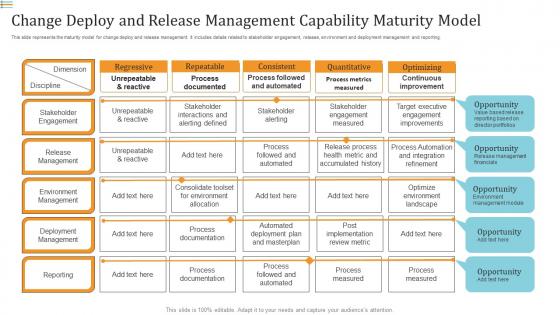
Change Deploy And Release Management Capability Maturity Model




Try Before you Buy Download Free Sample Product
 Impress Your
 Audience
 100%
100% Editable
 Save Hours
 of Time


This slide represents the maturity model for change deploy and release management. It includes details related to stakeholder engagement, release, environment and deployment management and reporting.
People who downloaded this PowerPoint presentation also viewed the following :
Change Deploy And Release Management Capability Maturity Model with all 6 slides:
Use our Change Deploy And Release Management Capability Maturity Model to effectively help you save your valuable time. They are readymade to fit into any presentation structure.





FAQs for Change Deploy And Release Management
Change management maturity models typically include initial/reactive, developing/planned, defined/systematic, managed/proactive, and optimizing/continuous stages. These progressive levels enable organizations to evolve from ad-hoc change responses to strategic transformation capabilities, with companies in manufacturing and financial services finding that higher maturity delivers faster implementations, reduced resistance, and sustained competitive advantage.
Organizations assess their change management maturity by evaluating capabilities across planning frameworks, leadership engagement, communication effectiveness, employee readiness, and measurement systems. Through structured assessments and benchmarking tools, companies in sectors like healthcare, financial services, and manufacturing identify gaps in their change processes, enabling targeted improvements that streamline transformations and deliver sustainable competitive advantage.
Leadership drives change management maturity by establishing strategic vision, fostering change-friendly culture, and providing necessary resources and accountability mechanisms. Through consistent communication, skill development, and modeling adaptive behaviors, leaders enable organizations to progress from reactive change approaches to proactive transformation capabilities, with many companies finding that engaged leadership accelerates maturity advancement significantly.
Employee engagement significantly influences change management success by reducing resistance, accelerating adoption rates, and ensuring sustainable transformation outcomes. Engaged employees actively participate in change processes, provide valuable feedback, and become change champions within their teams, with many organizations finding that highly engaged workforces experience 70% higher success rates in major initiatives, ultimately delivering faster implementation timelines and stronger long-term results.
Adopting a structured Change Management Maturity Model delivers improved organizational resilience, enhanced employee engagement, reduced resistance to initiatives, accelerated implementation timelines, and measurable transformation outcomes. These frameworks enable organizations to systematically build change capabilities, with many companies finding that structured approaches reduce project failure rates by up to 70% while significantly increasing adoption rates across departments.
Organizations can tailor change management strategies by assessing their current capabilities, resources, communication channels, leadership support, and cultural readiness to determine appropriate approaches. While mature organizations leverage sophisticated frameworks and cross-functional teams, emerging organizations focus on foundational elements like stakeholder buy-in and basic communication structures, ultimately delivering targeted interventions that match organizational capacity and maximize transformation success.
Effectiveness metrics include employee adoption rates, project timeline adherence, budget variance, resistance levels, and productivity measures during transitions. Through regular pulse surveys, performance dashboards, and stakeholder feedback, organizations can track engagement scores, training completion rates, and business outcome achievements, with many companies finding that combining quantitative data with qualitative insights delivers comprehensive change management optimization.
Technology integration significantly enhances change management maturity by streamlining communication workflows, automating progress tracking, and enabling data-driven decision making throughout transformation initiatives. Through digital platforms and analytics tools, organizations can accelerate stakeholder engagement, minimize resistance through transparent reporting, and deliver more consistent change outcomes, ultimately achieving higher maturity levels with measurable competitive advantage.
Organizations typically encounter resistance to new processes, lack of leadership commitment, insufficient change management skills, poor communication strategies, and inadequate measurement systems when enhancing change management maturity. These challenges often manifest through failed project implementations, employee disengagement, and inconsistent change approaches across departments, with many companies finding that investing in structured training and executive sponsorship significantly accelerates their maturity progression.
Organizations foster continuous improvement in change management by establishing feedback loops, conducting post-implementation reviews, investing in leadership development, and creating learning repositories from past initiatives. Through regular assessment cycles and cross-functional collaboration, companies like healthcare systems and financial institutions enhance their change capabilities, build organizational resilience, and ultimately deliver more successful transformations with reduced resistance and improved employee engagement.
Change Management Maturity Models specifically focus on an organization's capability to plan, implement, and sustain organizational transitions, while other maturity models assess broader areas like project management, technology adoption, or process improvement. While general maturity models evaluate overall operational capabilities, change management models uniquely measure readiness for transformation, stakeholder engagement effectiveness, and cultural adaptability, with many organizations finding that specialized change maturity assessments deliver more targeted insights for navigating complex business transitions.
Lessons learned from past initiatives provide critical baseline data for maturity assessments by revealing recurring resistance patterns, communication gaps, resource allocation challenges, and successful adoption strategies across different organizational levels. These insights enable organizations to accurately gauge their current change capabilities, identify systematic weaknesses in their processes, and develop targeted improvement strategies, with many finding that historical analysis significantly enhances the precision and relevance of their maturity evaluations.
Essential training includes change leadership development, stakeholder engagement strategies, communication planning, resistance management techniques, and project management fundamentals. Organizations typically benefit from combining formal certification programs, hands-on workshops, and mentoring initiatives, with many finding that cross-functional training sessions and access to proven frameworks ultimately enhance adoption rates and deliver more successful transformation outcomes.
Change management maturity significantly enhances business performance by enabling faster adaptation, reducing resistance to transformation initiatives, and improving success rates of strategic changes. Organizations with mature change capabilities demonstrate greater resilience through streamlined processes, enhanced employee engagement, and proactive risk management, with many companies finding that systematic change approaches deliver faster implementation, lower costs, and sustainable competitive advantage in volatile markets.
Organizations benchmark their change management maturity by conducting comprehensive assessments against established frameworks like Prosci's Change Management Maturity Model, Kotter's 8-Step Process, or ADKAR methodology. Through structured evaluations, peer benchmarking studies, and third-party assessments, companies identify capability gaps, measure progress across key dimensions, and establish improvement roadmaps, with many finding that regular maturity benchmarking significantly enhances their transformation success rates.
-
“I always have a wonderful experience with SlideTeam. It's my ""go to"" when I need a template.”
-
“Thanks to SlideTeam. Now I can make smart presentations in a fraction of time without any hassle.”